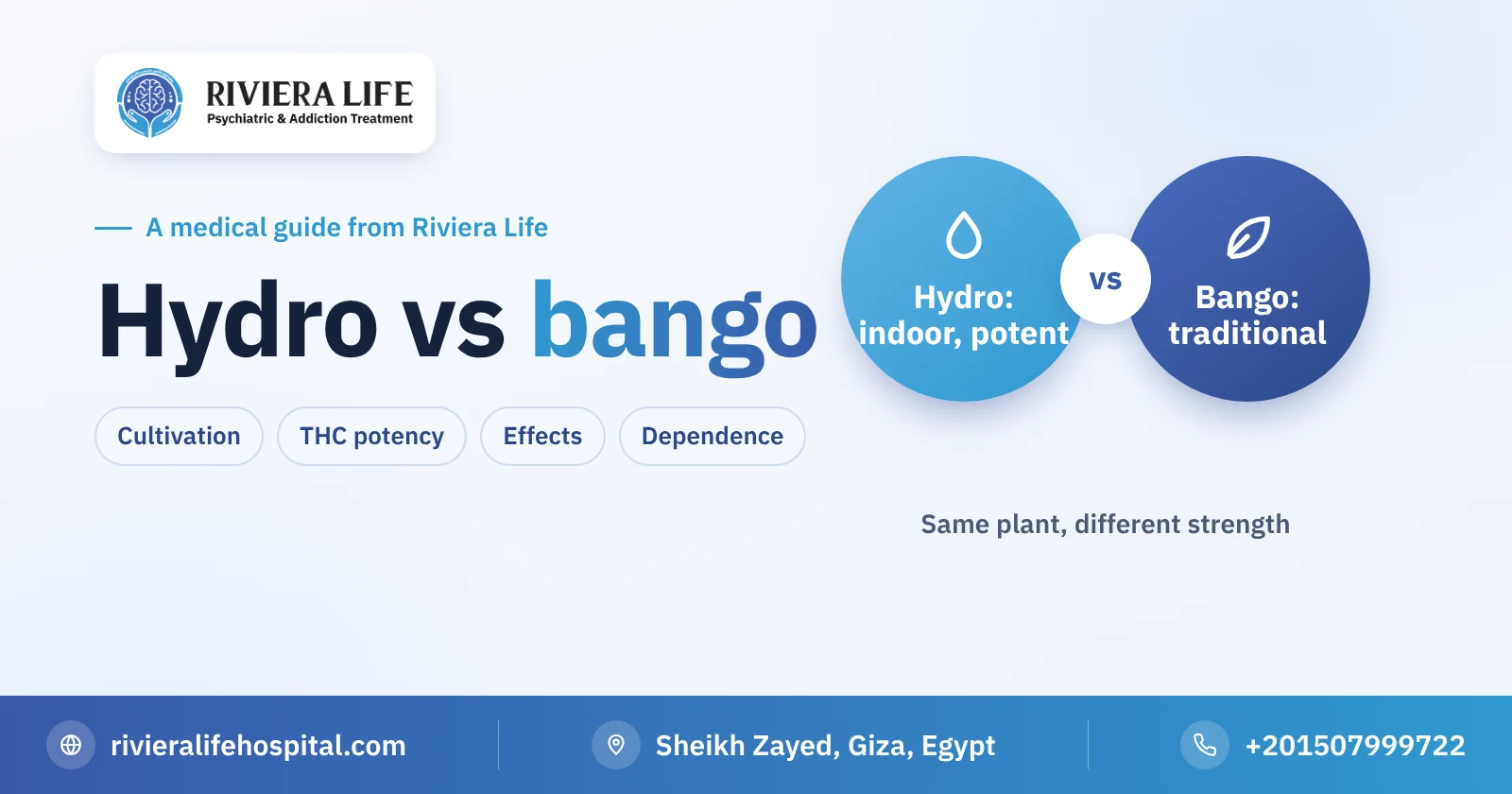
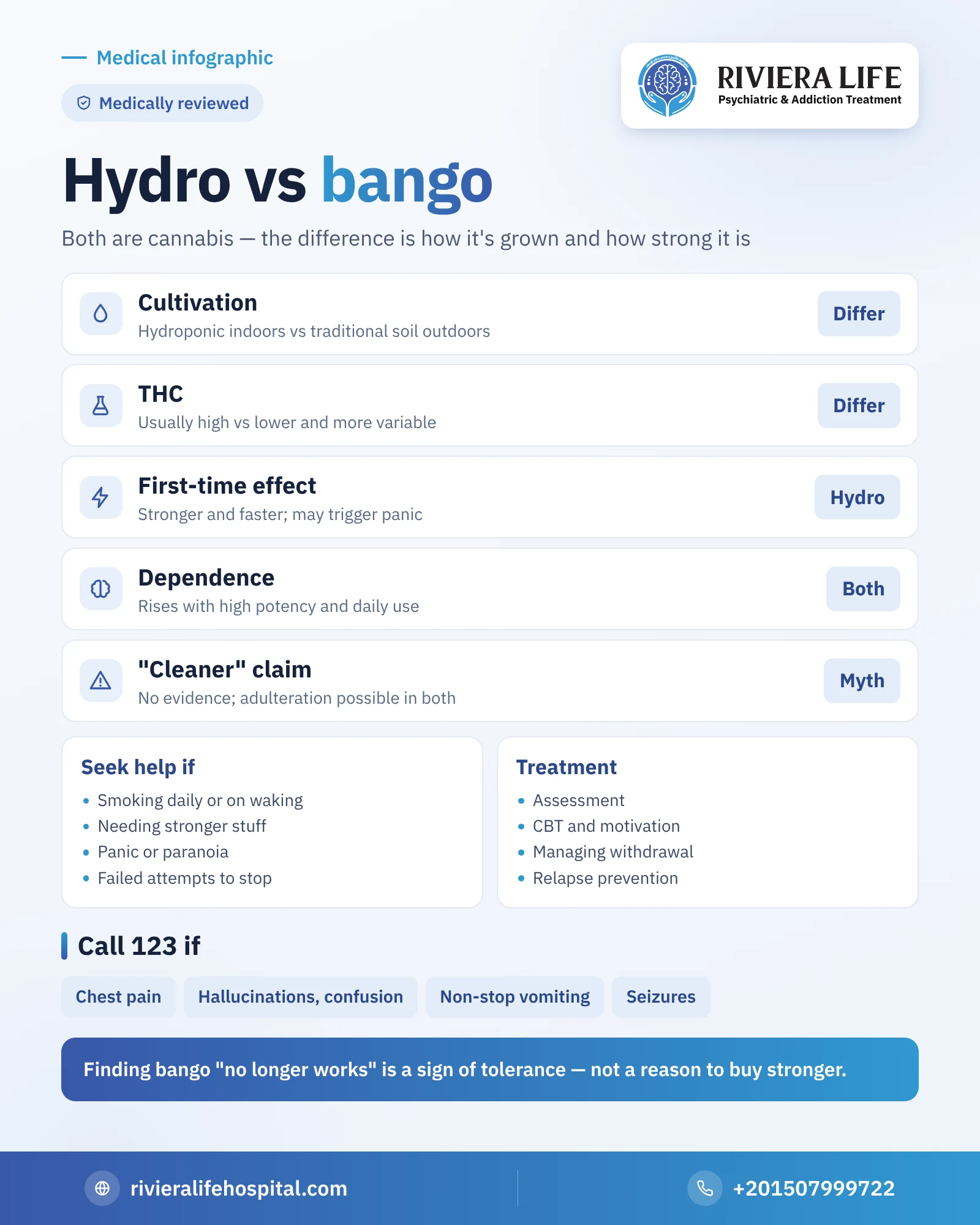
The difference between hydro and bango doesn’t lie in the plant species, as both are cannabis, but in the method of cultivation and the potency. Bango, in common Egyptian usage, is the dried leaves and flowers of cannabis grown by traditional methods in the ground, while hydro is cannabis grown with water and nutrients in closed spaces with controlled light and temperature, which usually raises the concentration of the active substance THC to much higher levels. This difference in concentration is what changes the effect, the risks and the speed of dependence. This article offers a simple comparison between the two in terms of cultivation, potency, contamination, harms and treatment.
The difference between hydro and bango in a table
| Aspect | Hydro | Bango |
|---|---|---|
| The plant | Cannabis | Cannabis |
| Cultivation method | Hydroponic or a closed artificial environment with controlled lighting and fertilizing | Traditional cultivation in soil and in the open air |
| THC concentration | Usually high | Usually lower and more variable |
| Appearance | Dense buds full of resin | Lighter, less dense dried leaves and flowers |
| Effect on a beginner | Stronger and faster, and may cause panic or paranoia | Usually milder but not guaranteed |
| Risk of dependence | Increases with high concentration and repeated use | Also present, and usually develops more slowly |
| Market reputation | Marketed as “premium” and therefore “cleaner” | Seen as cheaper and older |
| Risks of adulteration and contamination | Possible in both, and price doesn’t guarantee against them | Possible in both |
Hydroponic versus traditional cultivation
In traditional cultivation cannabis grows in soil under the sun, and its potency is affected by the weather, the soil and care. In hydroponic cultivation, the plant is watered with a nutrient solution without soil, the lighting and its duration, the temperature and humidity are controlled, and the plant is selected and pruned to raise the production of resin-rich flowers. The result is the same type of plant but with a higher concentration. This is where the popular name “hydro” comes from. For an introduction to bango you can refer to the harms of bango, and for hydro to hydro addiction.
Why does concentration matter?
THC binds to cannabis receptors in the brain, and the higher its concentration in what is smoked, the greater the amount that reaches the receptors in a single puff. This is where many smokers go wrong: they measure it by the number of joints, not by the strength of what is in them. Someone used to bango may think a hydro joint equals a bango joint, and so be exposed to a stronger effect than expected. The difference isn’t an absolute rule, as concentration varies within each type, but the general tendency is clear.
How does the effect differ?
The familiar effect of cannabis includes relaxation, red eyes, dry mouth, increased appetite, fuzzy short-term memory and slowed perception. With high concentration, more severe symptoms may appear in some people: palpitations, a panic attack, a feeling of detachment from reality and paranoia, and in those psychologically predisposed the condition may turn into psychosis. These symptoms aren’t exclusive to hydro, but they are more common with high concentration and early use at a young age. You will find the picture of physical and psychological harms in the harms of hydro.
Is hydro “cleaner” than bango?
This is an idea sellers repeat, and it has no basis. The word “hydro” isn’t a mark of quality or a certificate of safety. Artificially grown cannabis may be sprayed with pesticides or treated with substances to improve its appearance, and ordinary cannabis may be sold under the name hydro to raise the price. The same goes for traditional bango, which may carry mold, pesticide residues or poor mixtures. No one can guarantee the content of what they buy on an unregulated market, whether expensive or cheap. And talk of “the cleaner one” doesn’t change the fact that the smoke itself harms the lungs, mood and memory.
Dependence: potency speeds up the road
Any cannabis may lead to a use disorder in some people, and the risk increases when use starts at an early age, with daily use, and with high concentration. Someone who gets used to high concentration may find bango “weak, it doesn’t work”, so they stick to the stronger type and their consumption rises. On stopping, symptoms such as irritability, insomnia, poor appetite, anxiety and an urgent craving appear, usually subsiding within weeks. The details are in marijuana withdrawal symptoms, and the recognition signs in marijuana addiction symptoms.
Do they differ in tests?
Both contain THC, and urine tests usually look for its metabolites, so the usual test doesn’t distinguish between hydro and bango. What changes is how long the traces remain: the larger the amount that entered the body and the more repeated the smoking, the longer the metabolites stay in fat and urine. For details there are two separate articles, how long hydro stays in the body and how long marijuana stays in the body, which explain the approximate figures without promises.
Mixing and smoking: where do the risks multiply?
Many mix cannabis with tobacco, or smoke it with a shisha or electronic devices, so the harms of nicotine and combustion to the lungs are added to the effect of THC. With hydro in particular, the share a person takes in one session may be larger than they think, so drowsiness and dizziness increase, and they may drive a car while unable to judge their reactions. And if combined with alcohol or sedatives, depression of the nervous system and confusion double. That is why anyone who suffers palpitations, panic or severe nausea after smoking is advised not to stay alone, to stop any other mixing, and to seek medical help when needed.
The mind and teenagers
The brain in adolescence is still maturing, and high THC concentration at this stage is linked in studies to problems with attention, memory and achievement, and to an increased risk of anxiety, depression and psychosis in the genetically vulnerable. This doesn’t mean every teenager who tries it will be affected, but that the likelihood is higher and the loss greater. Parents may see a change in study, sleep and friends before their son admits anything. It may help here to read about the causes of marijuana addiction to understand what pushes young people down this road.
Which is more dangerous?
If we compare only the probabilities, higher concentration increases the risk of panic, psychosis and dependence, meaning hydro is on average more dangerous. But there is no “safe bango”. The more important question isn’t which is less bad, but how a person stops both if control starts slipping. And someone who finds that bango is no longer enough has a sign of tolerance that deserves assessment, not a justification for buying a stronger type.
Call an ambulance on 123 immediately if you see
After smoking any kind of cannabis, especially if mixed with other substances.
- Chest pain or a very fast, irregular pulse
- Hallucinations, severe confusion or aggression
- Continuous vomiting that won’t stop, or severe dehydration
- Loss of consciousness or a seizure
- Thoughts of harming oneself or others
Treatment is essentially the same
There is no approved medicine for treating cannabis use disorder. Treatment is based on a psychological and physical assessment, then cognitive behavioral and motivational therapy, managing insomnia and anxiety during withdrawal, treating any accompanying psychiatric disorder, and then a relapse-prevention plan with the family. There is no essential difference between someone who smokes hydro or bango, except that a history of high concentration may mean a greater need for psychiatric follow-up. Our article on marijuana addiction treatment details these steps.
When should you ask for help?
- If smoking has become daily or the first thing you do in the morning.
- If the amount or strength has increased because the old one is no longer enough.
- If panic attacks, paranoia or a feeling that things aren’t real appear.
- If study, work or relationships have declined.
- If attempts to stop have failed, or severe insomnia and irritability appear on stopping.
The consultants in psychiatry and addiction treatment at Riviera Life set a plan suited to each case, with round-the-clock medical supervision and complete confidentiality, and the first consultation is free on +201507999722.
More from our marijuana guide
- Marijuana: the complete guide
- Hashish vs marijuana
- How long hydro stays in the body
- Bango addiction treatment
Questions many people ask
Both are cannabis. Hydro is grown hydroponically in a closed, controlled environment so its THC concentration is usually higher, while bango is grown traditionally and is weaker and more variable.
On average yes, because the higher concentration increases the likelihood of panic, psychosis and dependence, but there is no safe cannabis, and the variation within each type is large.
There is nothing to prove that. The name doesn't guarantee quality, any type may contain pesticides or adulterants, and the content of an unregulated market can't be verified.
Usual tests detect THC metabolites in both without distinguishing between them, and they may stay longer with larger amounts and repeated smoking.
The steps are essentially the same: assessment, cognitive behavioral therapy, managing withdrawal and relapse prevention, and closer psychiatric follow-up may be needed with high potency.