Impostor syndrome is a persistent inner feeling that you don’t deserve your success, that what you achieved came by luck or a mistake in judgment, and that others will soon discover you “aren’t as competent as they think”. It isn’t a psychiatric diagnosis in official medical manuals, but a description of a common thinking pattern that affects many high achievers, students, doctors, new employees and entrepreneurs. But when it becomes intense it may be linked to anxiety, perfectionism, burnout and depression. In this article we explain its signs, who is most at risk, the cycle that feeds it, how to tell it apart from disorders that need treatment, and practical steps to deal with it.
Where did the term impostor syndrome come from?
The term appeared in 1978 when psychologists Pauline Clance and Suzanne Imes described the “impostor phenomenon” in academically and professionally successful women who, despite their achievements, were convinced they weren’t intelligent and that others had been fooled about them. Over the years it became clear that the phenomenon affects men and women alike, in different fields and ages.
The word “syndrome” here is commonly used but not medically precise; doctors talk about a “phenomenon” or “experience”, because it isn’t diagnosed as an illness and has no specific medicine. This doesn’t reduce the real pain it causes.
Signs of impostor syndrome
- You credit your success to luck, timing or others’ help, and credit any mistake to your lack of competence.
- You feel embarrassed or uncomfortable when someone praises you, and immediately try to downplay the achievement.
- You fear “being found out” in a meeting, exam or interview.
- You prepare excessively for every task, or postpone it until the last moment and then work under huge pressure.
- You always compare yourself with those who are better, and ignore what you have reached.
- You turn down promotion opportunities or new projects for fear of failure.
- You feel that relief after success is very short, then anxiety returns with the next task.
The cycle that feeds the feeling of being a fraud
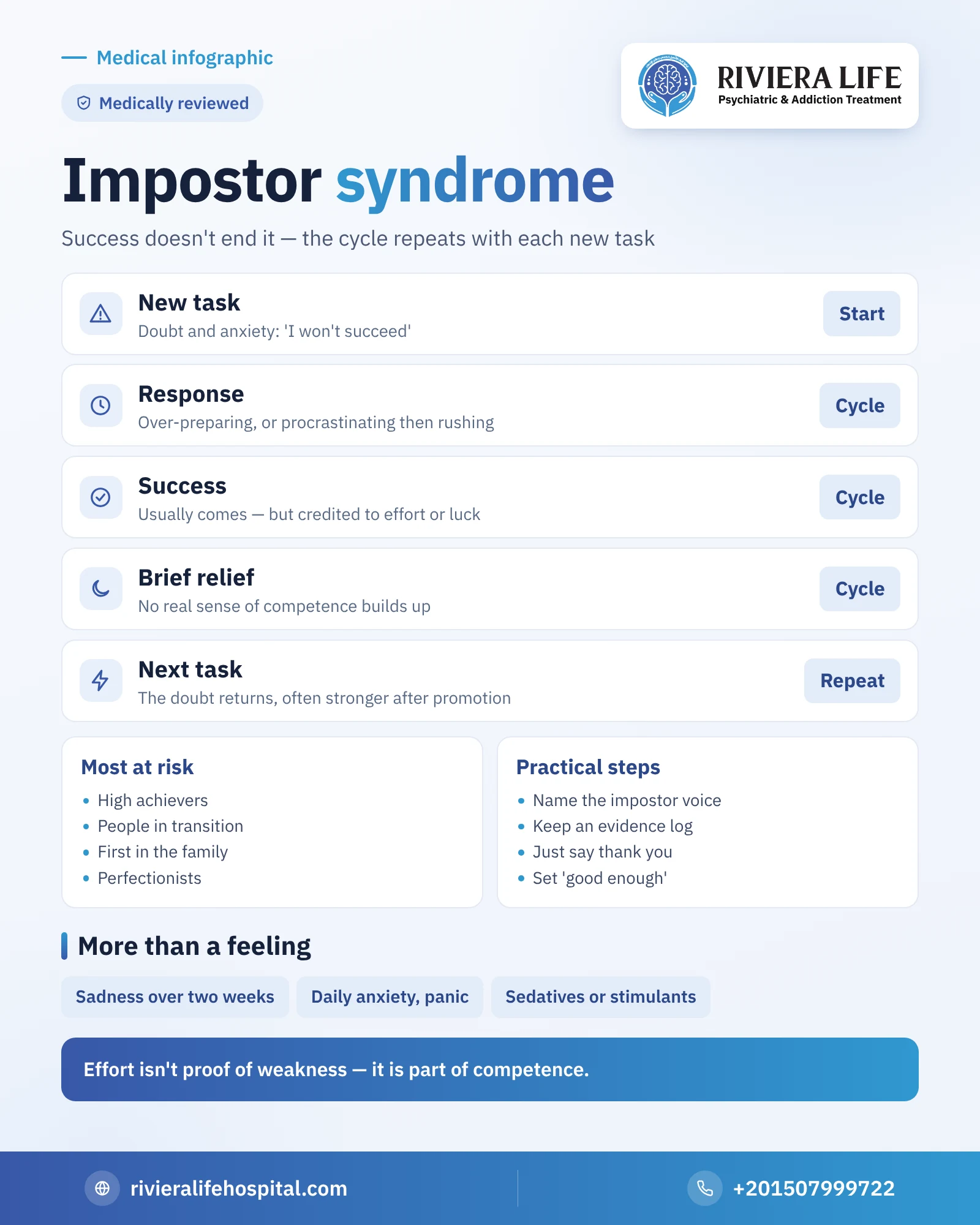
What keeps impostor syndrome going is that it reproduces itself. It starts with a new task, and anxiety and doubt appear: “I won’t succeed”. The person responds in one of two ways: excessive preparation that keeps them up at night, or procrastination followed by a last-minute rush. The task usually succeeds. But instead of saying “I’m capable”, they say: “I succeeded because I worked several times harder than others” or “I succeeded by chance”. A brief relief comes, then the cycle returns with the next task, without any real sense of competence building up.
This cycle explains why the syndrome doesn’t disappear with success, and may even increase with every promotion, because new responsibility means a greater chance of “being exposed”.
Who is most at risk of impostor syndrome?
- High achievers: the higher the ceiling of expectations, the greater the fear of falling.
- Those going through a transition: a student in their first university year, an intern doctor, or an employee in a new job.
- Those who grew up in an environment of constant comparison: “your cousin got full marks”, or a home where innate intelligence is praised more than effort.
- The first in their family to enter a field: the first university graduate or the first to work in a particular profession.
- Those who feel different from those around them: such as a minority in the workplace by sex or background.
- People with a perfectionist and anxious temperament: the group in which the syndrome is most linked to psychological suffering.
Common patterns: how does it show in each person?
Self-help books commonly divide the syndrome into patterns; these are descriptions useful for understanding, not scientific classifications:
- The perfectionist: sees any small flaw as complete failure.
- The expert: doesn’t feel deserving until they know everything, so they collect certificates and courses without stopping.
- The natural genius: thinks needing effort is evidence of low intelligence.
- The soloist: refuses to ask for help because they consider it an admission of inability.
- The superhero: tries to succeed in every role at once, at work, at home and in society.
Impostor syndrome, anxiety and perfectionism
Studies of the phenomenon link it to higher levels of anxiety and depression, and to perfectionism in particular. Healthy perfectionism means striving to do good work, while exhausting perfectionism means measuring your worth as a person by every result. When the feeling of being a fraud combines with exhausting perfectionism, every evaluation becomes a threat to identity itself.
It is important not to confuse it with social phobia, which revolves around fear of people’s evaluation in social situations in general, such as speaking or eating in front of others, not just doubt about competence.
From feeling like a fraud to burnout
Working twice as hard to prove yourself, refusing to ask for help, and staying up for excessive preparation are all a perfect recipe for exhaustion. That is why many who suffer from impostor syndrome later meet burnout: deep exhaustion, distance from work, and a feeling of ineffectiveness. For some, work may turn into an endless escape, which is explained in the article on work addiction.
When is it more than just a feeling?
Impostor syndrome alone doesn’t necessarily need a psychiatrist. But pay attention if signs appear with it that point to a disorder needing assessment:
- Sadness or emptiness lasting most of the day for more than two weeks, with loss of pleasure.
- Daily anxiety that is hard to control, with insomnia and physical tension.
- Panic attacks before meetings or exams.
- Relying on sedatives, stimulants or alcohol to prepare or to sleep.
- Thoughts that you are a burden or that life isn’t worth it.
And if thoughts of self-harm appear, seek urgent help immediately: the ambulance on 123 or the nearest emergency department, or the mental health hotline 16328.
How do you deal with impostor syndrome? Practical steps
- Name what is happening: saying “this is the impostor thought talking” creates distance between you and the thought.
- Keep a record of evidence: write down achievements, positive messages and problems you solved, and go back to them when doubt intensifies.
- Reframe success: effort isn’t evidence of weakness; it is part of competence.
- Accept praise: practice saying just “thank you”, without justifying or downplaying.
- Set a “good enough” standard: decide in advance when you will consider the task finished, and don’t go beyond it.
- Talk to someone you trust: you will often discover that your colleagues feel the same thing.
- Ask for help: asking a colleague or mentor is a professional skill, not an admission of inability.
How can parents and managers help?
The environment makes a big difference. Parents who praise their children’s effort and way of thinking, not just the grade, reduce the chances of this feeling developing. And a manager who gives clear, specific feedback, acknowledges that learning from mistakes is a natural part of work, and gives the new employee a mentor they can ask without embarrassment, greatly eases the fear of “being exposed”. Public comparisons and criticism in front of others, on the other hand, feed the syndrome and push those with it towards exhaustion or withdrawal.
Does psychotherapy help?
Yes, especially when the syndrome is linked to anxiety, perfectionism or depression. Cognitive behavioral therapy helps spot and modify the thoughts that downplay achievement, and change the behaviors of excessive preparation and procrastination. Support groups and professional mentoring also help. And if an anxiety disorder or depression is present, the doctor may suggest medication for it according to their assessment.
How does Riviera Life help you?
If the feeling of being a fraud has started stealing your sleep and peace of mind, you can talk with one of the consultant psychiatrists at Riviera Life to assess whether anxiety, depression or burnout lies behind it, and set a psychotherapy plan that suits you, in complete confidentiality. The first consultation is free.
Read also
- Burnout
- Anxiety
- Work addiction
- Psychological stress
- Low self-confidence and a weak personality: the causes and how to regain your confidence
Questions many people ask
No, it isn't a diagnosis in official medical manuals, but a description of a common thinking pattern. However, it may accompany anxiety or depression, and then the person needs an assessment.
Yes, and it is more common among high achievers, because success raises expectations and increases the fear of being exposed.
A humble person knows the value of what they achieved but doesn't boast about it, while someone with impostor syndrome doesn't believe at all that they deserve their achievement and lives in fear of being exposed.
It may ease with time, but it often returns with every new position or challenge. What really helps is changing the way success and failure are interpreted.
Researchers use scales such as the Clance Impostor Phenomenon Scale, but they are research tools for understanding, not diagnosis. What matters most is noticing the effect of this feeling on your life.