The short answer
Mental health is your ability to live your days in reasonable balance: you bear pressures and then regain your calm, you work and learn, you keep relationships that support you, and you feel your life has meaning. It doesn't mean the absence of sadness or anxiety, but dealing with them well. It goes up and down with circumstances, so you may be psychologically tired without being ill. And if disturbances in sleep, mood or relationships persist for weeks, that is a good time to consult a specialist.
- A moving balanceIt rises and falls with events, as weight and fitness change
- Habits protect itRegular sleep, movement and at least one honest relationship
- An early warningWeeks of insomnia, withdrawal and irritability deserve a pause
Mental health is present in the details of our day before it is a topic in a clinic: in your patience with the morning traffic on the Mehwar, in the way you answer your son when he comes home with a bad grade, and in your ability to sleep after a long day. On this page we explain what it means, the difference between it and mental illness, the signs that say it needs attention, and what protects it at home, at work and across the stages of life, then we gather our articles on this subject for you.
What is mental health?
The World Health Organization describes it as a state of mental wellbeing that enables a person to cope with the stresses of life, realize their abilities, learn and work well, and contribute to their community. Notice that the definition talks about "the ability to cope", not about a life without problems. The mother who cries the night her son travels and then gets up in the morning to prepare the family's breakfast enjoys good mental health, and so does the employee who gets angry at his manager's injustice and then thinks calmly about his next step.
Mental health, then, is a skill and a state at the same time: it is affected by genes and circumstances, but it also improves with habits, relationships and seeking support at the right time.
Your balance is a matter of degrees, not a fixed verdict
It helps to look at yourself on a graded ladder instead of the classification "healthy or ill". Each of us moves on this ladder during the year, according to the pressures and support we experience:
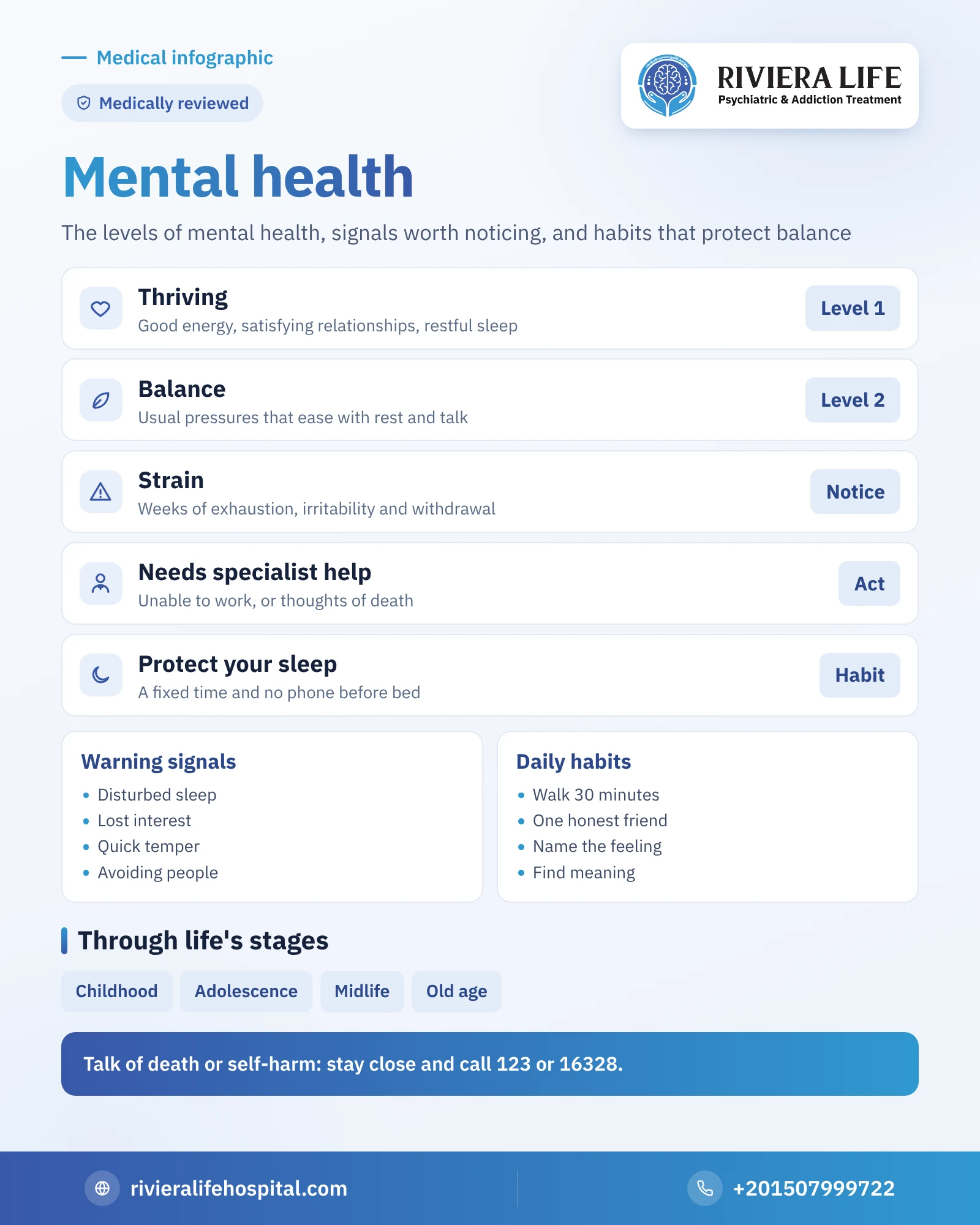
Good energy, satisfying relationships and restful sleepThriving
Usual pressures that improve with rest and talkingBalance
Exhaustion, irritability and withdrawal lasting weeksStrain that needs attention
Inability to work or thoughts of deathNeeds specialist help
The goal isn't to always stay at the top, which is unrealistic, but to notice when you go down a step and know how to come back. Caring for mental health is like caring for your teeth: small daily habits prevent painful visits later.
The difference between mental health and mental illness
Mental illness is a medical diagnosis with criteria for symptoms, their duration and their severity, such as depression or anxiety disorders. Mental health, however, is a broader concept that concerns everyone. The two can come together in different forms:
Decline without illness
- Burnout from work without full depression
- Loneliness after moving to a new city
- Self-reproach after a setback in studies
- Chronic tension in a marriage
Illness with good balance
- A depression patient committed to treatment and working efficiently
- A person living with bipolar disorder with a clear plan
- Someone recovered from addiction building a stable life
- A mother following anxiety treatment and raising her children calmly
If you are looking for the disorders themselves, you will find them in the section Mental illnesses, and if you are wondering about a particular sign, see the guide to mental illness symptoms. The article The difference between psychological and mental illness discusses a common popular division that medicine doesn't adopt.
Signs that your mental health needs attention
This isn't a diagnostic list, but warning signals. One of them appearing for two days is normal, but several signals coming together and persisting for weeks deserves a pause:
- Disturbed sleep, whether insomnia or long sleep that doesn't refresh.
- Indifference toward things that used to make you happy, such as visiting friends or an old hobby.
- Quick temper over small things, or crying that takes you by surprise.
- Repeatedly excusing yourself from gatherings and ignoring calls.
- Increasing escape into cigarettes, the phone or sedatives to ease the feeling.
- A harsh inner voice repeating: "You won't succeed" or "No one needs you".
And if these signals stretch out and deepen, they may be the start of depression, and the article When sadness turns into depression helps you tell the difference.
How do you look after your mental health? Habits that make the difference
Most of what protects mental health is simple, but it needs regularity more than enthusiasm:
1
Protect your sleep
A fixed time for sleeping and waking, and putting the phone away half an hour before sleep.
2
Move every day
A brisk thirty-minute walk eases stress and improves mood and sleep.
3
Keep one honest relationship
One person you can say "I'm tired" to without being judged.
4
Name what you feel
"I'm anxious about the exam" is clearer than "I'm upset" and easier to deal with.
5
Look for meaning
A role, work or volunteering in which you feel your presence makes a difference.
6
Stay away from quick fixes
Drugs, alcohol and sedatives without a prescription soothe for hours and then double the distress.
More practical details are in the articles Lifting your mood in safe natural ways and Building psychological resilience.
Stress and burnout: when does it go too far?
Stress is part of life, and a reasonable amount of it drives us to achieve. The problem is when it becomes chronic without periods of rest, so the hormone cortisol stays high and sleep, digestion and immunity are affected. The article Psychological stress and its effect on the body explains this mechanism.
Burnout, however, usually appears at work or in caring for a sick family member: emotional exhaustion, coldness toward those you serve, and a feeling that your effort is pointless. It differs from depression in that it is usually linked to a specific context, but neglecting it may pave the way for it. The details are in the article Burnout and ways to recover from it.
Feelings and thoughts: your relationship with what goes on inside you
Much of the decline in mental health starts from the way we interpret events, not from the events themselves. Two identical situations, such as a delayed promotion, may be read by one person as "bad timing" and by another as "proof that I'm a failure". Here simple skills help: noticing the thought before believing it, asking yourself about the evidence, and distinguishing between guilt that drives you to repair and guilt that whips you endlessly.
Start with the article Negative thinking patterns and how to free yourself from them, and if you need structured training, these skills are the core of cognitive behavioral therapy.
Relationships: support or drain?
Research consistently shows that the quality of relationships is one of the strongest psychological protections a person has, and that chronic isolation harms physical and mental health together. But the relationship itself may be a source of drain if it is built on control or constant belittling. And inside the home, spouses affect each other quickly: one's anxiety or depression changes the conversation, closeness and patience. Read The effect of psychological state on the marital relationship and the article Getting out of loneliness and isolation.
Mental health across the stages of life
Each stage has its challenges, and knowing them helps the family tell apart what is normal from what needs intervention:
- 1ChildhoodSafety first
A stable home and an encouraging word build the foundation, and bullying at school is one of the things that most destroys a child's self-confidence, so watch for the signs of being bullied.
- 2AdolescenceThe search for identity
Mood swings and the desire for independence are expected, and what matters is keeping the door to conversation open. See The normal psychological changes of adolescence.
- 3MidlifeTaking stock
Questions about achievement and meaning may turn into a crisis if support is absent and responsibilities pile up.
- 4Old ageLoss and loneliness
Retirement and the loss of peers need a social network, and whoever cares for an elderly relative needs support too.
The family and stigma: what stops people from seeking help
In many of our homes, talk about mental health is still met with silence or mockery, so people postpone seeking help until the problem gets worse.
What we often hear
- "Talking to a psychiatrist is a scandal"
- "Keep yourself busy and you'll forget"
- "A man doesn't complain"
What really helps
- The consultation is confidential and a health step like any check-up
- Keeping busy helps, but it doesn't treat what keeps recurring
- Seeking support is a strength men and women need
The article Common myths about mental illness corrects other notions, and the article Understanding the behavior of a mentally ill person guides the family to a calm response.
The work environment and your psychological balance
We spend a third of our day or more at work, so it is no wonder it is one of the biggest influences on mental health, negatively and positively. The World Health Organization estimates that depression and anxiety alone cause the loss of about twelve billion working days a year around the world. What exhausts employees most isn't the number of tasks alone, but the absence of appreciation, vagueness about what is required, and working without clear limits until midnight in work chats on WhatsApp.
What helps: reasonable limits on response hours, real holidays, and an honest conversation with the manager about the workload. Whoever succeeds and then feels they don't deserve their success may find themselves in the article Impostor syndrome, and whoever notices the effect of stress on their body will benefit from the steps to lower the hormone cortisol.
When it becomes an emergency
Most declines in mental health are treated calmly and gradually, but some moments need immediate action.
Don't wait in these cases
Stay close to the person and don't leave them alone, and ask for help immediately.
- Talk of death, a wish to disappear or to end life
- Self-harm or taking a large amount of medicines
- A clear detachment from reality or a threat to harm others
- The ambulance 123, and the hotline of the General Secretariat of Mental Health and Addiction Treatment 16328
If these thoughts are visiting you yourself, you are not alone, and help is possible now; read How to protect yourself from suicidal thoughts.
The mental health article guide: everyday life topics
We have arranged the articles of this section by what concerns you, so you can quickly reach what suits your situation.
Pressures, life crises and recovering from them
5 articlesWhen responsibilities weigh you down or a loss shakes you
- Exhaustion from work and caregiving: its dimensions and how it differs from depression.
- The questions of the forties and fifties: the signs of a midlife crisis and getting through it.
- The pain of separation and emotional loss: why it hurts and how to recover.
- Rising after crises: resilience and self-compassion.
- Improving mood without substances: methods supported by scientific research.
Feelings, thoughts and self-image
7 articlesUnderstanding what goes on inside you and tools for dealing with it
- Negative self-talk: its patterns and ways to break it.
- Healthy guilt and exhausting guilt: where the line between them lies.
- When you feel you are a failure: separating the event from your identity.
- Difficulty describing feelings in words: alexithymia.
- Psychological defense mechanisms: everyday examples and when they hold you back.
- Regaining self-confidence: the causes and practical steps.
- Feeling you don't deserve success: impostor syndrome.
Relationships and personality patterns
5 articlesMarriage, isolation and those who drain you
- Psychological state inside the marital home: how the relationship is affected and what helps.
- Social isolation and its effect: and the steps out of it.
- Dealing with a harmful person: the signs of a toxic relationship.
- Attachment to someone who abuses you: Stockholm syndrome and breaking free of it.
- Introversion, a temperament or a problem: and how it differs from phobia.
Children, teenagers and the elderly
3 articlesWhat each age stage needs
- The teenager's psychology: what is normal and what is cause for concern.
- Protecting the child from bullying: the role of home and school.
- Caring for a relative with dementia: a guide for caregivers.
The family, the psychiatric patient and stigma
6 articlesFamilies' questions and correcting misconceptions
- Mistaken ideas about mental illness: and what the facts say.
- Psychological and mental in people's language: and what medicine says.
- The psychiatric patient's responsibility for their actions: medicine and the law.
- A calm response to the patient's behavior: a guide for the family.
- Admitting a psychiatric patient without their consent: the conditions, the steps and the patient's rights under Egyptian law.
- Free psychotherapy in Egypt: the 16328 hotline, government clinics and remote sessions.
When should you seek help?
Seek a consultation if the disturbance in your sleep, mood or relationships persists for more than two weeks, or your usual habits no longer restore your balance, or you have turned to substances to get through your day. At Riviera Life, licensed by the Egyptian Ministry of Health, consultants in psychiatry have been offering confidential assessment for fourteen years, with a program for the family and ongoing follow-up. The first consultation is free and confidential; call us on +201507999722.
Medical sources and referencesThe information in this article is based on reliable scientific sources