Caring for a person with dementia means accompanying a human being who is changing before your eyes: they repeat the same question ten times, sometimes forget your name, get angry with whoever tries to help them, then come back an hour later as if nothing happened. Dementia is an illness that affects memory, thinking, behavior and the ability to manage daily life, and its best-known type is Alzheimer’s disease. The World Health Organization estimates that tens of millions around the world live with it, and that a large part of their care is borne by families. Here we offer a practical guide for caregivers: how to communicate, how to protect the patient and the home, and how to protect yourself from exhaustion.
Understand what is happening first
Dementia isn’t ordinary forgetfulness. It is gradual damage to brain cells that affects recent memory first, then language, judgment and recognizing places and people. What seems “stubbornness” or “acting” is usually the result of the illness, not a choice by the patient. They don’t remember that they asked, don’t understand why someone is stopping them from going out, and feel afraid of a world that is no longer familiar.
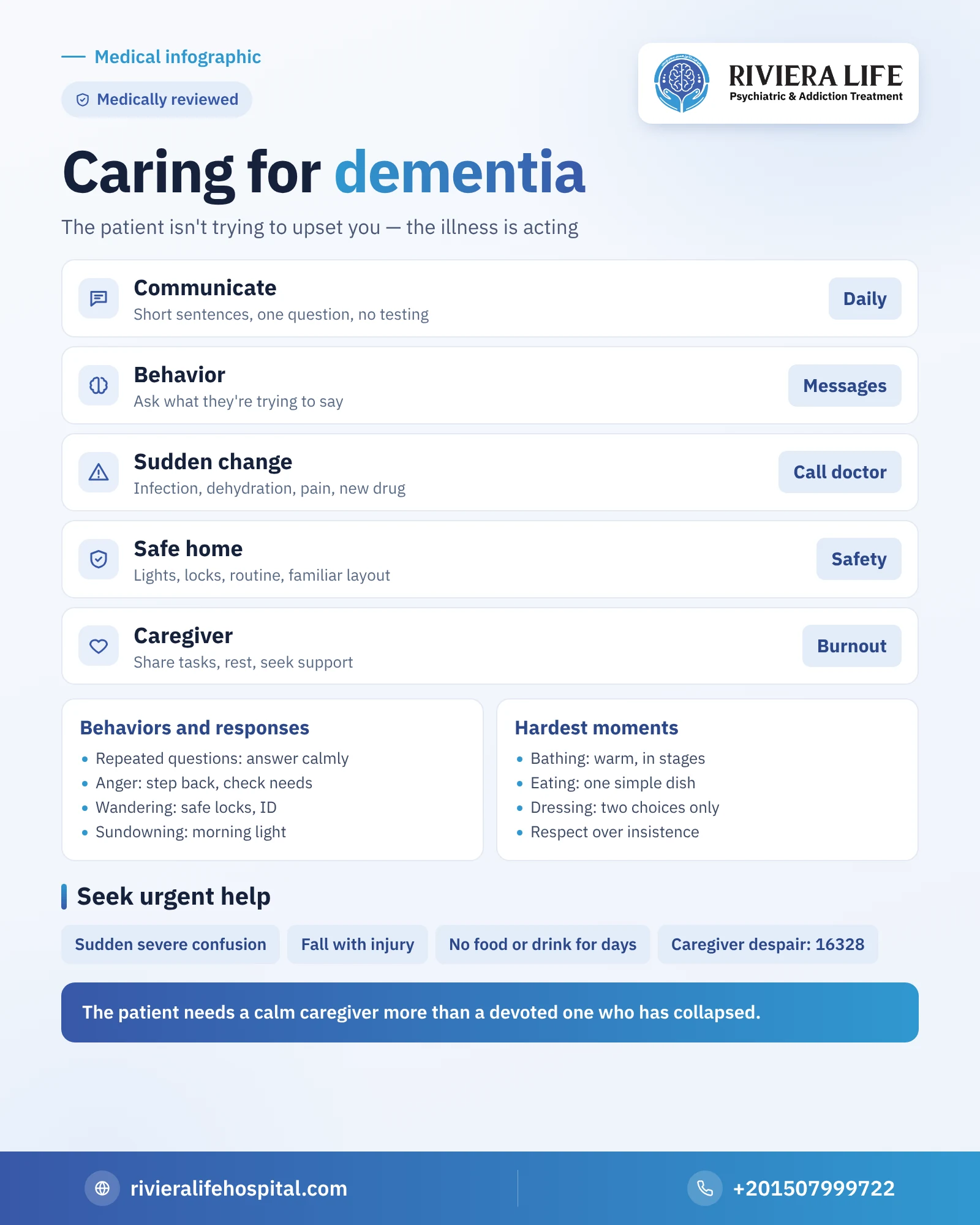
Remember this rule: the patient isn’t deliberately upsetting you; the illness is what is acting. This understanding alone eases anger considerably. And if you are wondering whether what is happening to your relative is dementia, depression or something passing, see the article on mental illness in the elderly.
How do you communicate with a person with dementia?
- Approach from the front and call them by name: don’t surprise them from behind, and pay attention to your tone of voice before your words.
- Short sentences and one question at a time: “Do you want tea?” is better than “What would you prefer to drink and when?”.
- Give them time to answer: silence doesn’t mean refusal.
- Don’t correct every mistake: if they say their dead brother is coming today, arguing hurts them every time as if they were hearing of the death for the first time. Try to respond to their feeling: “You miss him, don’t you?”.
- Use gestures and cues: a friendly touch, a calm look, and a hint by pointing to the thing.
- Avoid the question “Do you remember?” as it is a test that makes them feel failure.
Behavior changes: what do they mean and what do you do?
Not every behavior change is an illness in itself; many of them are messages. Always ask: what are they trying to say? Then try the following solutions before you think of medicine.
| Behavior | What may be behind it | What do you do? |
|---|---|---|
| Repeating the question | Loss of recent memory and anxiety about the unknown | Answer calmly as if it were the first time, write the answer on a paper or board, and change the subject |
| Anger and aggression | Pain, hunger, noise, or a sense of threat during bathing | Step back a little, check for pain and needs, reduce stimulation, and don’t argue |
| Suspicion and accusations of theft | Forgetting where things are and fear of losing control | Help them search without accusing them, and keep a copy of important things |
| Wandering and leaving the house | Boredom, looking for an old place, or excess energy | Fit a safe lock that is hard for them to open, an ID bracelet, tell the neighbors, and organize a daily walk |
| Night disturbance (“sundowning”) | End-of-day tiredness and a disturbed body clock | Activity and morning light, less caffeine and long daytime naps, and calm lighting in the evening |
| Hallucinations | The dementia itself or other causes such as infection | Don’t confront them that they are “imagining”, reassure them, and bring it to the doctor |
When behavior changes suddenly: think of a physical cause
If the patient’s confusion or aggression increases suddenly within days, don’t assume the dementia has worsened. The cause may be a urinary or chest infection, dehydration, constipation, pain they can’t express, or the effect of a new medicine. Call the doctor and describe the change as you see it. What is happening may be delirium that needs treatment of its cause. And if hallucinations or suspicions appear, read hallucination symptoms and their causes.
Make the home safe and familiar
- Remove slippery rugs and wires, and light the corridors at night.
- Put medicines, cleaners and sharp tools in a locked place, and don’t leave medicine times to them alone.
- Keep the routine: meal, sleep and bath times at fixed hours as much as possible.
- Put up a large clock, a clear calendar and family photos.
- Don’t change the arrangement of furniture except when necessary.
- Watch the gas, water and doors, and consider devices that switch off automatically.
- Ask the doctor to review sedatives and sleeping pills, as some increase confusion and falls. And if the patient has been using a sleeping pill for a while, don’t stop it suddenly, as that is the doctor’s decision. It helps to read about sleeping pill addiction to learn its risks in the elderly.
Bathing, eating and dressing: where most clashes happen
The hardest daily moments are those that touch the body. A patient who refuses to bathe may be afraid of water, of the cold, or of exposing their body in front of their daughter. Try making the bathroom warm before they enter, covering part of their body with a towel and washing them in stages, and following the same time every day. In eating, offer one simple dish instead of a crowded table, and give them utensils that are easy to use. In dressing, offer them only two choices, because a lot of choice confuses them and makes them feel failure. Respect and patience here work better than insistence.
Caregivers may come across prescriptions that include the medicine Lucidril with the aim of improving attention, and it is important to ask the doctor about the evidence of its benefit and its interactions with other medicines.
Medicine and treatment: what does medicine offer?
There is so far no medicine that cures most types of dementia. Medicines are available that may slow some symptoms or ease an aspect of them in certain types, and the doctor decides on their suitability for each patient. Non-drug measures come first for treating behavior disturbance: routine, familiar activities such as old music and photos of the past, and adjusting the environment. The doctor may resort to a medicine to calm severe behavior when other means fail, with special caution because some sedatives increase the risk of falls and early death in this group, and no medicine is given or stopped except on the doctor’s direction.
Caregiver burnout: don’t ignore it
Long-term care drains the body and the mind. You may notice in yourself constant tiredness, irritability, guilt because you got angry or because you want to rest, disturbed sleep, and withdrawal from your friends. These are signs of caregiver burnout, not weakness. They may turn into depression or anxiety if they last without support, and their symptoms resemble burnout.
- Share the tasks within the family with a clear schedule, and don’t carry everything alone.
- Take regular breaks, even two hours a week away from the house.
- Sleep, eat well and move, as whoever falls can’t care for anyone.
- Talk with someone going through an experience like yours, as just hearing “me too” eases things.
- Seek psychological help if sadness, anxiety or loss of interest persists for two weeks or more.
It is important that the family doesn’t lose its relationship with itself amid the caregiving. The patient needs a calm caregiver more than a devoted caregiver who has collapsed.
When do you seek urgent medical help?
Call an ambulance on 123 or go to the nearest emergency department if sudden severe confusion appears, a fall with injury, refusal to eat and drink for several days, or aggressive behavior that puts the patient or others in danger. And if the caregiver themselves feels despair or thoughts of harming themselves or others, they should call the mental health hotline 16328.
How does Riviera Life help you?
Riviera Life in Sheikh Zayed, Giza, offers a free first consultation with a psychiatry consultant to discuss behavior changes in a person with dementia and help the family with a care plan, and the caregiver exhausted by caregiving also has the right to support. The service is provided in complete confidentiality, and you can call +201507999722.
Read also
Questions many people ask
Use short sentences and one question, give them time to answer, don't test their memory or correct every mistake, and respond to their feeling.
The cause may be fear, pain, noise, hunger or not understanding what is happening, and the illness itself weakens emotional control.
Think of a physical cause such as an infection, dehydration, pain or a new medicine, and call the doctor because a sudden change may be delirium.
There is no medicine that cures most types, but some medicines may slow certain symptoms, and the doctor decides on their suitability.
Share the tasks within the family, take regular breaks, look after your sleep and food, and seek psychological support if sadness or anxiety persists.