Work addiction is a compulsive need to work constantly, not because the tasks demand it, but because stopping itself causes anxiety and guilt. The person works on holidays, answers email in the middle of the night, and feels empty if he isn’t busy, even when his health and family suffer. It isn’t an official diagnosis, but it is a real pattern with causes and treatment. In this article we clarify the difference between this compulsive pattern and diligence, its symptoms, causes and harms, its relationship with burnout, and psychological treatment and steps to regain balance.
What is work addiction?
It is known internationally as “workaholism”, and researchers describe it as an excessive preoccupation with work driven by an irresistible inner need, consuming time and effort at the expense of personal life and health. It hasn’t been listed as a standalone disorder in the American diagnostic manual or the International Classification of Diseases, and scientists still debate today whether it is a true behavioral addiction, a personality trait or the result of a particular work culture.
What everyone agrees on is the central sign: the person doesn’t just work a lot, he can’t not work.
The difference between work addiction and hard work
Long working hours alone aren’t evidence, as some jobs impose them and busy seasons pass. The difference is in the motive and in what happens on stopping:
| Hard work or passion | Work addiction |
|---|---|
| You work hard then can rest | Rest causes anxiety and a feeling of guilt |
| Work is an important part of your life | Work is life, and everything else is postponed |
| You enjoy achievement | No achievement is enough, and the goal keeps moving |
| Pressure is temporary and linked to deadlines | Pressure is constant even without real deadlines |
| You hear your family’s comments and adjust | You justify and promise change after “this project” |
Symptoms of work addiction
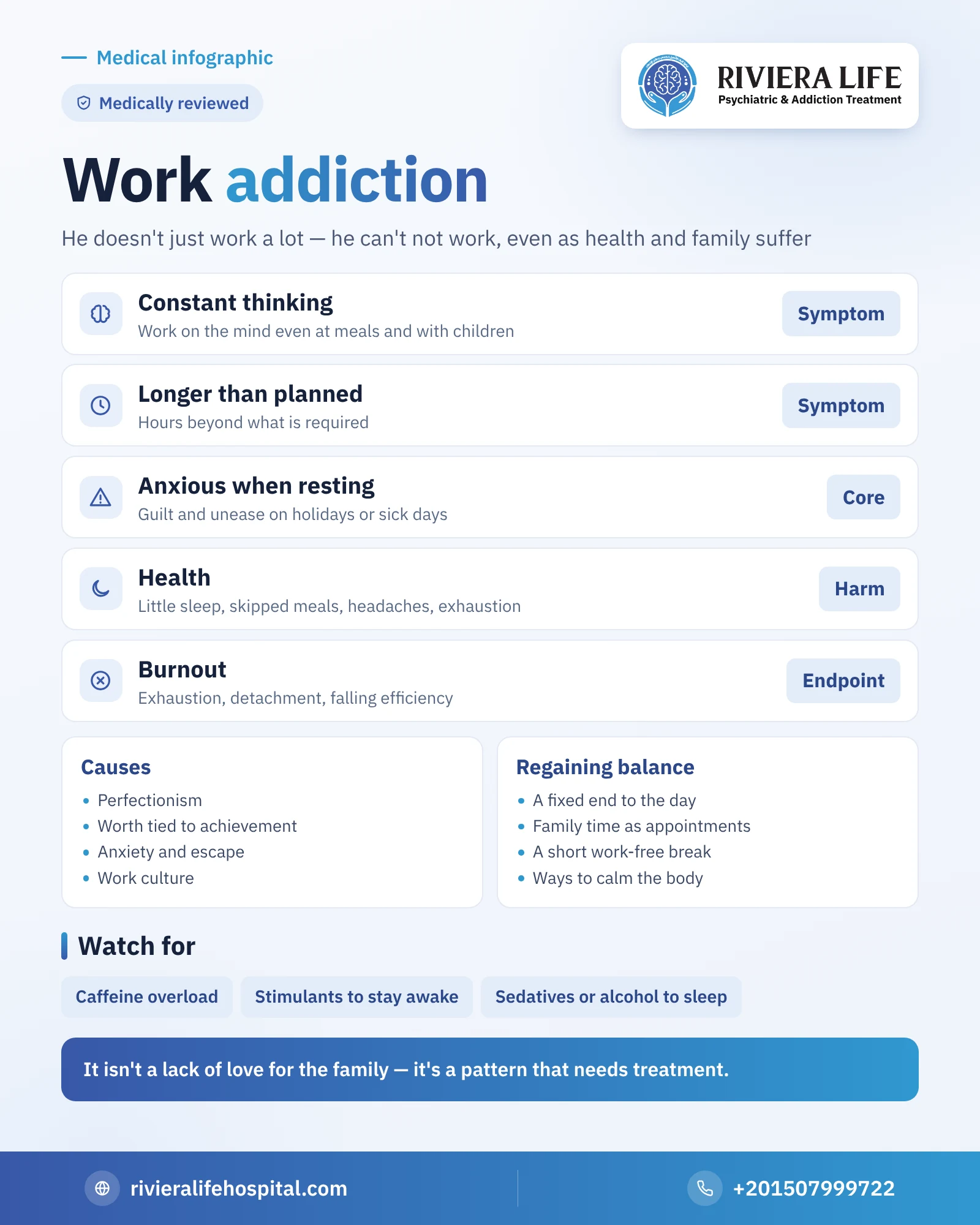
- Thinking about work constantly, even while eating or talking with the children.
- Working longer hours than required or than you planned.
- Working to relieve anxiety, sadness or a feeling of guilt.
- Ignoring others’ advice to ease off, and being annoyed by it.
- Tension or unease if prevented from working, as on holiday or when ill.
- Neglecting hobbies, exercise and relationships in favor of work.
- Health affected: little sleep, irregular meals, headaches and chronic exhaustion.
Work addiction and burnout: what is the relationship?
Burnout appears in the International Classification of Diseases (ICD-11) as an occupational phenomenon, not a medical condition, and is described by three features: severe exhaustion, psychological detachment from work or a negative view of it, and declining efficiency. It results from chronic work stress that hasn’t been managed.
Workaholism is one of the roads leading to it, but they aren’t the same thing. A workaholic may stay attached to his work even while exhausted, while someone burnt out loses the desire for it. And often a person starts as a workaholic and ends up burnt out.
Causes of work addiction
- Perfectionism: very high standards that make any work insufficient, so there is no moment in which he feels the task is finished.
- Linking self-worth to achievement: someone who grew up being praised only when he excelled may feel worthless if he stops.
- Anxiety: constant work gives a sense of control over the future. See anxiety.
- Escape: from marital disagreements, untreated grief or loneliness.
- Work culture: environments that reward staying late and consider holidays a weakness.
- Real financial pressure: long hours may start as a necessity then become a habit the person can’t get out of.
The harms of work addiction to mental and physical health
Chronic stress keeps the body’s stress system on alert, and over time the effect shows in sleep, mood, digestion and immunity. To understand this system, read about high cortisol symptoms.
Joint estimates by the World Health Organization and the International Labour Organization have linked working very long hours weekly with an increased risk of death from heart disease and stroke. Other common harms include:
- Insomnia and little sleep, and the weak concentration that follows.
- Anxiety and depression, which may reach full burnout.
- Excessive caffeine, and some people turning to dangerous stimulants to stay awake, a known door to addiction to substances such as Captagon.
- Using sedatives or alcohol to sleep after a long day.
Work addiction and its effect on the family
The family is usually the first to pay the price. A wife who feels she is raising the children alone, and children who learn that their father is available only by phone. Over time postponed promises pile up, so every conversation about time turns into a disagreement. It is important for the family to understand that the matter isn’t a lack of love, but a pattern that needs treatment, and to express their need clearly instead of constant blame.
Am I a workaholic? Questions for reflection
- Do I feel guilt or anxiety on a day off?
- Do I work to escape feelings I don’t want to face?
- Has more than one person close to me told me I work too much?
- Have I cancelled important family occasions because of work more than once this year?
- Do I remember the last time I enjoyed an activity that had nothing to do with work?
The answers don’t give a diagnosis, but they are the beginning of an honest conversation with yourself or with a specialist.
Treatment of work addiction
Treatment starts with a psychological assessment that determines what lies behind the pattern, then usually combines:
- Cognitive behavioral therapy: to challenge thoughts such as “if I stop everything will collapse”, and to learn to divide time and delegate tasks.
- Treating perfectionism: gradual training in accepting “good enough”.
- Acceptance and commitment therapy: to identify the real values in life and redistribute time towards them.
- Couples or family sessions: to repair what has been damaged and make realistic agreements.
- Treating accompanying conditions: anxiety, depression and sleep disorders, for which the doctor may decide on a medicine after assessment, as there is no medicine for work addiction itself.
Practical steps to regain balance
- Set a fixed end to the working day, and close work email on your phone after it.
- Put family activities and exercise in your schedule as appointments that aren’t cancelled.
- Try a short break without work, and notice what you feel without judging it.
- Learn ways to calm the body mentioned in our article on how to lower cortisol.
The right place for work addiction treatment: how to choose
The right place to treat this pattern is the one that understands the problem isn’t just the hours, but the anxiety, perfectionism and pressures behind them. Ask:
- Does a psychiatrist assess accompanying anxiety, depression and burnout?
- Does it uncover any use of stimulants, sedatives or alcohol that began with work stress?
- Does it offer structured psychotherapy that deals with perfectionism and linking worth to achievement?
- Can the spouse or family be involved in sessions?
- Are flexible, confidential appointments available that protect your professional privacy?
Beware of any program that promises you a guaranteed result or a radical change in days.
How Riviera Life meets these standards
Here is how Riviera Life meets each of the criteria above:
- Psychiatry consultants: a comprehensive assessment of anxiety, depression and burnout.
- Experience in addiction treatment: uncovering and treating any reliance on stimulants or sedatives.
- Individual psychotherapy: a plan that suits the nature of your work and its pressures.
- A family program: to repair what years of absence have damaged.
- Complete confidentiality: full protection of your privacy and professional standing.
- Aftercare: follow-up that prevents a return to the same pattern.
- An accredited facility with long experience: fourteen years under a Ministry of Health license, and medical care that doesn’t stop.
If work has swallowed your time and health, set aside a few minutes for a free first consultation; call +201507999722 at any time, or visit us in Sheikh Zayed, Giza.
Read also
- Noradrenaline and stress: why does concentration weaken under pressure?
- Anxiety treatment: psychotherapy and medicines
- Depression symptoms: when to worry?
- Smartphone addiction
- Burnout: its dimensions, signs, how it differs from depression and ways to recover
- Impostor syndrome: why you feel you don’t deserve your success and how to get rid of it
Questions many people ask
It isn't an official diagnosis in medical manuals, but it is a real compulsive pattern linked to anxiety, depression and burnout, and it responds to psychotherapy.
Work addiction is a compulsive need to keep working, while burnout is exhaustion and detachment from work resulting from chronic stress. The first often leads to the second.
Signs include working on holidays, feeling anxious if he isn't working, and always postponing the family with temporary promises. A calm conversation and a shared suggestion of consultation are better than blame.
There is no medicine for it itself, but the doctor may treat accompanying anxiety, depression or insomnia after assessment, alongside psychotherapy.
Look for a psychiatric assessment of anxiety, depression and burnout, screening for any reliance on stimulants or sedatives, structured psychotherapy, family sessions and full confidentiality. Riviera Life in Sheikh Zayed meets these criteria.