Burnout is a state of deep exhaustion that affects someone who drains their energy for a long time in a role that gives them no chance to recover: an employee working twelve hours a day, a daughter caring for her sick mother alone for years, or a father and mother carrying a whole household without support.
It doesn’t come suddenly, but creeps in slowly until its owner finds himself exhausted before he starts his day, without enthusiasm for what he used to love, and convinced that his effort is worthless. It isn’t laziness or weakness of character, but an expected response to a load that lasted longer than a person can bear. Here we explain its three dimensions, its forms in work, caregiving and parenting, how to tell it apart from depression, the steps to recovery, and when you need a doctor.
What is burnout?
The World Health Organization included burnout in the International Classification of Diseases as an occupational phenomenon, not a standalone mental illness. That is, it is a state resulting from chronic workplace stress that hasn’t been successfully managed. But doctors and researchers use the concept more widely today, because the same mechanism happens in those who care for a patient or raise children under continuous pressure.
The core idea is simple: stress itself doesn’t burn a person out, the absence of recovery does. A hard day followed by good sleep and a real holiday doesn’t leave a big mark. But years of hard days in succession consume the whole reserve.
The three dimensions of burnout
Researchers describe burnout through three overlapping dimensions, and often they don’t all appear with the same strength:
- Exhaustion: physical and emotional tiredness that a night’s sleep or a weekend doesn’t fix. The person wakes tired, and feels that his energy has run out completely.
- Numbness and mental distance: detachment from the work or role, and cynicism and indifference toward colleagues, clients or patients. The nurse who used to care about every detail starts doing her duty mechanically without any feeling.
- A reduced sense of achievement: a conviction that what he does is pointless and that he is no longer competent, with an actual decline in concentration and performance.
These dimensions feed one another: exhaustion pushes toward withdrawal, withdrawal reduces achievement, and reduced achievement increases the sense of failure and exhaustion.
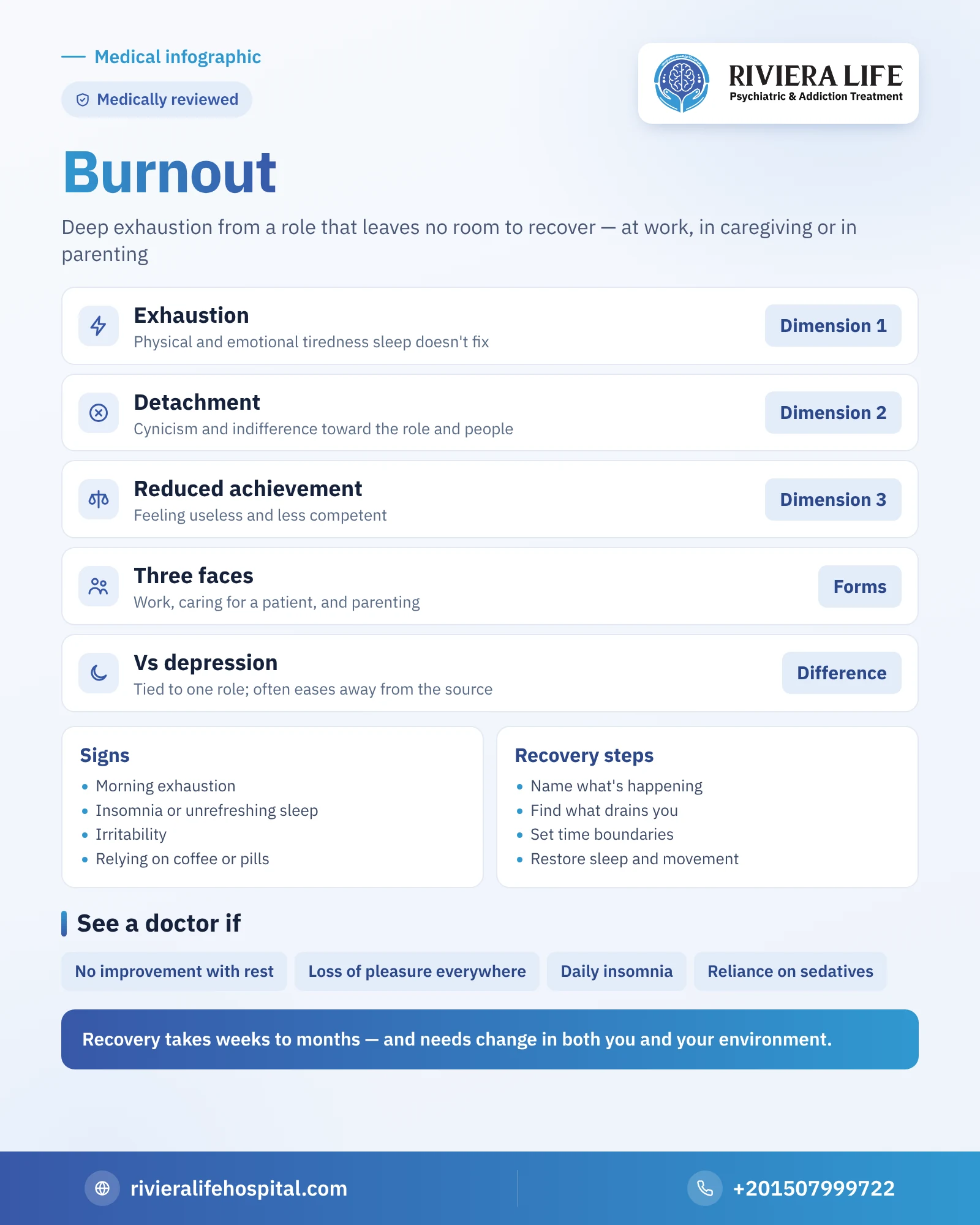
Three faces of burnout: work, caregiving and parenting
Job burnout
The best-known form. It is usually linked to a workload that exceeds the time available, lack of control over decisions, reward that doesn’t match the effort, unfairness or conflict within the team, or a clash between the person’s values and what is asked of him. Doctors, nurses, teachers and customer service staff are more at risk, but no profession is immune.
Caregiver burnout
It affects someone caring for a chronically ill or elderly person, or someone with dementia, a psychiatric disorder or addiction. There is no end of shift here and no holiday, and the illness may last years. The caregiver is often ashamed of being tired because he is “serving his family”, so he ignores himself until he collapses. Among its particular signs are guilt at any moment of rest, and suppressed anger at the patient followed by self-blame for it.
Parental burnout
Exhaustion that comes from the parenting role itself, especially with a sick child or one with special needs, with one parent absent, or with continuous financial pressure. A mother says: “I love my children, but I no longer feel anything when I’m with them.” This emotional distance is the essence of parental burnout, and it carries a heavy guilt that blame doesn’t treat, but support does.
Signs of burnout
- Morning exhaustion and a feeling of heaviness before the day begins.
- Headaches, muscle aches, digestive problems and frequent colds.
- Insomnia despite tiredness, or long sleep that doesn’t refresh.
- Excessive irritability with family and colleagues, and getting worked up over small things.
- Forgetfulness, distraction and difficulty making simple decisions.
- Putting off tasks, lateness, absence, or being physically present without focus.
- Growing reliance on coffee, cigarettes or sedatives to get through the day.
- Recurring daydreams of resigning or escaping from everything.
Burnout and depression: where is the dividing line?
They are similar in exhaustion and loss of enthusiasm, and long burnout may turn into actual depression. But there are important differences between them:
| Comparison | Burnout | Depression |
|---|---|---|
| Scope | Usually tied to a specific role: work, caregiving or parenting | Extends to all areas of life |
| Enjoyment | The person may enjoy a holiday and activities away from the source of stress | General loss of pleasure, even on holiday |
| How the person sees himself | A sense of incompetence in the role | A general sense of worthlessness and guilt |
| Response to rest | Improves relatively when away from the source | Doesn’t improve much with rest alone |
| Classification | An occupational phenomenon, not a standalone diagnosis | A psychiatric disorder that is diagnosed and treated |
If sadness and loss of pleasure last more than two weeks and extend to everything, review depression symptoms and ask for an assessment, because telling them apart needs a psychiatrist, not an online test.
How does it differ from stress and workaholism?
Psychological stress means feeling that the demands are many, but the person is still engaged and trying. In burnout the trying has stopped: stress is like drowning in too much, and burnout is like being empty of everything.
And work addiction is a compulsive behavior in which the person works excessively because he can’t stop, even if it isn’t asked of him. It may lead to burnout, but it isn’t the same thing. Many burn out without being workaholics at all, because circumstances imposed the load on them.
Why does burnout happen?
The causes are of two kinds, and both matter:
- Causes in the environment: a constant load, lack of support, an unclear role, lack of appreciation, financial circumstances that force extra work, and caregiving without a partner.
- Causes in the person: perfectionism, difficulty saying no, tying self-worth to achievement, neglecting sleep and movement, and bearing everything without asking for help.
The common mistake is to put all the responsibility on the individual, advising him to relax while his environment stays as it is. Real recovery needs change in both.
Steps to recovery from burnout
- Acknowledge what is happening: naming the state ends the cycle of self-blame and opens the door to a solution.
- Identify the sources of drain: write down exactly what exhausts you, and separate what can be changed from what can’t.
- Ask for an adjustment, not a miracle: reducing one task, delegating another, a short leave, or a sibling sharing the care of a parent.
- Draw time boundaries: a real end of the working day, with the work phone off afterward.
- Restore the body’s basics: sleep at fixed times, daily movement and regular meals. The steps for lowering cortisol help here.
- Take back what was taken from you: a hobby, a friendship or private time you neglected, even an hour a week.
- Look for a small meaning: focus on a part of your role that still gives you a sense of worth.
Recovery takes weeks to months, not days. And returning to the same environment without change usually brings the condition back.
How do you help a colleague or relative who is burning out?
Don’t tell him “we’re all tired”. Ask about his day and listen without quick solutions. Lighten a practical load for him if you can: an hour of caregiving in his place, or a task at work. And encourage him to see a specialist if you see signs of depression or reliance on pills or alcohol.
When should you ask for help?
Ask for a psychiatric assessment if you don’t improve despite rest and adjustments, loss of pleasure has spread to your whole life, you have started relying on sedatives or substances to cope, or insomnia has become daily. Cognitive behavioral therapy is effective in rebuilding coping tools, and someone who has developed depression or anxiety may need medicine determined by the doctor. And if a sense of isolation surrounds you after years of busyness, our article on loneliness and social isolation completes the picture.
Seek urgent help immediately if you see
Call an ambulance on 123 or the mental health hotline 16328, or go to the nearest emergency department.
- Thoughts of self-harm or that life is no longer worth it
- Complete inability to leave bed or eat for several days
- Crushing chest pain or severe palpitations with shortness of breath
At Riviera Life, psychiatry consultants distinguish between burnout that needs a recovery plan and depression that needs treatment, and set a realistic plan that suits your work or caregiving circumstances. The first consultation is free and confidential.
Read also
- Psychological stress: its signs and ways to cope with it
- Work addiction
- Nervous breakdown: what does it mean medically?
- Depression: the complete guide
- Midlife crisis: the signs, causes and how to get through it
- Psychological resilience and self-compassion: how do you recover from crises?
- Adjustment disorder: when does a reaction to a crisis become a disorder?
- Stress test: instant result
Questions many people ask
The World Health Organization classifies it as an occupational phenomenon, not a standalone disorder. But it may pave the way to depression or anxiety, and then it needs diagnosis and treatment.
A holiday eases exhaustion temporarily, but returning to the same conditions without changing the load or boundaries usually brings the symptoms back.
Yes, parental and caregiver burnout are recognized, and happen when the exhausting role continues for years without support or periods of rest.
It varies from person to person, and usually extends from weeks to months depending on the severity and how far the sources of stress are changed.
If you don't improve despite rest, loss of pleasure has spread to your whole life, or daily insomnia, reliance on sedatives or thoughts of self-harm appear.