Low self-confidence means doubting your ability and worth before you try, so you back away from speaking, an opportunity or a decision. The phrase “weak personality” is a common description in everyday speech, not a medical diagnosis, and usually hides a fear of rejection, a harsh upbringing or untreated anxiety. The good news is that confidence is a skill formed through experience, not a trait people are born with, and what looks like weakness of personality can be understood and changed. Here we explain what low confidence looks like, where it comes from, when it is part of a disorder that needs treatment, and how to build it step by step.
What does low self-confidence look like in daily life?
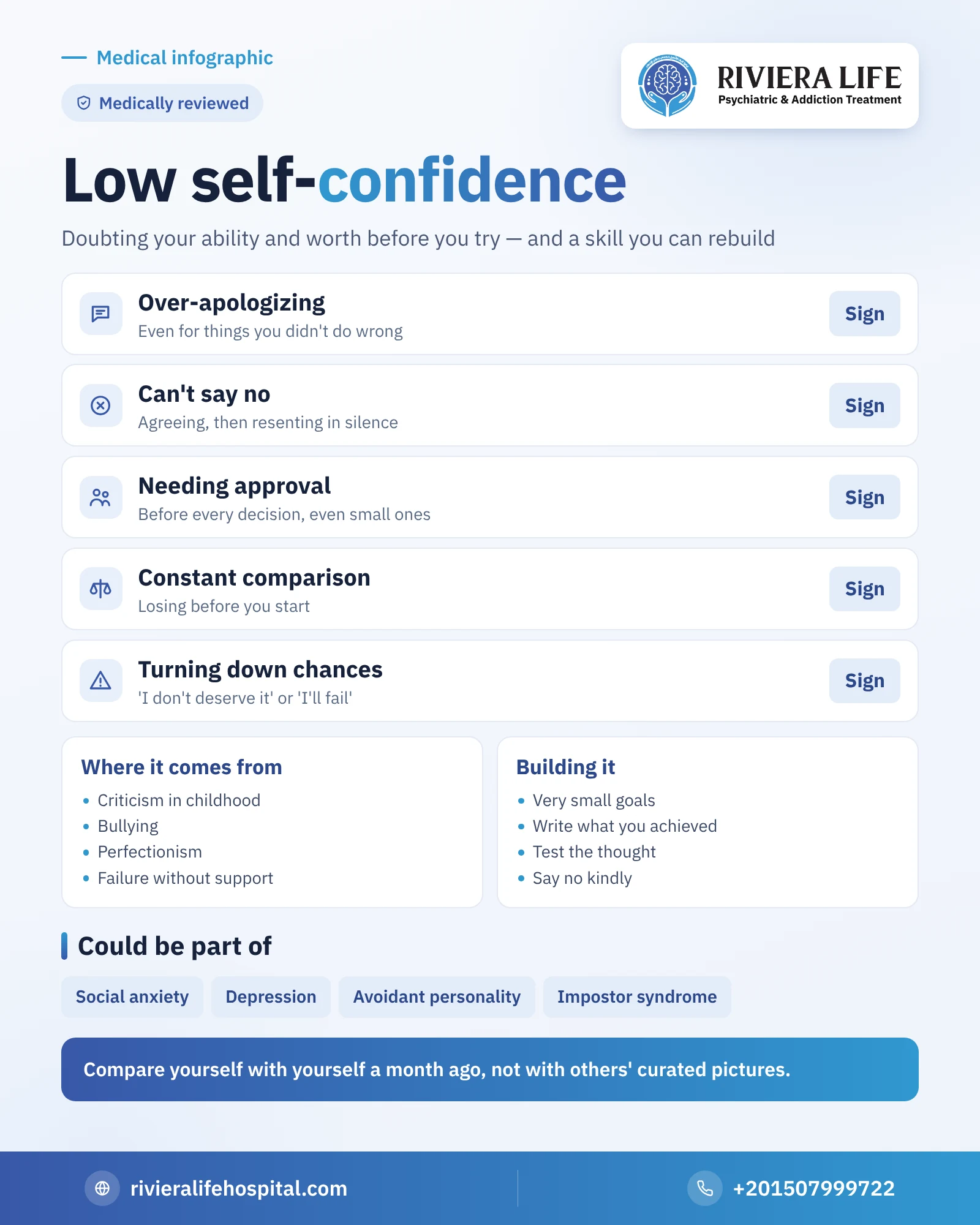
- You apologize a lot, even for things you didn’t do wrong.
- You find it hard to say “no”, so you agree and then feel upset in silence.
- You wait for others’ approval before every decision, even small ones.
- You avoid speaking in meetings or back down from your opinion at the first objection.
- You play down your achievements and magnify your mistakes.
- You constantly compare yourself with others, and lose the comparison before it starts.
- You turn down good opportunities because you “don’t deserve them” or “won’t succeed”.
These signs appear in different degrees in everyone, and having some of them from time to time is normal. What matters is how often they recur and their effect on your decisions and relationships.
Where does low confidence come from?
There is no single cause, but intertwined threads:
- Childhood: constant criticism, comparison with siblings or cousins, mockery, and overprotection that doesn’t let the child experience success on their own.
- Bullying and humiliation: being bullied at school or work leaves a long-lasting effect on self-image.
- Perfectionism: someone who sees any mistake as complete failure can’t feel they are enough.
- Repeated failure without support: failing exams, being fired, divorce or a collapsed project, with no one to repair the self-image.
- Anxiety and depression: they may cause self-doubt, and may also result from it.
- Digital comparison: watching other people’s curated lives on the screen makes your ordinary life seem lacking.
The vicious circle: why doesn’t confidence improve on its own?
Self-doubt pushes you to avoid, and avoidance stops you discovering that you were capable. You avoid speaking in the meeting so you never learn your idea would have been accepted, and your conviction that silence was safest grows. The cycle repeats until it becomes a fixed belief. Breaking this circle doesn’t need a big leap, but small, repeatable steps that show your mind different evidence.
Self-confidence, vanity and arrogance: what is the difference?
Many fear that building confidence will end in vanity. The difference is fundamental: the confident person knows the limits of their ability, accepts criticism and asks for help, because their worth doesn’t depend on a single result. The arrogant person needs to prove their superiority over others and rejects any criticism. In the opposite direction, someone who pretends to be confident to cover their fear drops the mask at the first pressure. Real confidence is calm and doesn’t need an audience.
Is it a trait or a disorder?
Low confidence on its own isn’t an illness. But it may be part of a wider picture that deserves assessment:
| Condition | What distinguishes it | For more |
|---|---|---|
| Social anxiety | Intense fear of people’s evaluation that prevents social situations, with physical symptoms | Social anxiety symptoms |
| Depression | Sadness or emptiness with loss of pleasure and an overall negative view of oneself | Depression symptoms |
| Avoidant personality | A stable pattern since youth of feeling inadequate and avoiding relationships for fear of rejection | Avoidant personality |
| Dependent personality | An excessive need for someone to decide for them and look after them, and fear of abandonment | Dependent personality disorder |
| Impostor syndrome | Real success the person doesn’t believe, fearing their “fakeness” will be exposed | Impostor syndrome |
Only a psychiatrist can distinguish between these pictures after a full assessment. And if you are the type who is affected by a passing remark, you may also want to read about the sensitive personality.
Is shyness the same as low confidence?
No. Shyness is a matter of temperament: a quiet person who needs time to get to know people, but may be confident in their worth and decisions. Low confidence is a negative judgment of oneself that appears even in familiar situations. The two may come together, or one may exist without the other. And if fear of people is the biggest obstacle, read about social anxiety treatment.
Where does low confidence show most?
At work it may look like a competent employee who doesn’t ask for a raise or promotion, and writes an email five times before sending it. In marriage and relationships it may appear as accepting bad treatment for fear of loneliness, or excessive jealousy caused by feeling you don’t deserve love. In study it shows in a student who knows the answer and doesn’t raise their hand. What these situations share is that the problem isn’t ability, but the prior judgment of oneself. That is why training ability alone, with a course or a new certificate, isn’t enough if the judgment stays the same.
Practical steps to build confidence
- Start with very small goals: asking one question in the meeting, or giving your opinion on a simple subject. Small repeated success builds the evidence.
- Write down what you achieved each evening: one line is enough, as the doubting mind quickly forgets the positive.
- Test thoughts before believing them: instead of “everyone will laugh at me”, ask: what is the evidence? And what could actually happen? This is the basis of cognitive behavioral therapy.
- Practise saying no kindly: “I can’t right now” is a complete sentence, and needs no long justifications.
- Look after your body: enough sleep and daily movement are reflected in your mood and in how you see yourself.
- Reduce comparison: compare yourself with your version a month ago, not with a curated picture of someone else.
- Choose your surroundings: people who constantly mock you block progress, and supportive people speed it up.
- Learn a specific skill: confidence grows from real competence, so learn something in which you can measure your progress.
Self-talk: change the tone, not only the content
Listen to how you address yourself when you make a mistake. If a dear friend said to you what you say to yourself, would you accept it? The point isn’t to beautify reality, but to admit the mistake and learn from it without insulting yourself. Self-compassion is a condition for learning, not a luxury. We have dedicated a whole article to it in this section: psychological resilience and self-compassion.
How can parents and partners help?
Praising effort and trying is better than praising intelligence or the result alone. Give your child or partner the chance to make mistakes and fix them without mockery. And avoid phrases that attach a fixed label, such as “you’re always weak” or “you don’t know how to handle things”, as they turn into an inner voice that stays with them for years.
When do you need a specialist?
- If weeks have passed and you are sad or empty or have lost interest in what you used to love.
- If fear stops you from work, study or relationships.
- If physical symptoms such as palpitations and trembling appear before social situations.
- If you have started turning to alcohol, sedatives or drugs to bear people.
- If you have thoughts that you are a burden or that life isn’t worth it; in this case call the mental health hotline 16328 or the ambulance on 123.
Psychotherapy, and sometimes medication if there is anxiety or depression, gives good results. Don’t start or stop a medicine except under the doctor’s supervision.
How can Riviera Life help you?
If you feel that low confidence has started to restrict your life, you can visit Riviera Life in Sheikh Zayed, where our consultant psychiatrists assess your condition and set with you a psychotherapy plan that suits you, with complete confidentiality and a free first consultation on +201507999722.
More from the mental health guide
- Impostor syndrome
- Avoidant personality
- Overthinking
- The personality disorders guide
- Self-confidence after recovery from addiction: how is it rebuilt?
- The Rosenberg self-esteem test
Questions many people ask
No, it is a common description, not a diagnosis. But it may hide anxiety, depression or a personality pattern that deserves assessment.
Criticism and comparison in childhood, bullying, perfectionism, failure without support, and anxiety and depression. More than one factor usually comes together.
Yes, it is a skill that grows with small successful experiences and changing your inner talk, and psychotherapy helps with this.
Shyness is a quiet temperament in new situations, while low confidence is a negative judgment of oneself that appears even in familiar situations.
If it is accompanied by sadness for weeks, fear that disrupts work and relationships, reliance on substances to bear people, or thoughts that you are a burden.