The short answer
Behavioral addiction is a condition in which a person loses the ability to control an activity that gives them quick pleasure or relief, such as betting, video games, pornography or buying, so they continue it despite clear losses in their money, studies, work and home. No drug enters the body, but the picture is familiar: an urgent craving, a gradual increase, promises to stop that don't hold, and distress when prevented. It is treated mainly with psychotherapy, along with treating the depression or anxiety that accompanies it.
- Harm is the criterionNot the number of hours but what the person loses because of them
- Official recognitionGambling and gaming are listed in the international classification ICD-11
- TreatableCognitive behavioral therapy is usually the first line
Behavioral addiction is one of the things fathers and wives ask about most in our clinics today, and the story often begins with a sentence like "He doesn't drink or use anything, he just sits on his phone until dawn". On this page we explain when an ordinary activity turns into an addiction, its types, how it differs from substance addiction, and what really helps in treating it, with a guide to all the section's articles arranged by type.
What is behavioral addiction?
To understand behavioral addiction, start from a simple fact: every person loves things that relax them: a match with friends, browsing the phone before sleep, a stroll in the mall. The problem doesn't start with pleasure, but when the activity becomes almost the only way of dealing with boredom, sadness or stress, and starts eating up the other areas of life one after another.
Doctors use three simple questions to judge: has the person lost control over the start of the activity, its duration and its timing? Has the activity come ahead of sleep, food, work and relationships? And does it continue even though they see the harm with their own eyes? If the answers are "yes" for an extended period, we are facing an addiction to the behavior and not just an exaggerated hobby. It is part of a broader concept we explain in the section Addiction: its definition and stages, which brings together substance and behavioral addiction.
Types of behavioral addiction and its best-known forms
The activities a person may become attached to are many, but some are more common in the psychiatric clinic than others.
Gambling and online betting
The clearest of the types and the most dangerous financially, it has spread with match-betting apps that reach any phone. The gambler chases his losses to make them up, so debts grow in silence. You will find its details on the page Gambling addiction.
Video games
They affect teenagers and young people in particular, and show up as staying up until dawn, a decline in studies and irritability when the device is taken away. See Video game addiction.
The phone, the internet and social media
Endless scrolling, anxiety if the phone is far away, and checking notifications every few minutes. We gather these forms on the page Digital addiction.
Pornography, masturbation and compulsive sexual behavior
Among the types most associated with shame and secrecy, which is why seeking help for them is delayed for years. We cover them in calm medical language on the pages Porn addiction, Masturbation addiction and Sex addiction.
Shopping and compulsive buying
Buying things the person doesn't need, then hiding them or feeling guilty, with credit cards filling up. The details are in Shopping addiction.
Smoking and nicotine
Nicotine is a chemical substance, not a pure behavior, but we put it in this section because the rituals of the cigarette and the shisha are a large part of the difficulty of quitting. Read Smoking addiction.
Work, food, exercise and love
Forms that are less scientifically settled, but carry the same pattern of loss of control and continuing despite harm, and you will find an article for each of them in the guide at the bottom of the page.
Does medicine recognize behavioral addictions?
The answer differs by type. The International Classification of Diseases ICD-11 issued by the World Health Organization places "gambling disorder" and "gaming disorder" under the heading of disorders due to addictive behaviors, and for gaming disorder it requires impaired control, prioritizing gaming over other interests, and continuing despite consequences, for a period usually extending twelve months. The American manual DSM-5 also includes gambling disorder alongside substance disorders, and mentions internet gaming disorder as a condition needing further research.
As for compulsive sexual behavior, ICD-11 classifies it among impulse control disorders, while there are as yet no separate official diagnoses for addiction to shopping, pornography or the phone. This doesn't mean the suffering isn't real; the doctor treats the loss of control and harm they see, whatever the name in the books.
The signs shared by all its types
However different the activity, almost the same signs recur. Some the person feels inside, and some the family notices from outside.
What the person feels
- Constant thinking about the activity, even during work or study
- Needing more time or larger sums to get the same pleasure
- Repeated attempts to cut down that end in failure
- Tension, distress and irritability if prevented from it
- Guilt and regret after every round
What the family notices
- Repeated late nights and exhaustion in the morning
- Lying about time or money spent
- Withdrawal from family gatherings and friends
- A decline in study or performance at work
- Vague requests for money or sudden debts
Many of these signs overlap with depression, which is why the matter deserves a specialist assessment; the article The relationship between depression and addiction explains how each feeds the other.
How does the behavioral addiction loop turn?
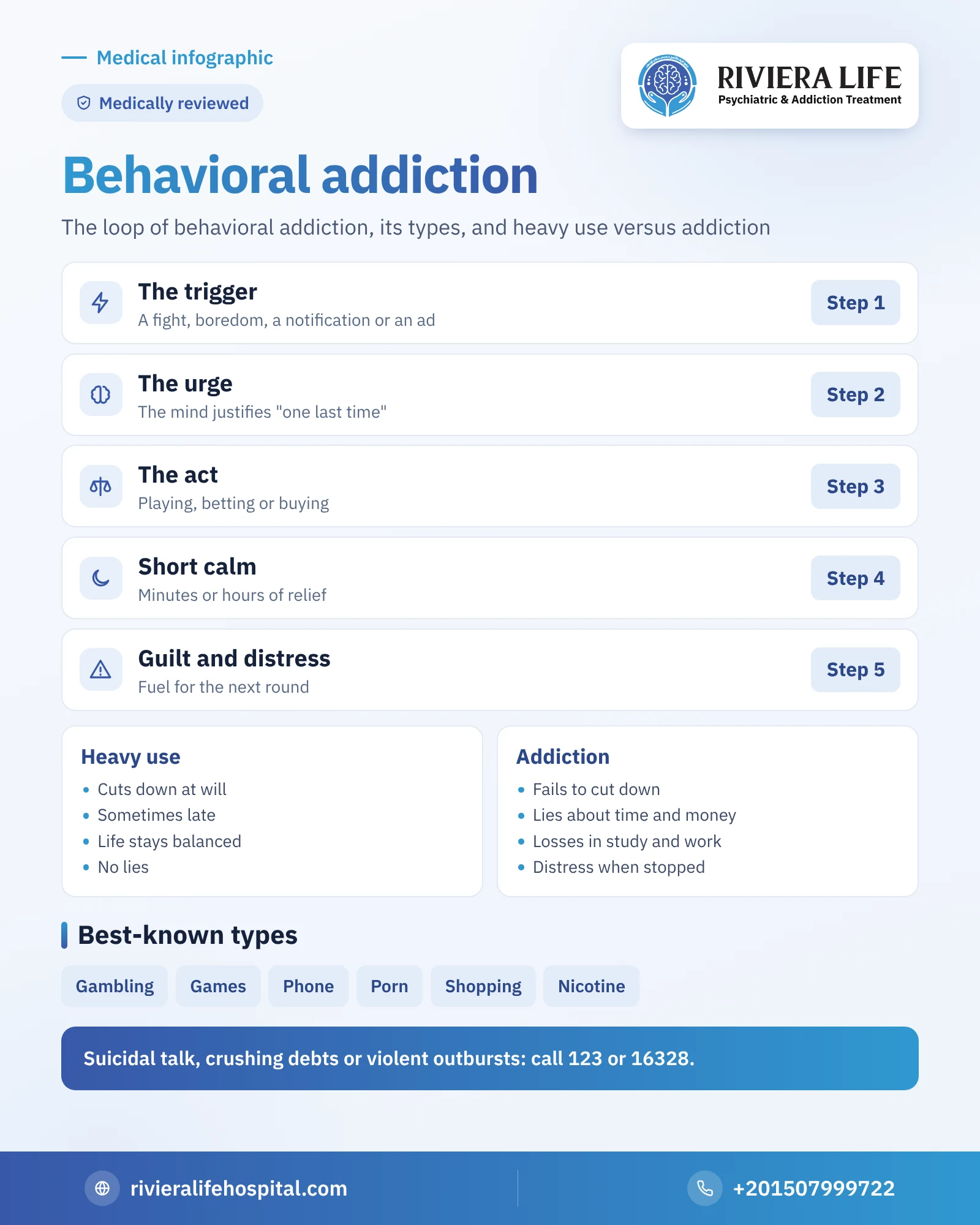
Behavioral addiction runs in a repeating loop, and whoever understands it can break it at more than one point. It usually repeats in the following order:
- 1The triggerSomething that wakes the urge
A fight at home, a night of boredom, a notification on the phone, or just seeing a betting ad during the match.
- 2The urgeA thought that grows fast
Thinking about the activity becomes dominant, and the mind starts justifying "one last time".
- 3The actPlaying, betting or buying
The activity offers instant relief because the brain releases dopamine, linked to anticipation and reward.
- 4The short calmMinutes or hours
The unpleasant feelings fade temporarily, so the brain learns that this is "the solution".
- 5Guilt and distressFuel for the next round
Regret comes and with it new tension, so the person looks for relief in the same activity, and the loop starts again.
The difference between behavioral and substance addiction
The two types share the brain basis and the pattern of loss of control, but they differ on practical points that matter to the family.
| Point of comparison | Behavioral addiction | Substance addiction |
|---|---|---|
| Source of pleasure | An activity the person does | A substance that enters the body |
| Withdrawal | Mostly psychological: irritability, insomnia and distress | Physical and psychological, and may be dangerous with some substances |
| Overdose | Doesn't exist | A real risk that may threaten life |
| Treatment goal | Sometimes moderation (such as the phone and food) | Usually abstinence |
| Discovery | Harder, because it has no smell and no test | Physical signs and tests may appear |
The two types may come together in the same person, such as gambling accompanied by drinking alcohol, and then the two conditions are treated within one plan.
When is a behavior a compulsion, not an addiction?
The two words are used as if they were one thing, but the doctor distinguishes between them. In addiction, the behavior starts as a search for pleasure or reward and then the person loses control over it. Compulsion in obsessive-compulsive disorder, however, is practiced to relieve intense anxiety caused by an obsessive thought, without being enjoyable in the first place, such as washing the hands dozens of times. Between the two lie conditions such as compulsive hair pulling and kleptomania. This distinction isn't a linguistic luxury, because it changes the type of treatment and the medicines used.
Why do some fall into it and not others?
There is no single cause. The picture is usually a mixture of factors that come together in the same person:
- Personal predisposition: impulsivity, difficulty tolerating boredom, and a constant search for excitement.
- Accompanying disorders: depression, anxiety and attention deficit hyperactivity disorder clearly raise the likelihood.
- Life pressures: unemployment, loneliness and marital disputes make quick escape tempting.
- The design of the products themselves: intermittent rewards in games and betting apps are built to make you come back.
- The environment: easy access, friends who practice the same behavior, and lack of supervision over children.
We discuss risk and protective factors more broadly in the section Causes of addiction.
Heavy use or addiction? How to tell the difference
A young man who plays four hours a day during the holidays and passes with distinction isn't necessarily addicted, while another who plays two hours but has left university and isolated himself from his family may be. The measure is the effect:
Cuts down when he wantsOrdinary use
Sometimes late for commitmentsExcessive use
Lies and fails to cut downA danger sign
Losses in study, money and relationshipsAddiction that needs treatment
Teenagers and screens: what is really worrying?
Parents worry about behavioral addiction in their children more than anything else, and they have a reason: the teenage brain learns fast and responds strongly to reward, while the areas of self-control and planning haven't yet matured. That is why children and teenagers are more prone to attachment to games and social media. The real worry isn't the number of hours alone, but the decline in sleep and studies, isolation, outbursts of anger when the device is taken away, or exposure to pornographic content at a young age. Clear rules agreed on by the whole house help here, such as keeping devices out of bedrooms at night. The article Addiction in teenagers will help you understand this stage.
Treating behavioral addiction: what works?
The good news is that treatment results are encouraging for those who stick with it, and that most cases are treated with outpatient sessions without needing a stay.
1
A comprehensive psychological assessment
The doctor determines the type of behavior and its severity, and looks for accompanying depression, anxiety, attention deficit or substance use.
2
Cognitive behavioral therapy
The patient learns to track their triggers and dismantle the thoughts that justify the behavior, and to build practical alternatives for dealing with stress and boredom.
3
Reducing access
Blocking betting apps, handing over money management temporarily to a trusted person, and controlling screen time with clear tools.
4
Treating what accompanies it
The doctor may prescribe medicines for accompanying depression, anxiety or attention deficit, and there is no approved medicine that treats the behavior itself.
5
Group support and the family
Group therapy and family sessions reduce isolation and help prevent relapse.
Cognitive behavioral therapy plays the biggest role in most types of behavioral addiction, and you will find the other methods in the section Psychotherapy, including group therapy. When the behavior comes together with substance addiction or a clear psychological disorder, the dual diagnosis program is the most suitable path.
Mistaken ideas that delay seeking help
What people say
- No drugs means no addiction
- He just needs to delete the app and that's it
- It's spoiling and bad upbringing
- He'll grow up and stop on his own
What the truth says
- Behavior changes the brain's reward circuits as substances do
- Prohibition alone without treatment usually pushes toward other substitutes
- Blame increases secrecy and delays treatment
- Early intervention is easier and gets results faster
The family's role and when the matter becomes urgent
The hardest thing the family faces is the balance between support and not enabling. Paying off the gambler's debts every time, or buying the son a new phone after he broke the old one in a fit of anger, unintentionally protects the behavior from its consequences. Better is a calm conversation at a suitable time, clear limits on money and devices, and an offer to go together to a specialist assessment instead of threats. And if the husband gambles, the article My husband gambles, what should I do? offers steps to protect the money and the children.
Signs that call for urgent intervention
Don't wait for the next appointment if any of the following appears, and call the ambulance on 123 or the hotline of the General Secretariat of Mental Health and Addiction Treatment on 16328:
- Talk of suicide, self-harm or that "the family would be better off without him"
- Huge debts with threats from creditors or legal danger
- Violent outbursts of anger that threaten a member of the household
- Complete cutting off from food and sleep for days
In the case of suicidal thoughts in particular, read How to deal with suicidal thoughts and don't leave the person alone.
The behavioral addiction article guide: by type
We have arranged the section's articles into categories by type, and almost every type has articles on symptoms, causes, treatment and the family's role. Everyday bad habits that don't reach the level of addiction belong on the page Bad habits.
Gambling and betting
5 articlesFrom the first signs to protecting the family's money
- The signs of a compulsive gambler: psychological, behavioral and financial signals, and when to seek help.
- Why does betting turn into a compulsive habit?: the psychological and environmental factors.
- Recovering from gambling and online betting: the steps and preventing relapse.
- The family's guide with a gambling addict: conversation and setting limits.
- When the husband gambles: the wife's steps to protect the money, the children and herself.
Games, the phone and the internet
8 articlesScreens when they steal sleep, study and relationships
- When does gaming become a problem?: signs that deserve a psychological assessment.
- What draws the player back: the psychological and social factors.
- The price of excessive gaming: the effect on health, study and relationships.
- Restoring balance with games: recovery steps and family support.
- Attachment to the internet: types, symptoms, causes and treatment.
- The smartphone when it controls your day: symptoms, effects and treatment.
- Excessive social media: its effect on mood and sleep and a plan to cut down.
- The truth about so-called digital drugs: binaural beats and what parents need.
Pornography and masturbation
10 articlesMedical facts away from exaggeration and stigma
- The signs of losing control over viewing: and when to seek help.
- What lies behind repeated viewing: the psychological and behavioral factors.
- The effects of pornography: on the self, relationships and teenagers.
- A practical plan for recovering from pornography: controlling daily behavior.
- What do you gain when you stop viewing?: the realistic gains and their limits.
- Why is masturbation hard to quit?: the reasons for repetition.
- Masturbation between fact and myth: what medicine says for men and women.
- Regaining control over masturbation: a guide to psychotherapy.
- What changes after quitting?: and what doesn't change.
- When the wife turns to masturbation: understanding desire and the marital relationship.
Compulsive sexual behavior and emotional attachment
4 articlesWhen the relationship or desire is out of control
- The signs of compulsive sexual behavior: and when you need an assessment.
- The roots of losing sexual control: the psychological and medical factors.
- The paths of treating sex addiction: psychotherapy and the role of medicines.
- Pathological attachment to love: symptoms, causes and psychotherapy.
Shopping and impulsivity
4 articlesBuying and stealing when a person loses the reins of impulse
- The signs of compulsive buying: and when to seek help.
- Why does the urge to buy keep coming back?: the reasons control is hard.
- Regaining control over spending: methods of psychotherapy.
- Kleptomania: how it differs from ordinary theft and how it is treated.
Nicotine, tobacco and caffeine
11 articlesCigarettes, shisha, toombak and energy drinks
- Nicotine dependence: symptoms, withdrawal, harms and ways to quit.
- A plan to quit cigarettes: from the day of the decision to the third month.
- Vapes and e-cigarettes: do they really help with quitting?
- Nicotine gum: how it works, the right way to chew it and who it doesn't suit.
- How long does nicotine stay in the body?: blood, urine, saliva and hair.
- The truth about shisha and molasses tobacco: the water myth and carbon monoxide.
- Other people's smoke: the effect of passive smoking on children and pregnancy.
- Snuff: what is proven about its harms to the nose and smell.
- Toombak: its harms to the mouth and the risk of cancer.
- Quitting toombak: a mouth examination and medical and behavioral support.
- Caffeine and energy drinks: dependence, withdrawal and how to cut down.
Work, food, exercise and other habits
4 articlesSocially accepted activities that may hide harmful attachment
- When work becomes an escape: the definition of work addiction, its symptoms and treatment.
- Attachment to food: the difference between it and binge eating disorder.
- Excessive exercise: when sport turns into harmful attachment.
- Nail biting: causes, harms and ways to stop for young and old.
When should you seek help?
If you or someone you love has tried to cut down more than once without success, or the behavior has started costing money, studies or a relationship, this is the time for an assessment, not the time to wait. At Riviera Life, a hospital licensed by the Egyptian Ministry of Health with fourteen years of experience, consultants in psychiatry assess the condition in complete confidentiality and set a treatment plan that suits it, with a program for the family and follow-up after improvement. Book your free and confidential first consultation on +201507999722.
Medical sources and referencesThe information in this article is based on reliable scientific sources