Marrying a recovered addict isn’t a wrong decision in itself, nor a venture with guaranteed results. What determines the outcome is the state of recovery at the time of engagement: is it stable and supported by treatment and follow-up, or just a short stop under family pressure? Here we set out the questions you should ask, the period usually advised, the warning signs it isn’t right to ignore, and how both partners protect their marriage if they choose to go ahead.
Can marrying a recovered addict work?
The honest answer: it works with some people in recovery and not with others, and the measure isn’t their past but their present. Someone who has spent years abstinent, follows up with a specialist and faces their past clearly may be a more aware partner than many who have never been through anything. And someone who stopped weeks ago and then got engaged quickly may be in the most dangerous stage for relapse.
Recovery is the management of a chronic illness, not its erasure, and this doesn’t diminish the worth of the person in recovery, but it does mean you will live with someone whose recovery needs ongoing care. Your decision is right if you accept this fact with open eyes.
How long should recovery last before marriage?
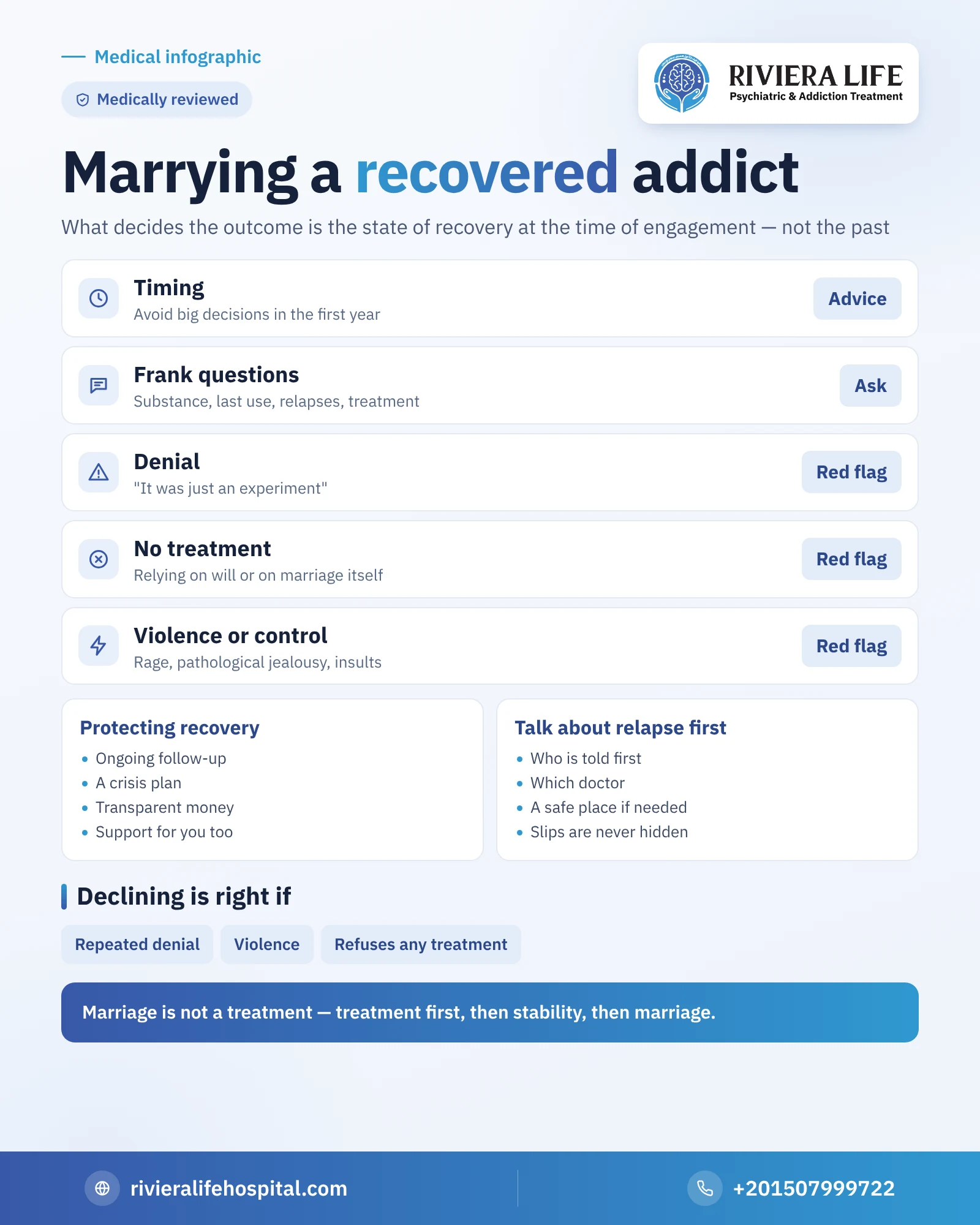
There is no magic number that suits everyone. But many specialists advise that no major commitment decision be made in the first year of abstinence, because it is the highest-risk period for relapse, and because the person is still getting to know themselves without a substance. The longer the period with regular follow-up, the greater the reassurance, and it also helps if they have been through real situations of stress, such as a dispute or losing a job, without relapsing.
Duration alone isn’t enough; someone who has abstained for two years without treatment or a plan may be weaker than someone who has abstained for one year with serious follow-up. Ask “how” before “how long”. You will find a map of the stages in our article on the stages of addiction recovery.
Frank questions to ask
You have the right to ask, and it is in their interest to answer without anger. Important questions include:
- What substance did you use, when was the last use, and how many times have you relapsed?
- Where were you treated, and did you complete the program or leave it?
- Are you still following up with a doctor, counselor or support group?
- What are your triggers, and what is your plan if a strong craving appears?
- Have your old relationships with users remained, and do you have debts from that period?
- Have you told your family and mine the whole truth?
An answer like “it’s over and there’s no need to talk about it” isn’t reassurance but evasion. A person confident in their recovery talks about it calmly and accepts review.
Warning signs before committing
Not every sign is a reason to refuse, but several of them together deserve a serious pause:
- Denial or minimizing: they think they were never an addict, or that it was “an experiment”.
- No treatment or follow-up: relying on willpower alone, or on the marriage itself to fix them.
- Constant blame: holding family, friends or circumstances responsible for everything that happened.
- Lying about details: you later discover things they hid from you.
- The old circle continuing: they sit with people who use and justify it.
- Violent or controlling behavior: excessive anger, pathological jealousy or insults, a sign that has nothing to do with the substance alone.
- Unstable work and income without any plan to address it.
When the family suggests marriage as a “cure”
One of the most common mistakes is saying in some homes: “marry him off and he’ll come to his senses”. Marriage doesn’t treat addiction. Rather, it adds new responsibilities to the pressure, and the partner is loaded with the role of doctor and monitor while having neither. These marriages often end in relapse, shattered trust on both sides, and perhaps children at the heart of the crisis.
The correct order is the reverse: treatment first, then stability, then a marriage built on full knowledge. And if you are under pressure from your family or theirs, remember that you have the right to enough time and to a specialist’s advice.
Should they tell me about their past?
Yes, before the contract and honestly. Hiding addiction from a partner builds the marriage on a shaky foundation, and when the spouse discovers it later the wound is double: the wound of addiction and the wound of deception. Honesty at this stage, even if it costs a refusal, is more useful for the person in recovery themselves, as they practice the most important recovery skill: not living with a secret.
And if you are the person in recovery reading this, choose a calm time and speak clearly, and give the other person time to think without pressure.
What about children and heredity?
Addiction has a partial genetic component, so the likelihood of children being exposed to it is slightly higher than others, but it isn’t an inevitable fate. A stable environment, frank conversation with children as they grow, and calm supervision in adolescence reduce the risk considerably. You will find prevention ideas in our article on drug prevention.
How does a couple protect recovery after marriage?
- Continued follow-up: they continue their sessions and regular visits, and don’t stop because life has become stable.
- Agreement on a crisis plan: what each of you does if a strong craving appears or a slip happens.
- Limits on money: a transparent joint account, and no large amounts of cash available without the other’s knowledge in the first months.
- Support for you too: don’t turn into a monitor. You have space, support, and sessions of your own or couples sessions.
- Agreement that a slip isn’t hidden: quick disclosure matters more than the slips being zero.
For detail on what changes inside the home after recovery, read does an addict return to normal after treatment?. And for those facing current addiction within a marriage, our article on the effect of addiction on married life is written for that situation.
How do you talk about relapse before it happens?
The hardest and most useful conversation is the one before the marriage: “what if you went back to using one day?”. Couples who agreed on the answer in advance act calmly when the crisis comes, and those who didn’t talk are taken by surprise into anger and accusation.
Agree on the following in clear words: who is told first, which doctor or counselor you go to, whether you stay at your family’s home temporarily if you feel in danger, and what each of you expects from the other at the moment of a slip. Having the plan doesn’t mean you expect failure; it means you respect the nature of the illness.
Should I consult a specialist before deciding?
Yes, and this isn’t excessive. A session or two with a psychiatrist or family therapist, with both partners present or with you alone, lets you ask about their substance specifically and its relapse risks, and hear the view of a neutral party who doesn’t pressure you and isn’t afraid of your refusal. The person in recovery can also ask their therapist for help in preparing the disclosure conversation.
When is declining the marriage the right decision?
If denial recurs, violence appears, they refuse any treatment or follow-up, they relapse repeatedly without changing anything in their plan, or you feel real fear of them, there is no shame in declining. This isn’t a judgment on them but protection for you and your future children. The decision is yours alone, and no party has the right to pressure you in either direction.
How can Riviera Life help you?
The person in recovery and their fiancée, or both families, can book a free consultation to talk with the consultants in psychiatry and addiction treatment at Riviera Life about the state of recovery and the risks of relapse. Our program includes family sessions and aftercare after treatment, in complete confidentiality. Get in touch on +201507999722; we are based in Sheikh Zayed, Giza.
Read also
- The effect of addiction on married life
- Does an addict return to normal after treatment?
- Dealing with a recovering addict
- The family rehabilitation program for addiction treatment
Questions many people ask
No, marriage doesn't treat addiction; it adds new pressures and responsibilities. Treatment first, then stability, then marriage.
There is no single number that suits everyone, but many specialists advise against making a big decision in the first year, and the quality of follow-up matters, not the duration alone.
Yes, honesty before the contract protects the marriage from a double shock later, and is also important practice for the person in recovery in living without secrets.
Addiction has a partial genetic component that raises the likelihood slightly, but it isn't fate. A stable environment and frank conversation reduce the risk considerably.
Don't cover it up; go quickly to the doctor or counselor and review the plan. A slip calls for adjusting treatment and doesn't necessarily mean the end of the marriage.