The short answer
The Riviera Life social anxiety test is ten questions about recent months: fear of others’ judgment, avoiding speaking and eating in front of people, physical symptoms in social situations, and replaying what you said after every meeting. Each answer scores 0 to 4, and the total is 0 to 40: below 10 is ordinary shyness, 10 to 19 mild social anxiety, 20 to 29 moderate, and 30 or more severe. A score of 20 or more deserves assessment, and cognitive behavioral therapy is very effective here.
- DurationAbout two minutes
- ScoreFrom 0 to 40
- 20 or moreAssessment by a specialist
Shyness is a trait, while social anxiety is a shackle. A shy person may be tense at a first meeting and then open up, while someone with social anxiety arranges their whole day around avoiding situations: they turn down a promotion because it requires presenting to management, put off a necessary call for days, and leave an occasion early then blame themselves for every word they said. These questions help you find out how far it has gone with you.
Start the social anxiety test
Social phobia test
Over the past months, how often has the following happened to you?
To discuss your result with a psychiatrist in confidence, the first consultation is free on +201507999722.
This is an awareness test prepared by the medical team at Riviera Life; it is not a research-standardized scale or a diagnosis. Your answers are not saved or sent to anyone; the calculation happens on your device only.
What your score means
| Score | Meaning | The suitable step |
|---|---|---|
| 0 to 9 | No clear signs | No action |
| 10 to 19 | Mild social anxiety | Gradually facing avoided situations |
| 20 to 29 | Moderate social anxiety | Assessment and cognitive behavioral therapy |
| 30 to 40 | Severe social anxiety | See a doctor or psychotherapist |
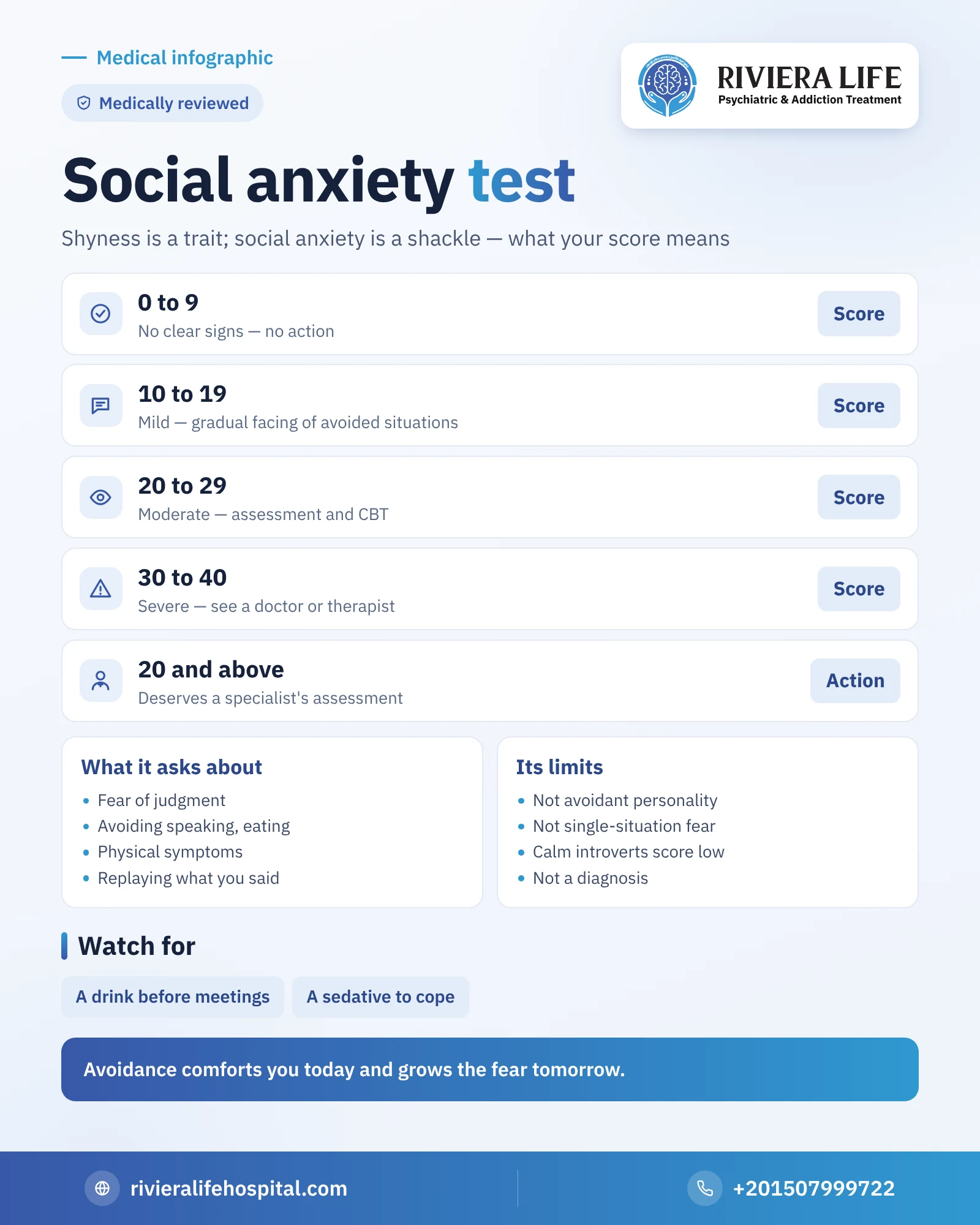
Avoidance comforts you today and grows the fear tomorrow
Every time you excuse yourself from a situation you fear, your mind learns that the situation really was dangerous, so the fear grows next time. That is why treatment works by reversing this cycle in small, graded steps, starting with easier situations and then moving up. And if you notice you rely on a drink or a sedative pill before meetings to cope, this is a sign that needs attention, explained in the article on social anxiety and addiction.
The limits of the test
- It doesn’t distinguish between social anxiety and avoidant personality; the difference is in avoidant personality.
- It doesn’t measure fear of a single situation only, such as public speaking, which is a type with a different nature that you will find in types of social anxiety.
- An introvert who prefers quiet without fear may get a low score, and that is normal.
About this test
These questions were prepared by the Riviera Life medical team; we wrote them in language close to everyday situations in our Arab societies, based on the diagnostic criteria for social anxiety. The test is for awareness and isn’t a standardized research scale; diagnosis is made in an interview with a specialist.
How can Riviera Life help you?
We offer a psychological assessment that determines the severity of social anxiety and what accompanies it, then a plan combining cognitive behavioral therapy and medication when needed; the details are in social anxiety treatment. The first consultation is free and confidential on +201507999722.
Read also
Questions many people ask
Shyness is passing tension that eases with familiarity, while social anxiety is intense fear that drives avoidance of situations until it affects work, study and relationships.
Yes, cognitive behavioral therapy based on gradual exposure is one of the most effective treatments, and the doctor may add medication when needed.