The behavior of a psychiatric patient isn’t “bad character” or “being spoiled”, but is often the first sign that something has changed inside. A son who was sociable starts closing his bedroom door for days, a calm sister starts spending without limit and not sleeping, or a father starts suspecting the neighbors and closing the windows. These changes alone aren’t enough for a diagnosis, which is the job of the doctor or psychologist, but they deserve attention. In this article we set out the behaviors families usually notice with each disorder, how to separate behavior from stigma, how to respond calmly, when behavior becomes an emergency, and how to persuade a refusing relative to be assessed.
Why does a psychiatric patient’s behavior change?
A psychiatric disorder affects the way of thinking, feeling and perceiving, and behavior is what shows of this to others. So a single action doesn’t matter much, but change does: the person behaving in a way unlike himself, this continuing for weeks, and several signs coming together.
The American Psychiatric Association points out that one or two signs alone don’t predict mental illness, but several signs together, such as changes in sleep and appetite, withdrawal, declining performance, neglecting hygiene and mood swings, call for assessment. Write down what you notice with dates; these notes help the doctor a lot later.
The behavior of a depression patient
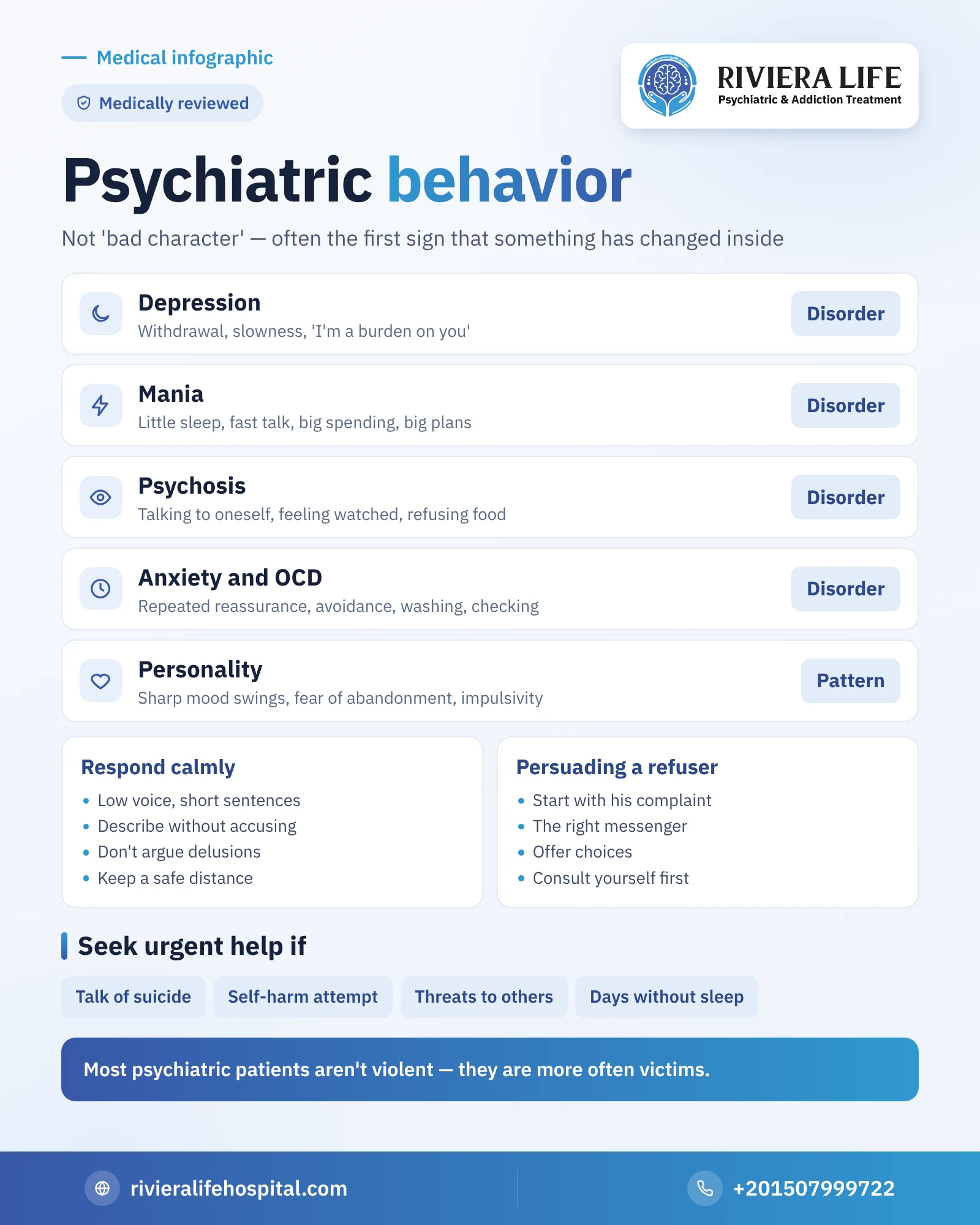
Depression doesn’t always appear as crying. The family often sees it as withdrawal and slowness: the person spends long hours in bed or on his phone without real interest, gives up prayer, sport or friends, takes less care of his appearance, and replies curtly or irritably. In men especially, depression may appear as anger, sharpness and staying up late, and sometimes as more smoking or substance use. The patient may say things like “I’m a burden on you” or “there’s no point in anything”, phrases that deserve listening, not blame. Details are in our depression guide.
The behavior of a patient in a manic episode
In bipolar disorder, a person may go through periods of mania in which he seems to the family like someone else: he sleeps only a few hours and doesn’t feel tired, talks quickly and jumps from idea to idea, suddenly starts big projects, spends a lot of money or borrows, drives recklessly fast, or talks about unrealistic abilities and plans. He may become quickly provoked if anyone contradicts him. The danger here is that the patient usually feels he is at his best, so he rejects the idea that he needs help.
The behavior of a psychosis and schizophrenia patient
Psychosis is a state in which a person’s contact with reality is disturbed, and it appears in schizophrenia and in other conditions, including the use of some drugs. The family may notice their relative talking to himself or answering voices no one else hears, laughing for no reason, or convinced that someone is watching him or putting something in his food, so he refuses to eat or keeps the curtains closed all the time. This may be preceded for months by isolation, neglect of study or work and incoherent talk. These hallucinations and thoughts are completely real to him, which is why arguing about them doesn’t help.
The behavior of an anxiety patient
An anxiety patient often seems “tiring for the family” without meaning to: he asks the same reassuring questions repeatedly, calls to make sure everyone is fine, avoids transport, occasions or crowded places, and complains of repeated physical symptoms and moves between doctors. He may delay making simple decisions for fear of making a mistake, or get worked up at any change of plan.
The behavior of an OCD patient
In OCD, actions are repeated in a way the family finds hard to understand: washing the hands until the skin cracks, repeating ablution and prayer many times, checking that the gas and door are closed dozens of times, or arranging things with rigid precision. He may ask his family to take part, such as preventing them from touching certain things. The patient usually knows these actions are excessive, but feels unbearable anxiety if he doesn’t perform them.
The behavior of personality disorders
Personality disorders are stable patterns that begin in adolescence or early adulthood, not temporary episodes. The most visible in clinics is borderline personality: sharp swings in feelings within hours, relationships that swing between intense attachment and cutting off, a strong fear of abandonment, impulsivity in spending, eating or driving, and sometimes self-harm. These behaviors tire the family, but they reflect real pain, and respond to specialized psychotherapies.
When drugs are behind the change
Some changes that look like mental illness are caused by substance use, or come together with it. Suspicion and isolation may be linked to hashish, staying up and aggression to stimulants, and drowsiness and stammering to sedatives. Our article on the behavior of a hashish user explains the signs specific to this case, and when the two come together, the person needs a plan that treats both together.
The behavior isn’t the person: behavior and stigma
The most dangerous thing about stigma is that it turns behavior into identity: “crazy”, “nervous”, “useless”. These words push the patient to hide and delay treatment. And the truth confirmed by studies is that most people with psychiatric disorders aren’t violent, and are more likely to be victims of violence than perpetrators. The disturbing behavior is a symptom of a treatable condition, just as a cough is a symptom of a chest illness.
How do you deal calmly with worrying behavior?
- Speak in a low voice and short sentences, and choose a calm time away from others.
- Describe what you see without accusing: “I’ve noticed you haven’t slept for days, and I’m worried about you”.
- Don’t argue with hallucinations or strange thoughts, and don’t endorse them; acknowledge his feelings: “it seems this is frightening for you”.
- Avoid mockery, threats and comparison with others.
- Keep a safe distance if he is worked up, and don’t corner him in a room.
As for long-term support at home, common family mistakes, and how to protect yourself from being drained, you will find them in our guide on how the family deals with a psychiatric patient.
When does behavior become an emergency?
Some behaviors can’t wait for a clinic appointment. If you feel there is a danger to the patient or those around him, safety comes first:
Seek urgent help immediately if you see
Call an ambulance on 123 or go to the nearest emergency department, and stay with the person if it is safe for you.
- Talk of suicide or ending life, or saying goodbye to the family and giving away belongings
- An attempt at self-harm or finding a means for it
- Aggression, threats to harm others or violently breaking things
- Voices ordering him to do something dangerous, or severe suspicion pushing him to attack
- Days without sleep with severe recklessness in driving or spending
- Complete refusal of food and drink or sudden clouding of consciousness
Move sharp tools and stockpiled medicines out of his reach, and don’t leave him alone if he talks about harming himself. You can also contact the General Secretariat of Mental Health and Addiction Treatment hotline on 16328 or 0220816831.
How do you persuade a refusing relative to be assessed?
Refusal is very common, especially in mania and psychosis, where the patient doesn’t see himself as ill. Some steps increase the chances of acceptance:
- Start from what bothers him: insomnia, exhaustion or tension, instead of the words “mental illness”.
- Choose the right person: he may accept from a close friend or a trusted relative what he refuses from his parents.
- Offer choices: “we’ll go to just one consultation and then you decide” eases his feeling of being controlled.
- Reassure him about confidentiality: many refuse for fear of people’s talk or of the effect on work.
- Consult first yourself: the family can sit with the psychiatrist to get a plan for coping even before the patient attends.
And in dangerous cases in which the patient refuses treatment despite danger to himself or others, Egypt’s mental health care law regulates involuntary admission procedures under specific conditions and safeguards decided by specialist doctors. You can learn the costs of the different options in our article on psychiatric hospital prices in Egypt.
How can Riviera Life help you?
The family can start by getting in touch alone. Riviera Life’s psychiatry consultants listen to what you have noticed, help you arrange a first assessment, and determine whether the case needs outpatient follow-up or a stay under round-the-clock medical supervision, with a family program, in complete confidentiality. The first consultation is free.
Read also
- How does the family deal with a psychiatric patient?
- Causes of mental illness
- Dual diagnosis program
- Mental illness: symptoms, types and treatment
- Mental vs psychological illness: the popular division and what medicine says
- When do you need a psychiatrist? Signs, the first visit and how to prepare
- Is a psychiatric patient responsible for his actions? Medicine, law and the family
- Committing a psychiatric patient: conditions, steps and his rights
Questions many people ask
No, stress, exhaustion, physical illnesses and substance use can also change behavior. What calls for assessment is a clear change from the person's nature that lasts weeks and affects his life.
Most psychiatric patients aren't violent, and are more likely to be victims of violence. The risk rises in specific cases, such as untreated psychosis or with drug use, and rapid intervention is then needed.
Don't argue about whether the voices exist or mock them, but ask him how he feels and reassure him. Then arrange an assessment with a psychiatrist as soon as possible, and call emergency services if the voices order him to harm himself or others.
Yes, the family can consult a psychiatrist to understand what is happening and get a plan for coping and persuading the patient to be assessed. But diagnosis and treatment need an interview with the patient himself.
The similarity is great, and the two may come together. Rapid changes linked to going out, money and things disappearing may point to substance use, but confirmation needs a medical assessment and sometimes a test.