Sadness with no clear reason is an experience many people know: you wake with a weight on your chest, with no bad event, no argument and no loss, and ask yourself why you are sad when everything is fine. Usually the sadness isn’t really without a cause; its cause just isn’t visible at first glance: lack of sleep, accumulated pressure, a hormonal swing, postponed grief, and sometimes the start of depression. This article sets out the most common hidden causes, and gives you a way to check whether it is a passing wave or a sign that needs a doctor.
Why do we feel sad with no obvious cause?
The brain doesn’t wait for an event to change your mood. Mood is the result of an interaction between sleep, hormones, food, light, stress and what has built up in memory. Just as blood pressure can rise without pain, mood can drop without an event to explain it. And sudden sadness may be a signal from the body that something needs attention, not proof of a flaw in your personality.
The most common hidden causes
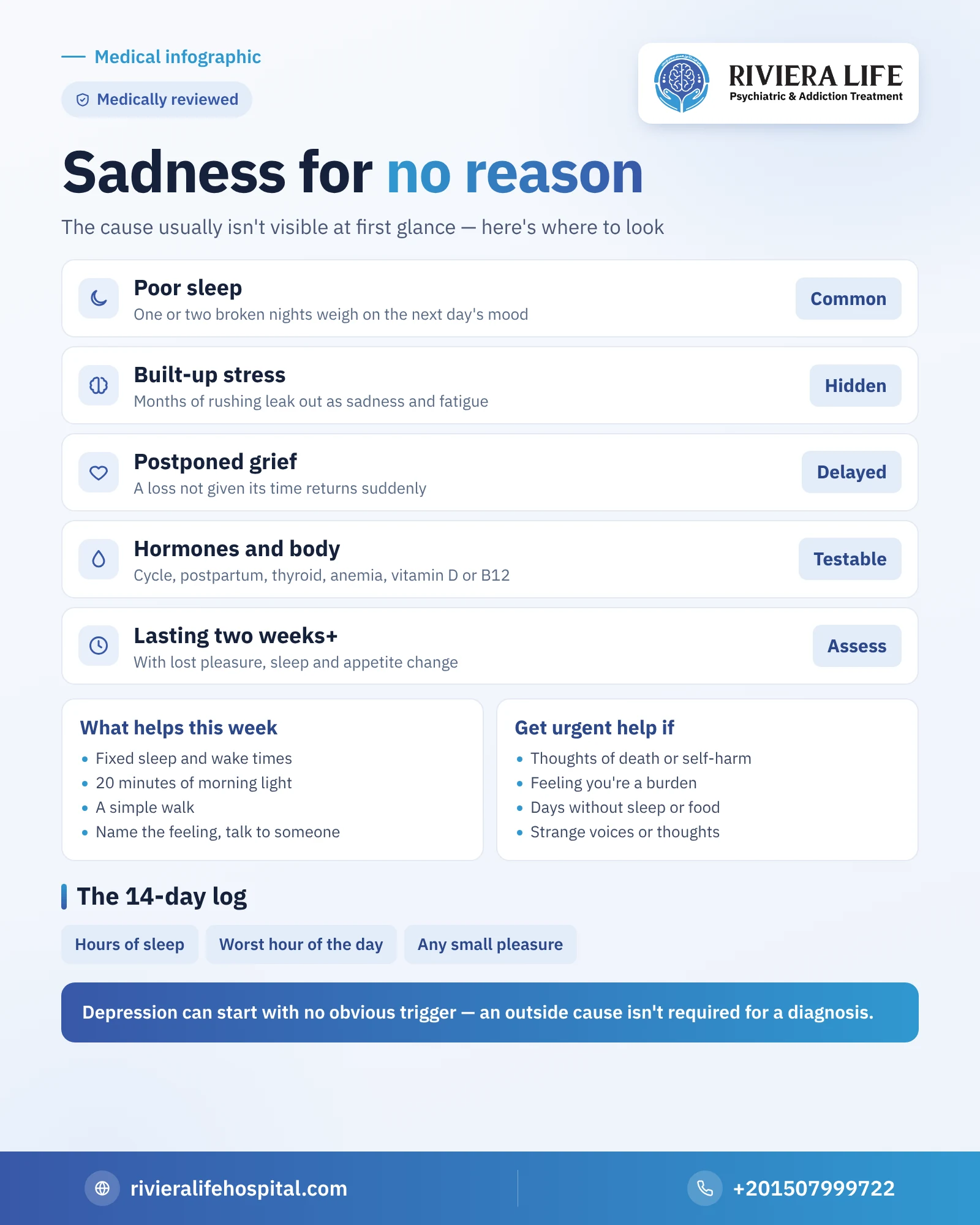
- Lack of sleep or disturbed sleep: one or two nights of broken sleep are enough to weigh down the next day’s mood.
- Accumulated pressure: it doesn’t explode in a moment but seeps out as sadness and exhaustion after months of rushing.
- Postponed grief: a death, a separation or a loss that wasn’t given its time comes back suddenly a year or more later, for no occasion.
- Hormonal changes: the days before a period, after childbirth, an underactive thyroid, and the years before menopause.
- Seasons and light: less sun in winter affects some people, as we explained in our article on seasonal depression.
- Hunger, little movement and too much screen time: small factors, but they add up.
- Substances: alcohol, hashish, stimulants and some medicines can lift mood temporarily and then drop it the next day.
Physical causes worth checking
Some physical conditions produce sadness and sluggishness that resemble depression: an underactive thyroid, anemia, low vitamin D or B12, blood sugar problems, and sleep apnea. Some medicines can also affect mood as a side effect. If the sadness is new for you and nothing explains it, a general medical check is a sensible step before any conclusion. That doesn’t mean the problem is necessarily physical, but these causes are easy to check and easy to treat.
Passing sadness, or the start of depression?
Sadness with no cause that is a few days old and improves with good sleep, an outing or a talk with a friend is usually a passing wave. But if it lasts most of the day on most days for two weeks or more, and comes with loss of pleasure, changes in sleep and appetite, difficulty concentrating, and a sense of guilt or worthlessness, it may be depression. For more detail on this difference, read our article on the difference between sadness and depression. Depression can start with no obvious cause, so the absence of a stressful event doesn’t mean it isn’t depression; an outside cause isn’t a condition for the diagnosis.
The fourteen-day test
Try this simple method. Each evening for two weeks, write three things on a single line: your hours of sleep, the worst hour of your day and when it came, and whether you enjoyed anything, even a little. After two weeks you will see a pattern: does mood worsen after nights of little sleep? Is it linked to a particular day of your cycle or to work? Has pleasure disappeared completely? This log eases the confusion, and if you see a doctor, it saves them a lot of time.
When does the sadness come? Its timing reveals a lot
Notice the hour at which the sadness peaks. Sadness that weighs on the morning and eases by evening is a recognized pattern in some forms of depression, and is worth mentioning to the doctor. Sadness that rises before working days or on Sunday evening is usually linked to work stress or anxiety, not necessarily depression. Sadness that increases a few days before a period and then disappears points to a hormonal effect. And sadness that rises after a night of alcohol or hashish is a natural rebound from the substance’s effect. Knowing the pattern doesn’t make a diagnosis, but it tells you which door to knock on first.
When anxiety is disguised as sadness
Sometimes the vague feeling of heaviness is suppressed anxiety rather than sadness: a constant inner tension, thoughts about the future that won’t settle, and then exhaustion from being on alert so much, which shows itself as sadness. The rough difference is that anxiety talks about “what if it happens”, while depression talks about “there’s no point in what happens”. The two can come together, and then it helps for the doctor to review the whole picture; you will find the full comparison in our article on the difference between depression and anxiety, and the signs of anxiety itself in the symptoms of anxiety.
The phone and comparison: a source of sadness we don’t notice
A person may spend half an hour scrolling through other people’s pictures — travel, success and beautiful homes — then put the phone down and feel a weight they can’t place. That doesn’t mean the phone causes depression, but comparing your ordinary day with other people’s best moments leaves a mark. Try noticing how you feel after scrolling rather than during it, and setting a time limit on some apps for a week to see the difference.
What eases sadness this week?
- Fix your sleep and wake times even if you sleep little, and avoid screens in the last hour.
- Get out into natural light for twenty minutes in the morning; it sets the internal clock.
- Move: a simple walk is better than nothing, even if you don’t feel like it.
- Put the feeling into words: “I’m sad” is better than “I’m not okay”, because naming it lowers its intensity.
- Talk to someone you trust, and don’t wait to find a “convincing reason” to justify talking.
- Cut down on caffeine, alcohol and substances, which increase mood swings.
- Don’t try to “think your way out” of the feeling for hours; over-analyzing usually prolongs sadness.
When should you ask for medical help?
See a psychiatrist if the sadness lasts two weeks or more, if it disrupts your work or relationships, if it comes with a feeling that life has no meaning, if it returns repeatedly with no explanation, or if you start turning to alcohol or sedatives to bear it. You can read when do you need a psychiatrist? to find out what the first visit looks like. A psychiatric assessment isn’t a declaration that you are ill, but a way of understanding what is happening.
Get urgent help immediately if you see
Call an ambulance on 123 or go to the nearest emergency department; you can also ask for guidance from the mental health hotline on 16328.
- Thoughts of death, self-harm or wanting to disappear
- A feeling that you are a burden on those around you and they would be better off without you
- Being unable to sleep or eat for several days with severe hopelessness
- Strange voices or thoughts you haven’t had before
If the person who is sad for no reason is close to you
Don’t ask them “why are you sad?” again and again; the answer “I don’t know” will hurt them more. Instead say: “I notice you’ve been tired lately — would you like me to sit with you?” Avoid minimizing, such as “you have everything”, because it adds guilt to the sadness. And suggest a small step together: a walk, a meal or an appointment with the doctor.
How can Riviera Life help you?
If sadness you can’t explain has worn you down, the consultant psychiatrists at Riviera Life in Sheikh Zayed will listen to you in a confidential session, examine the psychological and physical causes together, then map out your next step. The first consultation is free on +201507999722.
More from our depression guide
- Depression: the complete guide
- The difference between sadness and depression
- Psychological stress
- The symptoms of depression
Questions many people ask
There are usually causes that aren't obvious: lack of sleep, built-up stress, postponed grief or a hormonal change. And sometimes it can be the start of depression.
Not always. If it is passing and improves with sleep and rest, it is usually a wave; but if it lasts two weeks or more with loss of pleasure and changes in sleep and appetite, it deserves an assessment.
Yes. An underactive thyroid, low vitamin D or B12 and anemia can cause sluggishness and sadness. A simple blood test rules them out.
Steady your sleep, get out into light and movement, name your feeling, and talk to someone close. If it repeats or lasts, consult a specialist.
Yes. It can be linked to the premenstrual days, after childbirth, the years before menopause, or a thyroid disorder, and a doctor assesses this.