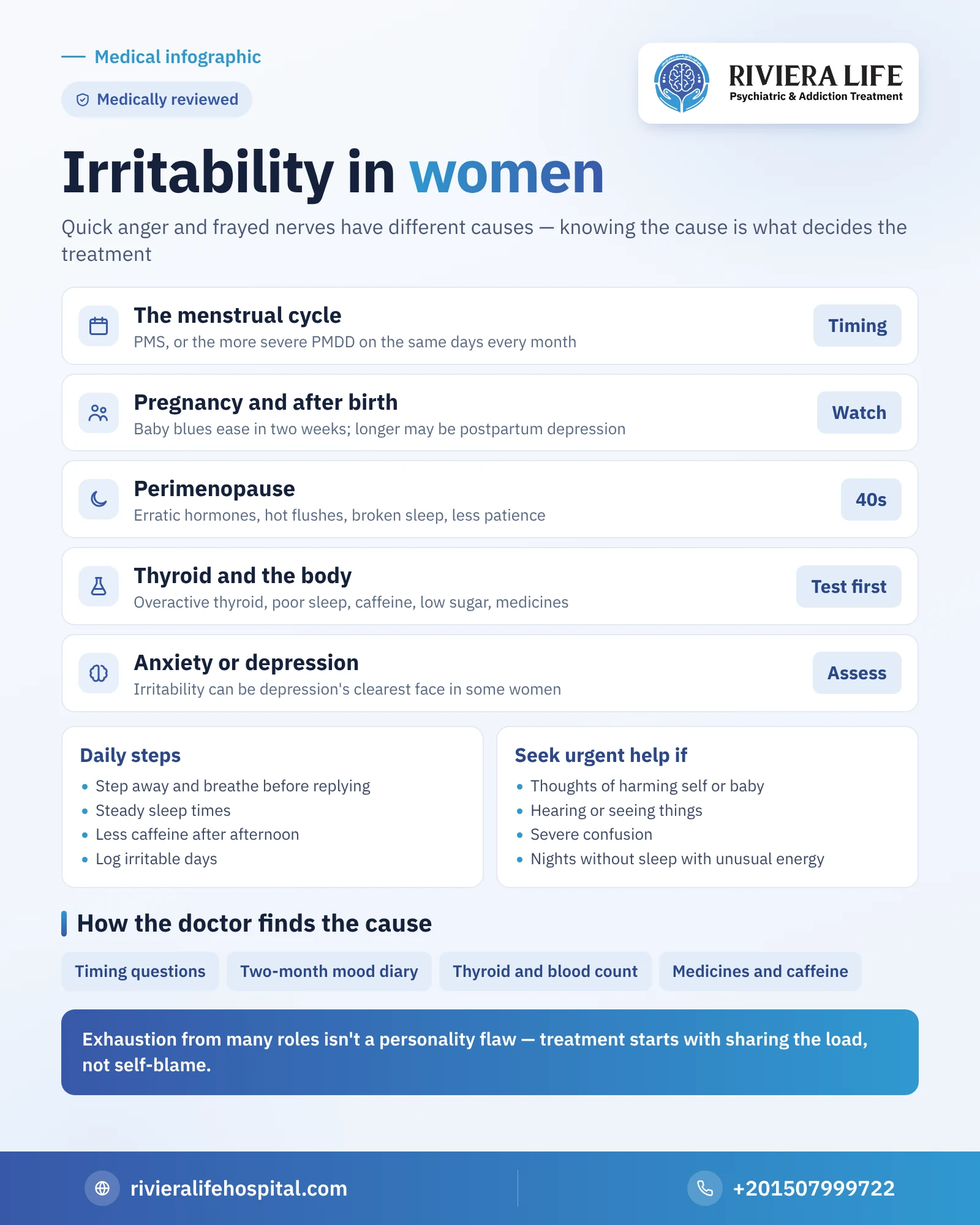
Excessive irritability in women means quick reactions and anger over small things, impatience with people and noise, and a feeling that the nerves are “stretched” most of the time. It isn’t a diagnosis in itself, but a sign with different causes: hormonal changes with the menstrual cycle, after giving birth or before menopause; a thyroid disorder; lack of sleep and accumulated stress; or anxiety and depression not yet diagnosed. Knowing the cause is what decides the treatment, which is why this article sets out the causes one by one, and explains when irritability is passing and when it deserves a visit to the doctor.
What is meant by excessive irritability in a woman?
Every woman gets angry sometimes, and that is normal. But irritability becomes “excessive” when the reaction is much bigger than the situation, repeats daily, or affects her relationship with her husband, children and work, followed by regret and a feeling that she is “not herself”. A woman may describe herself as on the verge of exploding all the time, or say that the noise of children and other people’s questions weigh on her unusually.
Irritability differs from anxiety even though they overlap: anxiety is fear and expecting the worst, while irritability is impatience, agitation and a short temper. To know what anxiety itself looks like, see the symptoms of anxiety.
Signs that irritability has gone beyond normal
- Repeated outbursts of anger over trivial things, followed by crying or regret.
- Headache, tension in the neck and shoulders, and teeth grinding.
- Difficulty sleeping or frequent waking, and morning exhaustion.
- Poor concentration and clear forgetfulness.
- Avoiding people and gatherings because being patient with them has become hard.
- A pattern that repeats on certain days of the month and then disappears.
The menstrual cycle: from premenstrual syndrome to the dysphoric disorder
A large proportion of women have mild to moderate symptoms in the days before their period, such as irritability, bloating, breast pain and food cravings, which calm down when bleeding starts or shortly after. This is premenstrual syndrome, and its cause is thought to be the brain’s sensitivity to the natural fluctuations in estrogen and progesterone and the accompanying change in serotonin.
Premenstrual dysphoric disorder is a more severe form affecting a smaller proportion of women: sharp anger, deep sadness or despair, and severe tension that disrupts work and relationships on the same days every month. The key to diagnosis is timing, which is why the doctor usually asks for symptoms to be recorded daily for at least two cycles.
Irritability during pregnancy and after giving birth
Pregnancy combines big hormonal changes with lack of sleep and worry about the baby, so irritability increases in many women. After birth most mothers go through what is known as the baby blues: crying, mood swings and irritability in the first days, which improve on their own within about two weeks.
But if symptoms last longer or intensify, with sadness, loss of pleasure and feelings of guilt or inability to care for the baby, it may be postpartum depression, a common and treatable condition that doesn’t mean the mother is failing. In rare cases postpartum psychosis appears, a genuine psychiatric emergency.
Seek urgent help immediately if you see
After giving birth or at any time, call an ambulance on 123 or go to the nearest emergency department without waiting.
- Thoughts of harming herself or the baby
- Hearing voices or seeing things others don’t
- Severe confusion or incoherent speech
- Barely sleeping for several nights with unusual energy and impulsivity
Perimenopause
In the years before menopause, usually in the forties, hormone levels fluctuate irregularly. Hot flushes and night sweats appear and break up sleep, and with that the ability to cope decreases. Many women notice irritability, mood swings and poor concentration in this stage without linking them to hormones. The good news is that these symptoms have several treatments that the gynecologist discusses according to each woman’s condition.
The thyroid and other physical causes
An overactive thyroid speeds up the whole body, showing as irritability, tension, palpitations, tremor, sweating and weight loss despite a good appetite. Thyroid disorders are more common in women and are revealed by a simple blood test, so it is advisable to check them before considering irritability a purely psychological problem.
Other physical causes include chronic sleep deprivation, too much caffeine, low blood sugar when meals are delayed, chronic pain and some medicines. Stopping some sedative or painkilling medicines suddenly may also cause severe irritability and needs medical follow-up.
Stress and multiple roles
A woman who works, cares for children and perhaps elderly parents, and carries most of the household burden lives in a constant state of alert. Over time her store of patience runs out, so she explodes at those closest to her. This exhaustion isn’t a personality weakness, but a natural result of pressure without rest, and its treatment starts with redistributing the load, not blaming herself.
Is irritability a sign of anxiety or depression?
Sometimes yes. Irritability is one of the known symptoms of generalized anxiety disorder, and in some women it may be the clearest face of depression instead of obvious sadness. Women are about twice as likely as men to develop anxiety disorders. If irritability is accompanied by persistent worry, loss of pleasure, or changes in sleep and appetite for weeks, a specialist psychological assessment is best. Learn more about anxiety disorders and depression. Less commonly, sharp swings between periods of high energy and lows are a sign of bipolar disorder.
Is irritability different in women and men?
Anger is one human feeling, but the triggers and expression differ. In women, hormonal fluctuations are linked to a monthly pattern or to life stages, while anger in men tends more toward outward impulsivity. Women are often more willing to seek help, but they postpone it a lot because they are busy caring for others.
How does the doctor determine the cause of irritability?
- Questions about when the symptoms began, their timing and their link to the cycle, birth or age.
- A daily diary of mood, sleep and the cycle for about two months.
- Blood tests according to the case, most importantly thyroid function and a blood count.
- A review of medicines, supplements, caffeine and any other substances.
- A psychological assessment for anxiety and depression and any stress or trauma.
Treating excessive irritability in women by cause
| Cause | What usually helps |
|---|---|
| Premenstrual syndrome | Regular sleep, exercise, less caffeine and salt, and medical follow-up if severe |
| Premenstrual dysphoric disorder | Psychotherapy, and the doctor may prescribe antidepressants or hormonal treatment |
| After giving birth | Family support with sleep and care, and psychological and medication treatment suitable for breastfeeding when needed |
| Perimenopause | Treating the physical symptoms with the gynecologist, and improving sleep |
| The thyroid | Treating the thyroid itself; irritability usually calms down with it |
| Anxiety or depression | Psychotherapy and medicine according to the psychiatrist’s assessment |
Cognitive behavioral therapy is one of the most useful psychological treatments here, because it teaches you to catch the moment before an outburst and deal with it. Medicines are only taken on a doctor’s prescription after assessment.
Daily steps that ease the intensity of reactions
- When you feel anger rising, step away from the situation for a few minutes and breathe slowly before replying.
- Keep sleep times as steady as possible, and ask your partner to share waking at night with the baby.
- Cut down on coffee, tea and energy drinks, especially after the afternoon.
- Move for half an hour on most days of the week, even just walking.
- Don’t delay meals for long hours.
- Record your irritable days; seeing the pattern eases self-blame and helps the doctor.
Stress and the menstrual cycle: a two-way relationship
The cycle is affected by stress because the glands that regulate female hormones are linked to the brain’s stress-response centers. Ovulation may be delayed in an exhausting month, so the period comes late, heavy or light, and it may be absent for months with severe stress or rapid weight loss.
The reverse is also true: an irregular cycle, pain and heavy bleeding tire the body and reduce sleep, so irritability increases and stress intensifies again. And so the cycle turns.
To tell passing stress from a problem that needs examination, watch for these signals:
- No period for three months in a row or more without pregnancy.
- Heavy bleeding that soaks pads quickly or lasts more than a week.
- Pain that stops you studying or working.
- Sharp mood swings before your period that disrupt your relationships.
In these cases the doctor usually requests thyroid, hormone and blood count tests before attributing it to stress. Recording the dates of your period and your mood daily for two or three months gives a clearer picture. You can also read about symptoms of depression in women and the hormonal stages if sadness stays with you alongside cycle changes.
How can Riviera Life help you?
If you feel that irritability is stealing your calm and your relationships, you can book a free first consultation with Riviera Life’s consultant psychiatrists in Sheikh Zayed, to assess the cause in complete confidentiality and set a plan that suits you, coordinating with your gynecologist or endocrinologist when needed. We are available around the clock: +201507999722.
Read also
- The causes of anxiety: psychological and physical factors
- The psychological and physical symptoms of depression
- Noradrenaline, stress and its effect on sleep and focus
- Anxiety treatment: psychotherapy and medicines
- Women’s addiction: why it is different and how a woman can start treatment confidentially
- Treating excessive irritability: hidden causes and steps to control anger
- Anxiety at bedtime: why it gets worse at night and how to calm your mind before sleep
- Exam anxiety: the symptoms, a study plan and steps for test day
Questions many people ask
Usually because of the brain's sensitivity to the cycle's hormonal fluctuations, which is premenstrual syndrome. If the symptoms are severe and disrupt your life every month, it may be premenstrual dysphoric disorder, which deserves a medical assessment.
It isn't an illness in itself, but a sign whose cause may be hormonal, physical or stress, and it may be part of anxiety or depression. A medical assessment is what determines the cause.
The doctor decides the tests according to the case; the best known are thyroid function and a blood count, along with a daily diary of mood and the cycle for about two months.
Mood swings, crying and irritability in the first days are common and improve within about two weeks. If they persist or intensify with sadness and loss of pleasure, they need assessment for postpartum depression.
Treatment follows the cause: it may need thyroid treatment, hormonal or psychological treatment, or antidepressants, and no medicines are used except on a doctor's prescription after assessment.