Nail biting is a habit that often starts as a passing movement in front of a screen or in the exam hall, then turns into an automatic act its owner only notices when he sees that the nail is short and sore. It is a very common behavior among children and teenagers and continues in some adults, and it isn’t a sign of weak character. Doctors place it among what are called body-focused repetitive behaviors, and in most cases it improves with simple behavioral training. In this article we explain the causes of nail biting, the harms many underestimate, and the practical steps to stop it in young and old.
What is nail biting and when does it become a problem?
Occasional biting is no cause for concern. The problem begins when it becomes repeated and happens without a decision, when it leaves a mark on the fingers and teeth, or causes embarrassment that makes you hide your hands. Doctors sometimes call it “onychophagia”.
Studies indicate that it affects a large proportion of children and teenagers, perhaps around a quarter or more at some ages, and then the proportion falls in adulthood. But those who keep it for years know it isn’t just “lack of attention”; the habit works through a mechanism similar to other repetitive habits: a feeling or situation calls it up, then an almost automatic act, then brief relief that makes the brain repeat it.
Causes of nail biting
There is no single cause. Usually more than one factor comes together, and their order differs from person to person.
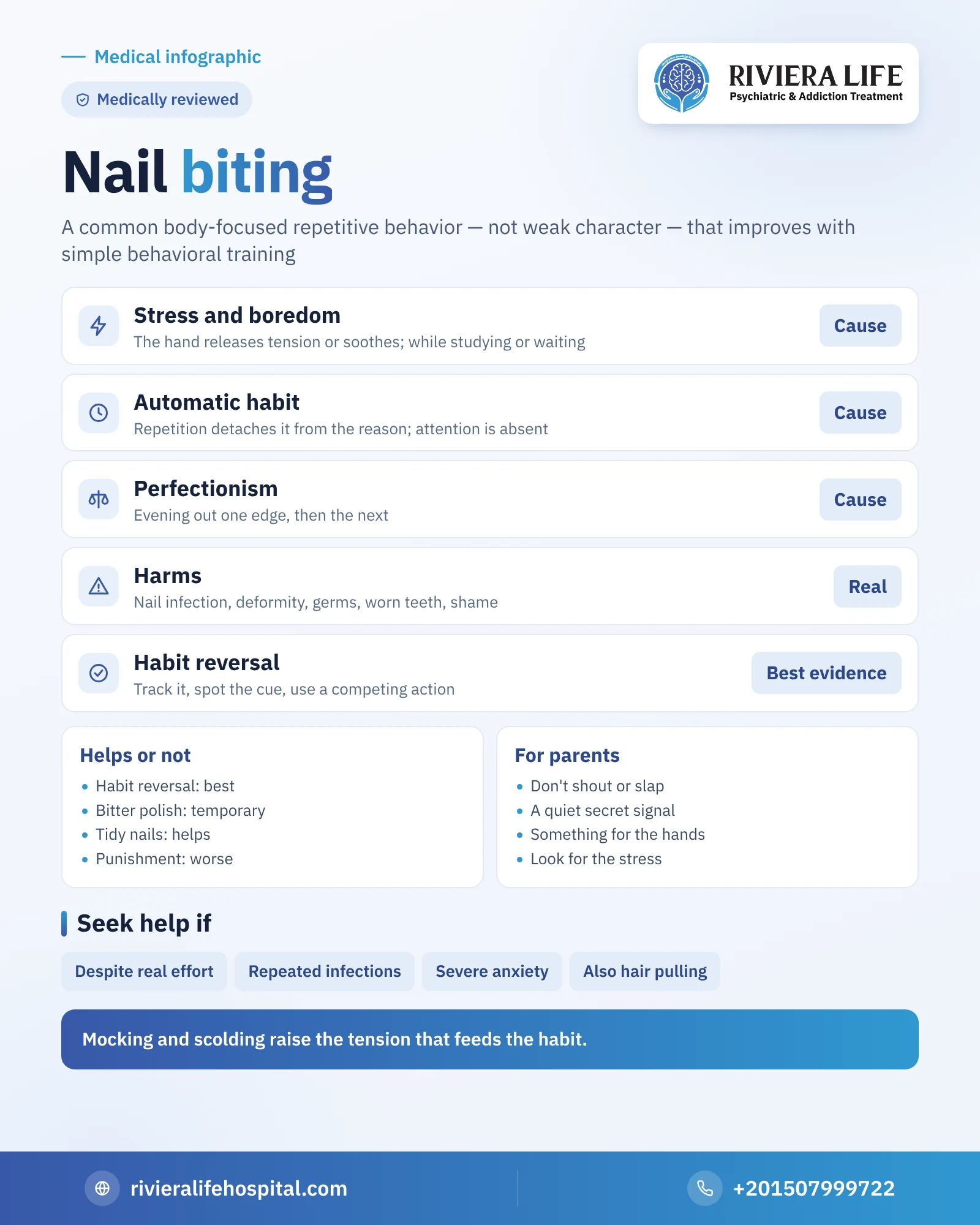
Stress and boredom
Some people bite their nails when anxious, and others when bored, waiting or concentrating hard. In both cases the hand serves to release excess energy or to self-soothe. That is why you see a student biting his nails while studying, and an employee during a long meeting.
An automatic habit that takes root with repetition
Over time the act becomes detached from the original cause. You may find yourself biting your nails while completely relaxed because the hand has got used to the way to the mouth. Here advice like “try to pay attention” fails, because the problem is that attention is absent in the first place.
Perfectionism and the feeling of an uneven nail
Some start biting to even out a small edge, then continue because the next edge is also uneven. This completing pattern resembles what happens in trichotillomania, where the feeling of imperfection drives more adjustment.
Anxiety, ADHD and heredity
Biting increases in those with anxiety symptoms or attention deficit hyperactivity disorder, and the habit recurs in some families, whether by heredity or by imitation. If one parent bites his nails, it is common for the child to do so as well.
Nail biting in children: when is it normal?
Many children bite their nails in periods of transition: starting school, the arrival of a new baby, disagreements at home, or exam pressure. The habit usually eases on its own when the situation calms.
It deserves follow-up if it continues for months, if blood and infection appear around the nail, if the child starts avoiding play and photos out of embarrassment about his hands, or if other signs come with it such as constant tension, insomnia and difficulty concentrating. In this case it helps to read about mental illness in children to understand when the behavior is part of a wider picture.
Harms of nail biting
The physical harms are real, and aren’t limited to the look of the nails:
- Infection around the nail: tearing the surrounding skin opens a door to bacteria and fungi, so the skin reddens, swells and hurts, and may need treatment with antibiotics.
- Nail deformity: permanent shortness, irregular edges, and sometimes lines and a change in shape if the growth area is damaged.
- Transfer of microbes: nails carry germs from everything we touch, and biting them transfers them to the mouth, and warts may spread from the fingers to the lip and face.
- Teeth and gums: repeated pressure may cause wear and tilting of the front teeth’s edges, and sometimes pain in the jaw joint.
- The psychological effect: embarrassment about the look of the hands, avoiding handshakes or photos, and a feeling of failure after every attempt to stop.
Most of these harms improve after stopping, but someone with repeated infection or a nail whose shape keeps changing should see a dermatologist.
Is nail biting OCD?
It isn’t an obsession in the usual sense, but it is close to it. Doctors classify severe biting among disorders related to OCD, because it is a repetitive behavior that is hard to stop. The difference is that an obsession is preceded by a worrying thought its owner tries to silence with a particular ritual, while biting is usually linked to a physical or emotional state or to automaticity. You can read our OCD guide to learn about the related disorders.
And if the person bites his nails and follows it with pulling hair or picking skin, he most likely has more than one behavior of this category, and deserves a specialist assessment.
How to stop nail biting: habit reversal training
The best studied method is habit reversal training, part of cognitive behavioral therapy. Its steps are simple but need patience:
- Track the habit: write down when and where you bite: while reading? in the car? in front of the TV? after an argument? You will be surprised that the habit has specific situations.
- Know the early cue: it may be a desire to even out an edge, raising the hand toward the mouth, or tension in the fingers. Catching this cue is half the treatment.
- Choose a competing action: instead of biting, gently clench your hand, put your palms under your thighs, or hold a small ball for about a minute until the urge calms.
- Change the environment: keep nails short and tidy, as protruding edges invite biting. And keep scissors or a file nearby.
- Reward yourself: celebrate every week without infection or obvious biting, and don’t punish yourself for a lapse.
What helps and what doesn’t
| Method | How useful | Note |
|---|---|---|
| Habit reversal training | The most scientifically supported | Can be started on your own in mild cases |
| Bitter nail polish | A temporary aid for some people | Doesn’t treat the cause, and its effect stops when you get used to it |
| Nail care and manicure | Helps many | A tidy nail reduces the urge to adjust |
| Tools to occupy the hands | Useful while studying and waiting | Rubber balls and spinning rings |
| Punishment, scolding and mockery | Make the problem worse | Raise the tension that feeds the habit |
For parents: how do you help your child without making the problem worse?
- Don’t shout or slap the hand every time you notice biting, and don’t comment on it in front of others.
- Agree with the child on a calm secret signal that alerts him when he bites without awareness.
- Give him something to occupy his hands while studying or watching TV.
- Look for the source of stress: bullying, study pressure, family disagreements, or fear of something.
- Take care of his nails with him, as a child who feels his hands are acceptable improves faster.
When should you ask for specialist help?
Ask for a medical or psychological assessment if biting continues despite serious attempts, causes repeated wounds and infections, comes with severe anxiety, persistent sadness or avoiding people, or goes together with hair pulling or skin picking. The psychiatrist assesses anxiety, depression and ADHD if present, and trains in the behavioral method, and only turns to medicines in specific cases and by the doctor’s decision alone, as the evidence for their benefit in this habit is limited.
How can Riviera Life help you?
At Riviera Life, psychiatry consultants assess the habit and the anxiety, tension or accompanying behaviors behind it, and set a suitable behavioral treatment plan for the child, teenager or adult, involving the family when needed. The first consultation is free and confidentiality is complete, and you can contact us on +201507999722 in Sheikh Zayed, Giza.
More from our repetitive behaviors and OCD guide
- OCD: the complete guide
- Trichotillomania: why the hand doesn’t stop
- Tourette syndrome and tic disorders
- Body dysmorphic disorder
Questions many people ask
The most common are stress, boredom and automatic habit, and it may increase with anxiety, ADHD and perfectionism, or by imitation within the family.
Many children bite their nails during periods of change and stress and the habit usually eases, but it deserves follow-up if it continues for months or causes infection or embarrassment.
Infection around the nail and its deformity, carrying germs to the mouth, wear of the tooth edges, and psychological distress about the look of the hands.
It may help some people temporarily, but it doesn't treat the cause, and habit reversal training remains the most scientifically supported method.
It isn't an obsession in the usual sense, but it is classified among related disorders called body-focused repetitive behaviors.