Postpartum depression is a real mood disorder that affects a not insignificant proportion of mothers during the first year after giving birth, and differs from the passing mood swings most women go through in the first days. Its main sign is sadness, emptiness or anxiety that lasts more than two weeks and disrupts the mother’s ability to care for herself and her baby. It isn’t evidence that she is a bad or weak mother, but a condition with clear biological and psychological causes that responds well to treatment. In this article we distinguish between baby blues, depression and psychosis, and explain the signs, risk factors, the father’s role and treatment options that take breastfeeding into account.
What is postpartum depression?
It is a depressive episode that begins during pregnancy or in the weeks and months after birth. The American diagnostic manual places this episode under the description “depression with peripartum onset”, setting its start during pregnancy or the first four weeks after delivery, but in practice doctors stay alert throughout the first year, because many cases appear late. Estimates indicate that roughly one in seven to ten mothers goes through it, and the real figure may be higher because many keep what they feel to themselves for fear of how others will see them.
Baby blues, depression and psychosis: three different conditions
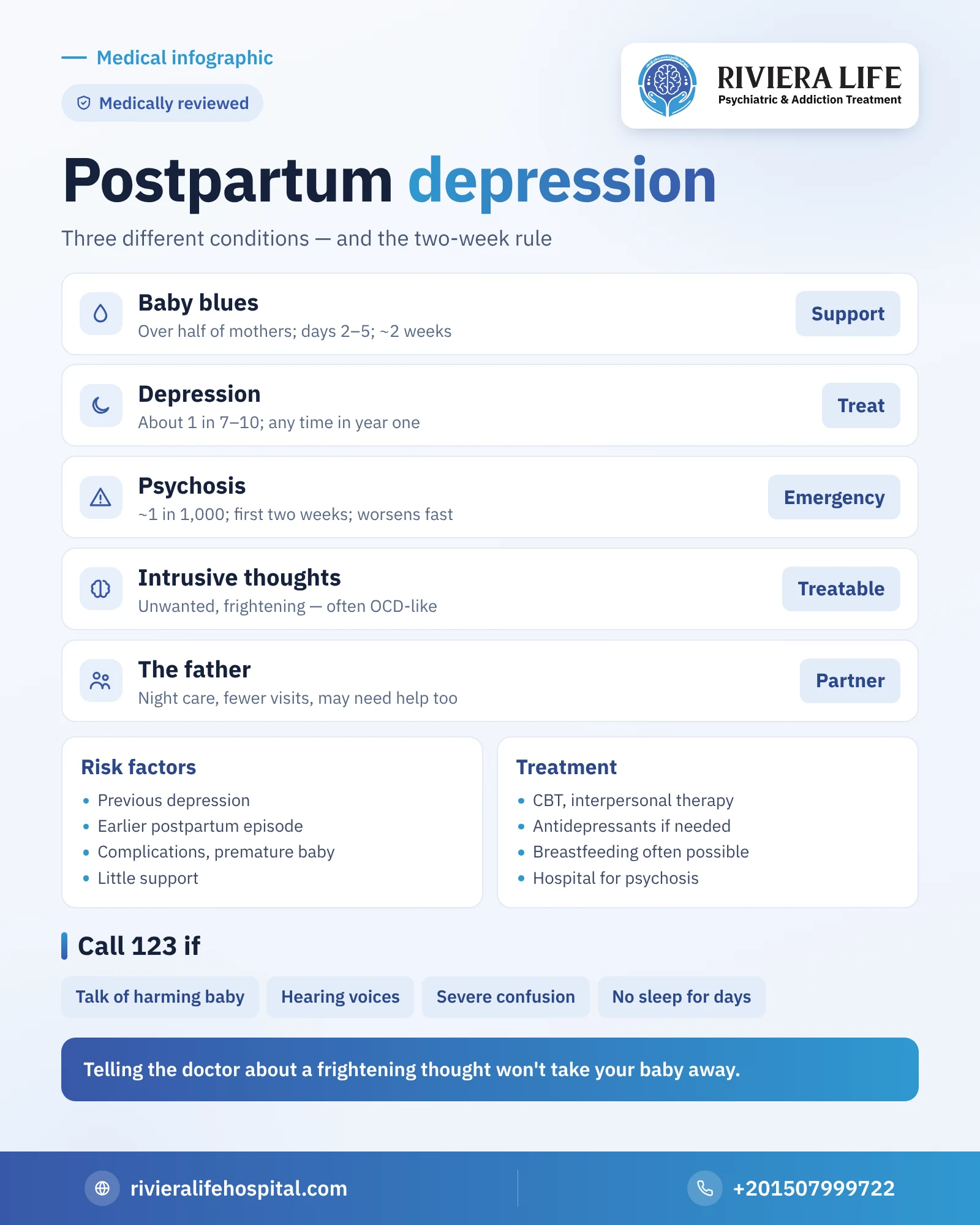
Families often confuse these conditions, and distinguishing between them is the first step in judging what the mother needs:
| Point of comparison | Baby blues | Postpartum depression | Postpartum psychosis |
|---|---|---|---|
| Prevalence | Very common, affecting roughly more than half of mothers | About one in seven to ten mothers | Rare, about one case per thousand births |
| Time of onset | Usually day two to five | Any time during the first year | Usually within the first two weeks |
| Duration | Goes away within about two weeks | Weeks or months without treatment | Worsens quickly |
| The picture | Crying, sensitivity and swings with moments of joy | Persistent sadness, loss of pleasure, guilt and helplessness | Hallucinations, strange thoughts and confusion |
| What it needs | Support, rest and sleep | Psychological assessment and treatment | Emergency care immediately |
The practical rule is simple: if the sadness goes beyond two weeks, or is severe from the start, it is no longer ordinary baby blues.
Postpartum psychosis: an emergency that can’t wait
Psychosis is a rare but serious condition in which the mother loses contact with reality within a few days. She may hear voices, or believe the baby isn’t hers, or is possessed, or in danger from a hidden force, or talk quickly and jump between thoughts, or seem confused not knowing where she is. The risk is higher in those with bipolar disorder or a previous psychotic episode after a birth. Despite its seriousness, most mothers recover completely with appropriate treatment in hospital.
Seek urgent help immediately if you see
Call an ambulance on 123 or go to the nearest emergency department, and don't leave the mother alone with the baby until a doctor assesses her.
- The mother talking about harming herself or her baby or feeling she might do so
- Her saying the baby or family would be better off without her
- Hearing voices or seeing things others don’t see
- Strange beliefs about the baby or about forces controlling her
- Severe confusion or not knowing the place and time
- Complete refusal to sleep for days with excessive activity or talking
You can also call the hotline of the General Secretariat of Mental Health and Addiction Treatment on 16328 or 0220816831.
Symptoms: what the mother feels and what those around her notice
Many mothers don’t describe what they are going through with the word “sadness”, but with sentences such as: “I feel I’m doing a duty, nothing more” or “I don’t feel anything towards my baby”. Among the signs that deserve attention:
- Sadness, crying or emptiness most of the day, or irritability unlike her usual nature.
- Loss of pleasure, and difficulty feeling bonded with the baby.
- Insomnia even when the baby sleeps, or excessive sleep and escaping to bed.
- Loss of appetite or eating without desire.
- An overwhelming feeling of guilt or failure: “I’m not a good mother”.
- Excessive worry about the baby’s health, or panic attacks.
- Withdrawing from visits and family, and avoiding answering the phone.
- Thoughts about death or about escaping everything.
A woman who seems calm and composed in front of guests may be collapsing once the door is closed, which is why calm, direct questions are worth more than observing from a distance. For the general picture of the disorder see the symptoms of depression.
Frightening thoughts about the baby: when are they obsessions?
Many mothers get sudden terrifying images, such as the baby falling from her hands or her harming it unintentionally. When these thoughts are completely unwanted and frightening to the mother, and push her to avoid holding the baby or to constantly check on it, they are usually obsessive thoughts that don’t mean a wish to harm, and may be part of depression or of obsessive-compulsive disorder that appears or intensifies after birth. Thoughts that seem logical to the mother, or that are accompanied by strange beliefs, on the other hand, are a sign of psychosis that calls for emergency care. In both cases, talking frankly with the doctor is the solution, and they won’t take the baby from you because you admitted a thought that frightens you.
Who is most at risk of postpartum depression?
There is no single cause, but factors that accumulate. The sharp fall in pregnancy hormones after birth plays a role in some women who are more sensitive to it, added to which is long sleep deprivation. Among the most important risk factors:
- A previous depressive or anxiety episode, or depression during the pregnancy itself.
- Depression after a previous birth, or a family history of mood disorders.
- An unplanned pregnancy, complications in pregnancy or birth, or premature birth.
- A baby who needs special care or an incubator.
- Marital disagreements or lack of support, or financial pressures.
- Using alcohol, drugs or medicines without supervision.
Having one or more factors doesn’t mean depression is inevitable, but it is a good reason for early follow-up. You will find a wider explanation of the general factors in the article on the causes of depression.
How are the baby and family affected?
A depressed mother loves her baby, but may lose the energy needed to connect with it: fewer looks, less talk, and a slower response to its crying. Research indicates that untreated depression for a long period may be linked to difficulties with feeding and sleep, and with the baby’s emotional and language development later. The reassuring news is that this effect isn’t fate; treating the mother early and having another warm person in the baby’s life protect it to a great extent. At the family level, tension between the spouses increases, and older children may feel they have temporarily lost their mother.
The father’s role: a partner in protection who may also need help
The father is usually the first to notice the change, and the one most able to help in practice: taking on night care so the mother can sleep for unbroken hours, reducing exhausting visits, and going with her to the doctor instead of saying “pull yourself together”. It is important that he avoids phrases of blame or comparison with other mothers.
And doctors don’t overlook that fathers themselves may develop depression after the baby arrives; some studies estimate it at roughly one father in ten, more if the wife is depressed. In men it usually appears as irritability, excessive preoccupation with work, withdrawal, or turning to late nights, smoking and sometimes drugs. Dealing with it seriously protects the whole family.
Treating postpartum depression
Treatment starts with an assessment by a psychiatrist, who rules out physical causes such as a thyroid disorder or anemia, and determines the severity and the presence of any dangerous thoughts. After that the options are graded according to the case:
- Psychotherapy: such as cognitive behavioral therapy and interpersonal therapy, both effective especially in mild and moderate cases.
- Antidepressant medicines: used in moderate and severe cases. The doctor chooses the type after weighing the benefit of treatment against the risks of leaving depression untreated.
- Newer treatments: the US Food and Drug Administration has approved medicines specifically for postpartum depression, but they aren’t available everywhere, and the doctor decides how suitable they are.
- Hospital admission: with psychosis, danger to the mother or baby, or her complete inability to care for herself.
Breastfeeding and medicines: what do you need to know?
What worries the mother most is the question: will I have to stop breastfeeding? In many cases, no. Some antidepressants have a long record of use during breastfeeding, and a tiny amount of them reaches the milk. But the choice remains the psychiatrist’s decision alone after knowing the medical history, the baby’s age and health and any other medicines, and the pediatrician may share in it. Don’t start a medicine on your own, and don’t stop a prescribed medicine suddenly without going back to your doctor. And if sleep deprivation is making your condition worse, mixed feeding with the father’s participation may be a solution the team discusses with you without a feeling of guilt.
When should you seek help?
Don’t wait until you collapse. Ask for an assessment if sadness or anxiety continues for more than two weeks, or if you feel you can’t care for your baby or yourself, or if frightening thoughts about the baby recur, or if you have a previous history of depression or bipolar disorder, in which case it is better to set a preventive plan before birth in the first place. You can start with the obstetrician or family doctor, who will refer you to the psychiatrist.
How does Riviera Life help you?
At Riviera Life, the consultant psychiatrists assess the mother’s condition in complete confidentiality, and set a plan that takes breastfeeding and family circumstances into account, involving the husband in family support sessions. And when a safe stay is needed, round-the-clock medical supervision is available. The first consultation is free on +201507999722; we are based in Sheikh Zayed, Giza.
More from the depression guide
- Depression: the complete guide
- Types of depression and medical classifications
- Depression treatment and the steps to recovery
- Seasonal depression: causes and treatment
Questions many people ask
It may start during pregnancy or at any time during the first year after birth, and appears most in the first months. So symptoms shouldn't be ignored because they appeared months after giving birth.
Mild baby blues go away within about two weeks, but depression may continue for months without treatment and affect the mother and baby. Early assessment shortens the suffering a lot.
No, the psychiatrist's aim is to help you and protect both mother and baby. Unwanted intrusive thoughts are common and treatable, and disclosing them is a first step towards improvement.
The likelihood is higher in those who had it after a previous birth, but it isn't inevitable. Setting a preventive plan with the doctor during the next pregnancy clearly reduces the risk.
By taking on part of the night care so she can sleep, reducing exhausting visits, listening without blame, and going with her to the doctor. And he must seek emergency care immediately if signs of psychosis or thoughts of harm appear.