The difference between depression and anxiety is that anxiety lives in the future and expects danger, while depression lives in heaviness and emptiness and sees no point. Anxiety raises alertness and puts the body on guard, and depression lowers it and makes the body slow. But the boundaries between them aren’t sharp: the two disorders often come together, and their symptoms are similar in sleep, concentration and irritability. Here we present the differences in a table, then explain the overlap, and how the doctor deals with both together.
Anxiety and depression in one sentence
Anxiety is fear of something that hasn’t happened yet: “What if I fail? What if I get ill?”. Depression is a feeling that what has happened or will happen has no value: “There’s no point, nothing will change”. The first pushes you to think, check and avoid, and the second pushes you to withdraw and switch off. This is a simplified sentence, because many people live both on the same day.
Comparison table
| Aspect | Anxiety | Depression |
|---|---|---|
| The main feeling | Fear, anticipation and tension | Sadness, emptiness or numbness |
| Direction of thinking | Towards the future: what if | Towards the self and the past: there’s no point and I’m a failure |
| The body | Palpitations, tremor, sweating and muscle tension | Heaviness, slowness and exhaustion |
| Sleep | Difficulty falling asleep because of thoughts | Early waking or oversleeping |
| Appetite | Usually decreases or is disturbed with tension | Clearly decreases or increases |
| Drive | Present but paralyzed by fear | Weak or absent |
| Behavior | Avoidance, checking and seeking reassurance | Withdrawal, slowness and neglect |
| Pleasure | Remains but is blocked by tension | Recedes in most activities |
This table is for illustration only, and doesn’t replace an assessment. Anxiety may appear with symptoms such as heaviness, and depression may appear with tension and irritability.
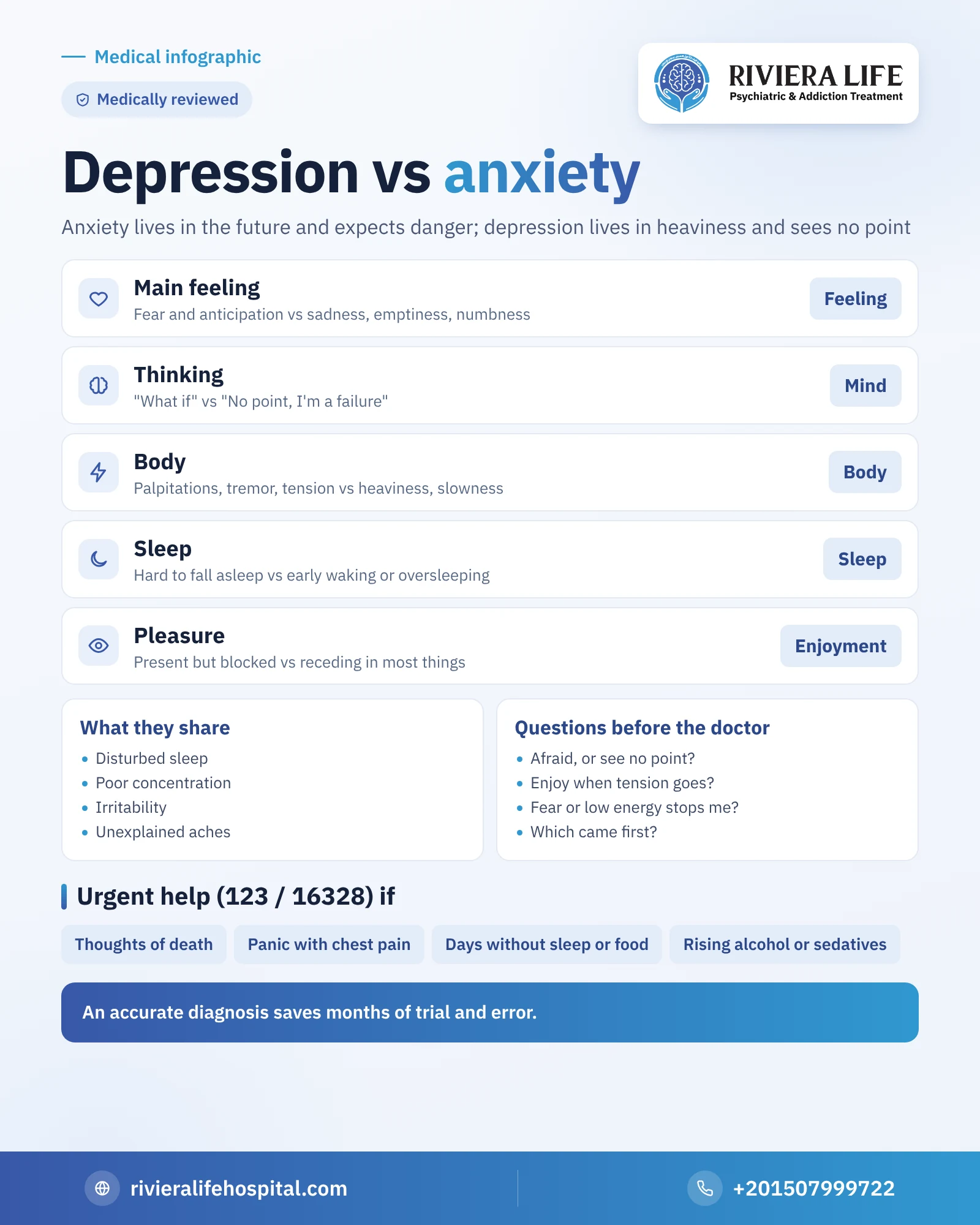
What do the two disorders share?
- Disturbed sleep, even if its form differs.
- Difficulty concentrating and absent-mindedness.
- Irritability, tightness in the chest and agitation.
- Exhaustion and unexplained body aches.
- Withdrawal from people, whether out of fear or switching off.
- Repetitive thinking that circles in the head, common in both.
That is why the doctor takes time asking questions before judging, and asks about the duration, which began first and the physical signs. For those confused between repetitive thinking and anxiety: overthinking.
When do they come together?
Anxiety and depression come together in a large proportion of patients, and often one precedes the other. Long anxiety may begin and drain the person until his mood collapses, or depression may begin and be followed by fears about the future, work and health. Doctors sometimes know it as anxious or mixed depression. Having both together doesn’t necessarily mean the illness is more severe, but it requires a plan covering both sides, and may need longer for its results to show.
Types of anxiety that come close to depression
Generalized anxiety disorder resembles depression more than others, because of exhaustion, lack of sleep and difficulty concentrating. Panic attacks differ in their sudden, violent nature and stay closer to anxiety, and depression may follow them as life is affected by fear of the next attack. You will find the full classification in types of anxiety, and on attacks in panic attacks. Similarly, OCD is often accompanied by depression, which we explained in OCD and depression.
Three scenes from life
The first scene: an employee spends the night imagining tomorrow’s meeting and what may be said in it, sweats before going in, then relaxes when it ends. This is a pattern of anxiety: fear precedes the event and goes when it goes. The second scene: a woman wakes at dawn and can’t sleep, says she sees no point in going to work, and enjoys nothing even on holiday. This is closer to depression. The third scene: a young man fears failing his studies so he avoids studying, then feels guilty and helpless so he withdraws from his friends, loses his appetite and says he is useless. Here anxiety began and depression followed, and both need follow-up.
Questions that help you tell them apart before seeing the doctor
- Am I afraid of something that will happen, or do I see no point in anything that happens?
- Do I still enjoy things when the tension goes, or do I not enjoy even when I rest?
- Does fear stop me doing things, or does switching off and low energy stop me?
- Do I stay up because my mind won’t stop, or do I wake early and can’t get back to sleep?
- Which began first, and which was stronger in the last two weeks?
Write your answers and keep a record for two weeks; it gives the doctor a clearer map than a general description.
Does treatment differ?
The overlap is wide in treatment too. Cognitive behavioral therapy helps in both, though the focus differs: gradual facing of fears in anxiety, and behavioral activation and modifying negative thoughts in depression. Some antidepressants, especially the selective serotonin reuptake inhibitor class, are used by doctors in both disorders together. Sedatives of the benzodiazepine class aren’t considered a treatment for depression, and may weigh down mood and cause dependence, which is discussed with the doctor. No medicine is started or stopped except under the doctor’s supervision. For details: medication for depression and anxiety, depression treatment and anxiety treatment.
Medical causes that imitate both
The thyroid is a clear example: overactivity causes palpitations, tremor and insomnia that resemble anxiety, and underactivity causes sluggishness, sadness and weight gain that resemble depression. The same goes for anemia, vitamin deficiencies, sugar disturbance, excessive caffeine, some medicines and stopping substances. That is why the doctor sometimes requests simple tests before settling on the psychiatric diagnosis or in parallel with it. And tests shouldn’t be a reason to delay assessment, as physical and psychological causes may exist together.
Common mistakes in understanding the two disorders
- “Anxiety is just nerves, and depression is just sadness”: both are disorders with criteria that improve with treatment.
- “Someone who laughs isn’t depressed”: many hide depression behind a social smile.
- “Apparent calm means no anxiety”: the affected person may fight his anxiety in long inner silence.
- “If I’m not sad, I’m not depressed”: depression may appear as numbness, irritability or exhaustion.
- “A sedative treats both”: sedatives may relieve anxiety for hours but don’t treat depression, and carry dependence risks.
Why does the difference between depression and anxiety matter?
A correct diagnosis makes the difference between a plan that treats part of the pain and a plan that treats all of it. Because someone being treated for “anxiety” who is really depressed may improve partly and the heaviness remains, and vice versa. And because some strategies help one and harm the other: repeated reassurance increases anxiety, while withdrawal and long rest increase depression. An accurate diagnosis saves months of trial and error.
Seek urgent help immediately if you see
Call an ambulance on 123 or go to the nearest emergency department, and you can seek guidance from the mental health hotline on 16328.
- Thoughts of death, self-harm or a wish to disappear
- A panic attack with severe chest pain or fainting, as you may need an urgent medical check
- Inability to sleep or eat for several days with despair or severe agitation
- Turning to alcohol, sedatives or substances in increasing amounts to cope
How can Riviera Life help you?
The psychiatry consultants at Riviera Life in Sheikh Zayed don’t settle for naming the symptoms, but go into their history and timing to determine whether it is anxiety, depression or both, then set a plan in complete confidentiality. The first consultation is free on +201507999722.
More from our depression guide
- Depression: the complete guide
- Anxiety: the complete guide
- Depression symptoms
- Anxiety symptoms
- GAD-7 anxiety test
Questions many people ask
Anxiety is fear and anticipation of what may happen, and depression is sadness or emptiness and a feeling that there's no point. The first raises alertness and the second lowers energy.
Yes, they often come together and one sometimes precedes the other. Having both together requires a plan that treats both sides.
Some antidepressants, such as the selective serotonin reuptake inhibitor class, are used by doctors in both disorders, and the doctor chooses what suits each case.
They may ease anxiety temporarily but don't treat depression, and may cause dependence. Their use is decided by the doctor only.
You can't be certain yourself, but writing down the symptoms, their timing and which came first helps the psychiatrist who makes the diagnosis.