The difference between strox and hash is bigger than it looks to someone seeing them from afar: a rolled joint, a smell that clings to clothes, and red eyes in both cases. But a family that has lived through one strox episode knows the result is completely different. Hash usually numbs and slows down, while strox may turn within minutes into agitation, seizures and hallucinations.
The reason is that it is a herbal mixture sprayed with manufactured chemicals whose concentration no one knows, while hash is a resin from the cannabis plant. This article compares them from the angle of what families notice and what the doctor sees in the emergency department, and takes apart the common ideas that push young people to move from the first to the second.
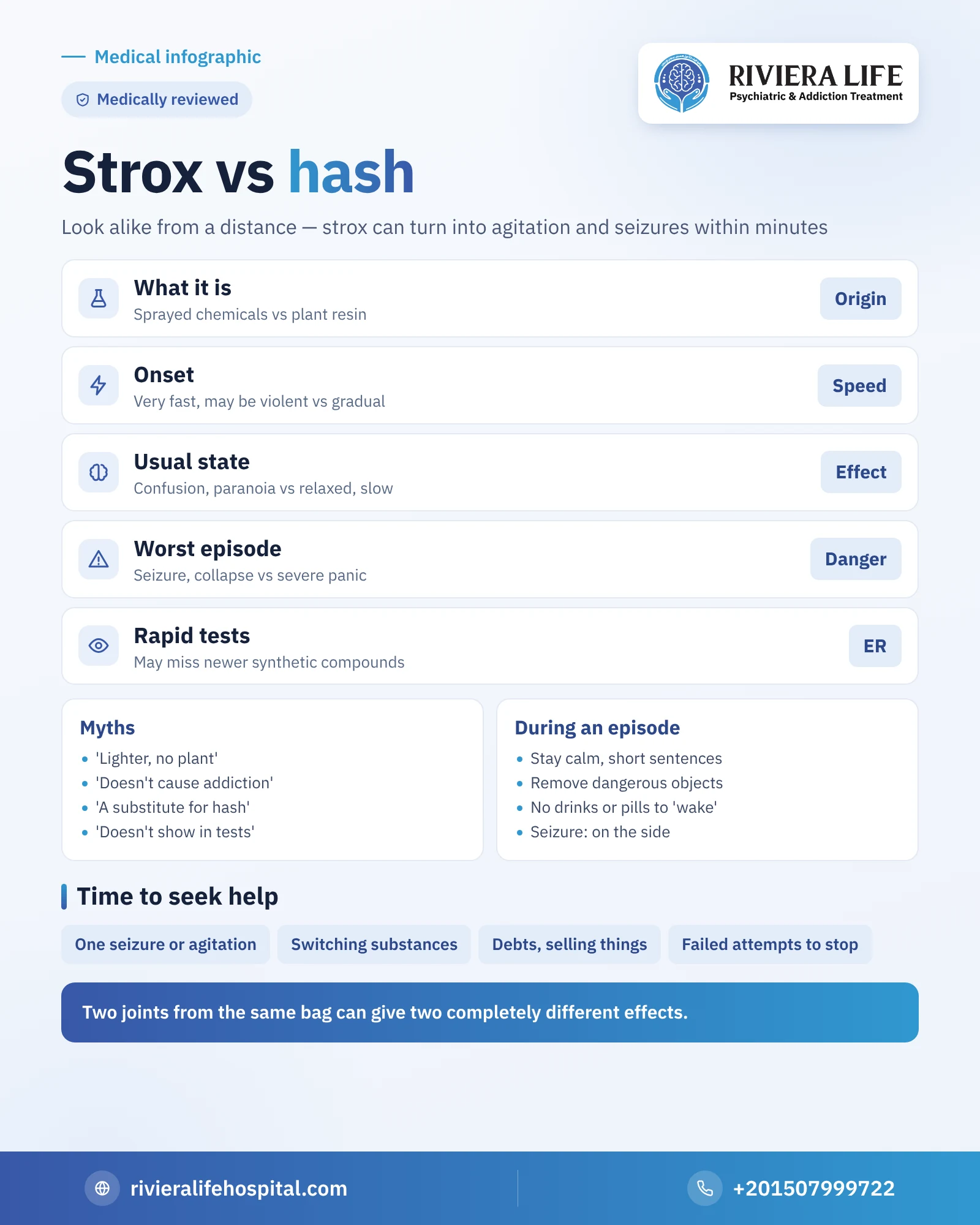
The difference between strox and hash in a table
| What those around notice | Strox | Hash |
|---|---|---|
| Appearance | Crumbled green or brown leaves, sometimes without a distinctive smell or with an artificial scent | A dark, hard or crumbled piece, and a known pungent smell |
| Onset of effect | Very fast and may be violent | More gradual after smoking |
| Usual state during the effect | Confusion, anxiety and suspicion, and sometimes agitation | Relaxation, laughter, slowness and absent-mindedness |
| Most dangerous episode | Seizure, loss of consciousness, hallucinations or aggression | Severe panic or suspicion, usually lighter |
| Duration of effect | May last long or rebound after it fades | Hours then drowsiness |
| Recognition when suspected | Families are often fooled because the symptoms change | Relatively clearer signs such as red eyes and increased appetite |
| Handling in the emergency department | Heart monitoring, seizure watch and kidney tests | Usually calming and observation |
| Withdrawal | Anxiety, palpitations, insomnia and sharp swings | Irritability, insomnia and poor appetite |
What does a strox episode look like compared with hash?
A young man coming home after a hash session is usually slow and sleepy, looks for food and sleeps. A young man back from a strox session may be confused, not knowing where he is, sweating heavily, speaking in broken words or shouting that someone is following him, and may suddenly collapse unconscious. This difference is the first thing families notice, and it explains why strox cases are so often taken by ambulance compared with hash. The strox guide page presents the full picture of the substance.
Why is strox considered less predictable?
Because what is in the bag isn’t one fixed substance. A chemical compound is dissolved in a solvent and sprayed on leaves, so it concentrates in some places and is sparse in others, and the compound itself changes from batch to batch. So two joints from the same bag may give two completely different effects. Hash also varies in concentration, but its ability to surprise is much smaller. If you want the scientific detail of the differences in composition and receptors, it is in the article on the difference between spice and hash, while here we focus on the picture the family and patient see.
Myths young people repeat
“Strox is lighter than hash because it has no plant”
The opposite is closer to the truth. The absence of the plant doesn’t mean the absence of effect, as manufactured substances may bind to receptors more strongly. You will find the harms in the article on the harms of strox.
“Strox doesn’t cause addiction”
It causes psychological dependence and may cause physical dependence, and many complain of urgent craving, anxiety and insomnia on stopping. The details are in strox withdrawal symptoms.
“It is a suitable substitute for someone who wants to quit hash”
This is the most dangerous myth. Someone who leaves a known substance for an unknown one doesn’t recover but swaps one problem for a more severe one. And the belief that it doesn’t show in tests changes nothing about the harm; the article on how long strox stays in the body explains what can be said scientifically without promises.
Harms to the heart, kidneys and mind
The harm of hash is concentrated in the lungs through smoking and in motivation, memory and mood, and it may trigger psychosis in those genetically predisposed. The harms of strox are wider and faster: a racing heart, high blood pressure and severe vomiting, seizures and disturbed kidney function in some of those affected, and acute psychosis that may continue after the substance has gone. Severe cases remain relatively rare but are documented in poison center reports, and no one knows in advance who will develop them. The details for hash are in the harms of hash.
Call an ambulance on 123 immediately if you see
After strox or hash; don't leave the person alone and don't try to control them by force.
- A seizure or loss of consciousness
- Severe agitation, hallucinations or aggression
- Chest pain or a very fast pulse
- Continuous vomiting, dehydration or little urine
- Severe confusion or inability to wake them
What does the family do during the episode?
- Stay calm and speak in a low voice and short sentences, and move away noise and crowds.
- Remove from the place everything that may hurt him or you, and don’t confront him or argue with him about his hallucinations.
- Don’t give him any medicine, stimulants or drinks thinking they will wake him, and call an ambulance.
- If a seizure happens, move hard objects away, put him on his side and don’t put anything in his mouth.
- Keep what he used if possible to show the medical team, as knowing the substance helps.
For those living with someone who uses these substances, the article on how to deal with a strox addict explains how to handle the daily situation.
How does the doctor tell them apart in the emergency department?
The doctor doesn’t rely on the name the patient says or the smell of the room. They ask about the timing and method of use and what accompanied it, check the pulse, blood pressure, temperature, consciousness and pupils, watch for seizures, and may ask for kidney, muscle and electrolyte tests. Most available rapid strips detect natural cannabis derivatives and don’t necessarily detect the renewed manufactured compounds, so the test may come back negative while the patient is in a real episode. That is why decisions are built on the clinical state, not the strip. And it is best for the family to say frankly what they know, as confidentiality is kept and the goal is to treat the person, not to hold them to account.
After the episode: the delayed effect
After a hash session most people move into drowsiness and then a near-normal state, and some slowness in concentration may remain for a day. After a severe strox episode, however, the person may suffer for days from insomnia, anxiety, palpitations and a feeling that things aren’t real, and suspicion and some delusions may remain in those with a psychological predisposition. And if the episodes repeat, mood becomes fragile and behavior erratic, so study and work are affected faster than happens with hash. This is one of the reasons doctors advise a full psychiatric assessment after any acute episode, rather than just resting at home.
Dependence and treatment
There is no approved medicine specific to hash or strox addiction. With strox, treatment starts with a careful assessment of the heart, kidneys and psychological state, then monitoring withdrawal and treating insomnia, anxiety and psychosis if present, then cognitive behavioral therapy and relapse prevention. With hash the steps are similar with a difference in severity. You will find both paths in strox addiction treatment and hash addiction treatment.
Signs that it is time to ask for help
- Sudden absence from home and work with sharp mood swings.
- An episode of confusion, seizure or agitation, even once.
- Moving from hash to strox or the reverse looking for a different effect.
- Repeated borrowing or selling things to buy the substance.
- Failed attempts to stop because of anxiety and insomnia.
Riviera Life assesses these cases with a team of consultants in psychiatry and addiction treatment, with round-the-clock medical supervision and complete confidentiality, and the first consultation is free on +201507999722 in Sheikh Zayed City, Giza.
More from the strox guide
- Strox: the complete guide
- The difference between spice and hash
- Strox addiction symptoms
- The causes of strox addiction
Questions many people ask
Hash is a resin from the cannabis plant, while strox is herbs sprayed with manufactured chemicals of unknown concentration, which is why its episodes are less predictable and usually more severe.
No. The absence of the plant doesn't mean safety, as its compounds may cause seizures, agitation, hallucinations and heart and kidney disturbance in some users.
Hash tends towards relaxation and slowness, while strox may cause confusion, suspicion, agitation or seizures, but these are signs for suspicion, not diagnosis, and the judgment belongs to the doctor.
Call an ambulance on 123, move hard objects away, put them on their side, don't put anything in their mouth and don't try to restrain them by force.
No, it is a move to an unknown, more dangerous substance. Whoever wants to quit needs a medical and psychological treatment plan supervised by specialists.