Misophonia, literally “hatred of sound”, is a condition in which a particular sound triggers a sharp emotional reaction out of proportion to its simplicity: sudden anger, disgust, bodily tension, and an urgent desire to escape or silence its source. The best-known irritating sounds are chewing food, the breathing of someone nearby, the clicking of a pen and the tapping of fingers. Those who suffer from it aren’t exaggerating or being spoiled; the irritation is real and starts in an instant, and may ruin an entire family meal. Here we explain what we know about it, what is still being researched, and how to ease its effect.
What is misophonia?
Researchers proposed the name about two decades ago to describe people who are distressed by certain sounds made by others, even though their hearing is normal. The problem isn’t the loudness of the sound, as the irritant may be a faint whisper such as the sound of licking lips. The problem is what the brain does with this sound: it links it to a strong alarm, so the body ignites in preparation to confront or flee.
It is important to say honestly that misophonia isn’t yet a recognized standalone diagnosis in the American diagnostic manual or the International Classification of Diseases, even though researchers have proposed criteria for it, and studies on its nature are ongoing. This doesn’t mean it isn’t real, but that knowledge about it is still forming, and that treatment methods are built on accumulated experience with related disorders.
What irritates people with misophonia?
Trigger sounds
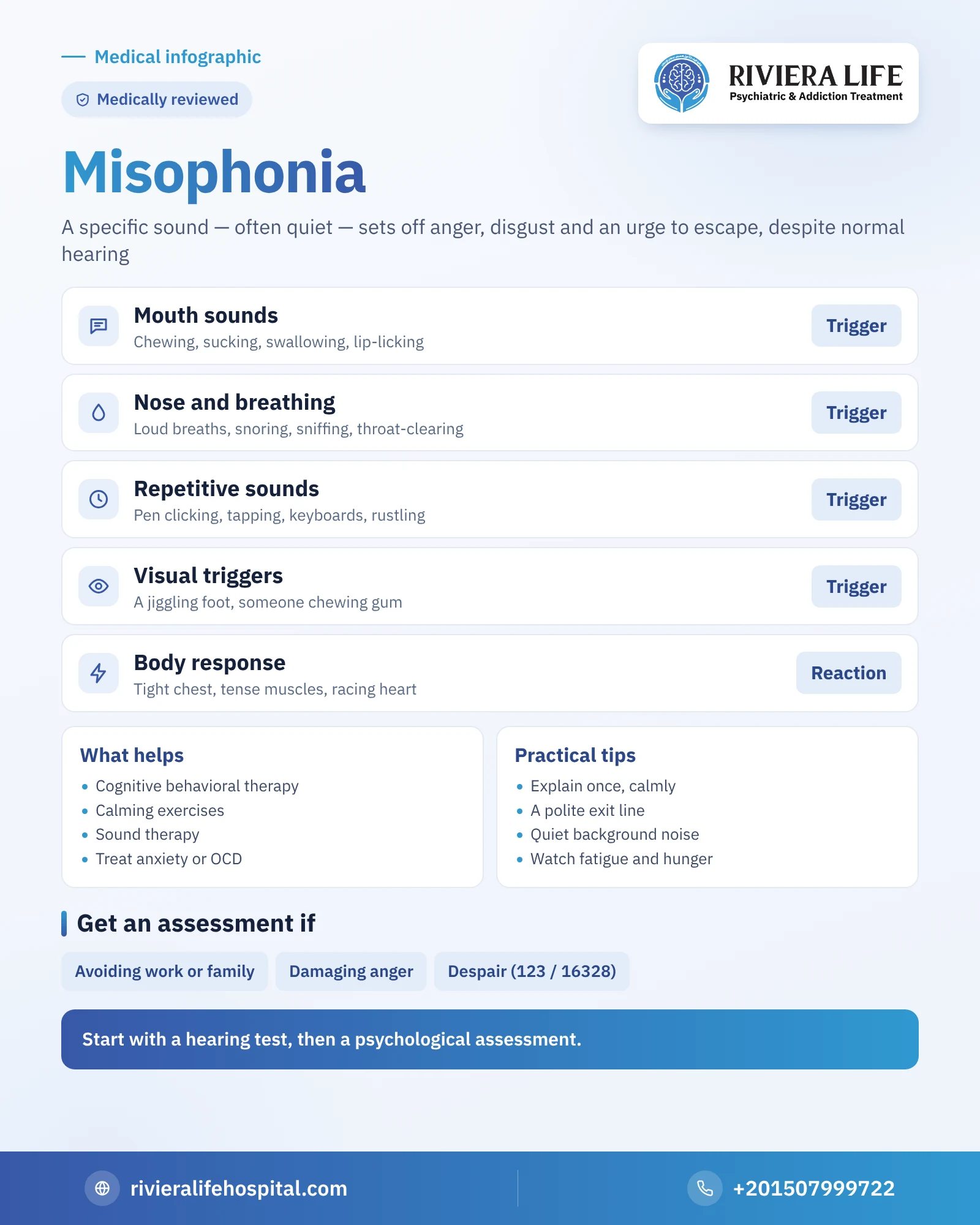
- Mouth sounds: chewing, sucking, swallowing, burping and licking.
- Nose and breathing sounds: loud inhaling, snoring, repeated coughing or throat-clearing.
- Repetitive movement sounds: tapping a pen or fingers, cracking joints, jiggling a leg, rustling bags, and the sound of typing on a keyboard.
Visual triggers
Some people are also irritated by particular sights, such as a foot jiggling or a person chewing gum in front of them, which is sometimes called movement sensitivity. Merely anticipating the sound or seeing the person who makes it may be enough for the reaction to start.
What does the experience feel like from the inside?
The response starts within seconds: the chest tightens, the muscles tense and the heart races, then comes a flood of thoughts: “stop”, “I can’t stand it”, “why doesn’t he notice me?”. The anger is sometimes preceded by a feeling of disgust and helplessness, and followed by guilt and embarrassment, so many cry, leave or explode and then regret it.
Life gradually turns into a series of avoidances: leaving the family table, preferring to eat alone, sitting far away in the office or on the bus, and wearing headphones all the time. A marriage may be affected when the partner feels they are the source of the irritation.
The difference from similar conditions
| Condition | What is the problem? | What distinguishes it |
|---|---|---|
| Misophonia | An emotional reaction to a specific sound | The sound is often quiet, and anger and disgust come first |
| Hyperacusis | Ordinary sounds seem loud and painful | The loudness itself bothers them, and they may feel pain in the ear |
| Phonophobia | Fear of certain sounds | Anxiety and fear are the basis, not anger |
| Tinnitus | Hearing a sound with no external source | The sound is internal and continues without a trigger |
Some people with misophonia also have other hearing problems, which is why it is advised to start with a hearing test by a specialist. Intense distress at a particular sight resembles what happens in trypophobia, but the latter is a visual phobia dominated by disgust, while misophonia centers on sound and carries clear anger.
Why does it happen? What we know and what we don’t
There is no confirmed cause. Brain imaging studies point to differences in the activity of areas responsible for attention, emotion and control when trigger sounds are heard, and there may be predispositions in families. The condition usually begins in late childhood or early adolescence, then may intensify over time if not treated. As for claims that it is “because of a strict mother” or “being spoiled”, there is no evidence for them.
In some people it occurs together with anxiety, obsessive-compulsive disorder, attention-deficit/hyperactivity disorder or the autism spectrum, all of which increase a person’s sensitivity to sensory stimuli. The irritation intensifies with psychological stress and lack of sleep, and eases with rest.
How can it be eased?
There is no approved medicine for misophonia. Treatment is based on reducing the response and improving coping, and the options include:
- Cognitive behavioral therapy: it re-examines the thoughts that accompany the sound and trains in calming the body and changing the reaction, and it has the most support from early studies. It is explained in our article on cognitive behavioral therapy.
- Calming exercises: slow breathing, muscle relaxation and directing attention to something else at the moment of the sound.
- Sound therapy: listening to light noise or calm music in the background, and, under the supervision of an audiologist, programs that train adaptation to sound.
- Treating accompanying problems: anxiety, obsessions and depression, for which the doctor may prescribe medicine, and the patient doesn’t start or stop it themselves.
Earplugs and noise headphones help temporarily in difficult situations, but relying on them completely and avoiding every situation may entrench the problem in the long term. The aim is balance: what comforts you now without shrinking your world.
At work, school and home
Misophonia appears in different forms depending on the place. In a shared office, a colleague who chews gum or taps their pen becomes a source of tension that drains concentration all day, so work is delayed and mood sours. At school a student may be unable to follow the lesson because of a nearby classmate’s sound, and is thought to be disruptive or rude, while they are actually resisting an urge to scream. At home the dining table is the first battleground: someone asks to eat in a separate room, and tension arises between siblings and spouses.
What helps in these places are simple agreed solutions: changing where you sit, accepting light headphones during office work, short breaks outside the room, and asking the teacher or manager for understanding without going into exhausting details. When those around understand that it isn’t a lack of respect, half the burden lifts.
Practical tips for the person affected
- Explain the matter to those around you once, calmly and outside a moment of emotion, and ask for specific solutions such as sitting a little further away.
- Prepare a polite exit for yourself: “I’ll get a glass of water” is better than exploding in front of everyone.
- Use calm background noise during meals or work.
- Watch what increases the irritation: tiredness, hunger and stress, and deal with what can be dealt with.
- Don’t judge yourself harshly after every situation; improvement comes gradually.
What do family and partners do?
Don’t accuse the person of exaggerating, and don’t make the sound deliberately to test them, as this hurts them and breaks trust. On the other hand, the person affected has no right to ask everyone to change their whole lives; the solution is a middle agreement that considers both sides. Affected children especially need patience: don’t scold your child for their reaction, help them name what they feel and ask permission to leave, then take them to a specialist if it recurs. You will find more in mental illness in children.
When do you need specialist help?
Ask for an assessment if you have started avoiding work, school or family because of sounds, if outbursts of anger appear that harm your relationships, or if it is accompanied by anxiety, depression and despairing thoughts. Start with a hearing test, then a psychological assessment. At Riviera Life, consultant psychiatrists listen to your complaint in complete confidentiality, and the first consultation is free. And if you have thoughts of self-harm, call an ambulance on 123 or the hotline on 16328 immediately.
More from our anxiety and sensitivity guide
- Anxiety: the complete guide
- Trypophobia: why clustered holes trigger disgust
- Psychological stress: its signs and effects
- Overthinking: the difference between rumination and worry
Questions many people ask
A condition in which a particular sound, such as chewing, breathing or tapping, triggers intense anger or disgust out of proportion to how simple the sound is, despite normal hearing.
It isn't yet a standalone diagnosis in the American diagnostic manual or the international classification, but it is a real condition researchers study, and it can be eased.
In hyperacusis ordinary sounds seem loud and painful, while in misophonia specific sounds trigger an emotional reaction even when they are quiet.
There is no approved medicine for it. Easing it relies on cognitive behavioral therapy, calming exercises and sound therapy, and treating anxiety or OCD if present.
They help temporarily in difficult situations, but relying on them and avoiding every situation may entrench the problem; it is better to combine them with a treatment plan.