Trichotillomania, or hair-pulling disorder, is a condition in which a person feels a repeated, hard-to-resist urge to pull out their hair, from the scalp, eyebrows, eyelashes or elsewhere, until clear gaps appear.
It isn’t a bad habit that can be stopped by a decision, nor a sign of weak will, but a recognized disorder that falls under what are called body-focused repetitive behaviors, and doctors classify it in the obsessive-compulsive spectrum. It usually begins in early adolescence, affects females more, and responds well to a specific behavioral treatment called habit reversal training. In this article we explain its signs, causes and treatment in children and adults.
What are body-focused repetitive behaviors?
They are a group of acts a person repeats on their body in a way that causes harm, and tries to stop again and again without success. The best known is hair pulling, along with severe nail biting and skin picking until it bleeds. These acts aren’t obsessions in the strict sense, as they aren’t usually preceded by a frightening thought, but by a physical feeling of tension, an “itch” or a need, followed by temporary relief after the act.
Some people have more than one behavior, so you find someone who pulls their hair and bites their nails together. What they all share is a repeating loop: tension, then the act, then relief, then shame and regret, then new tension.
Signs of trichotillomania
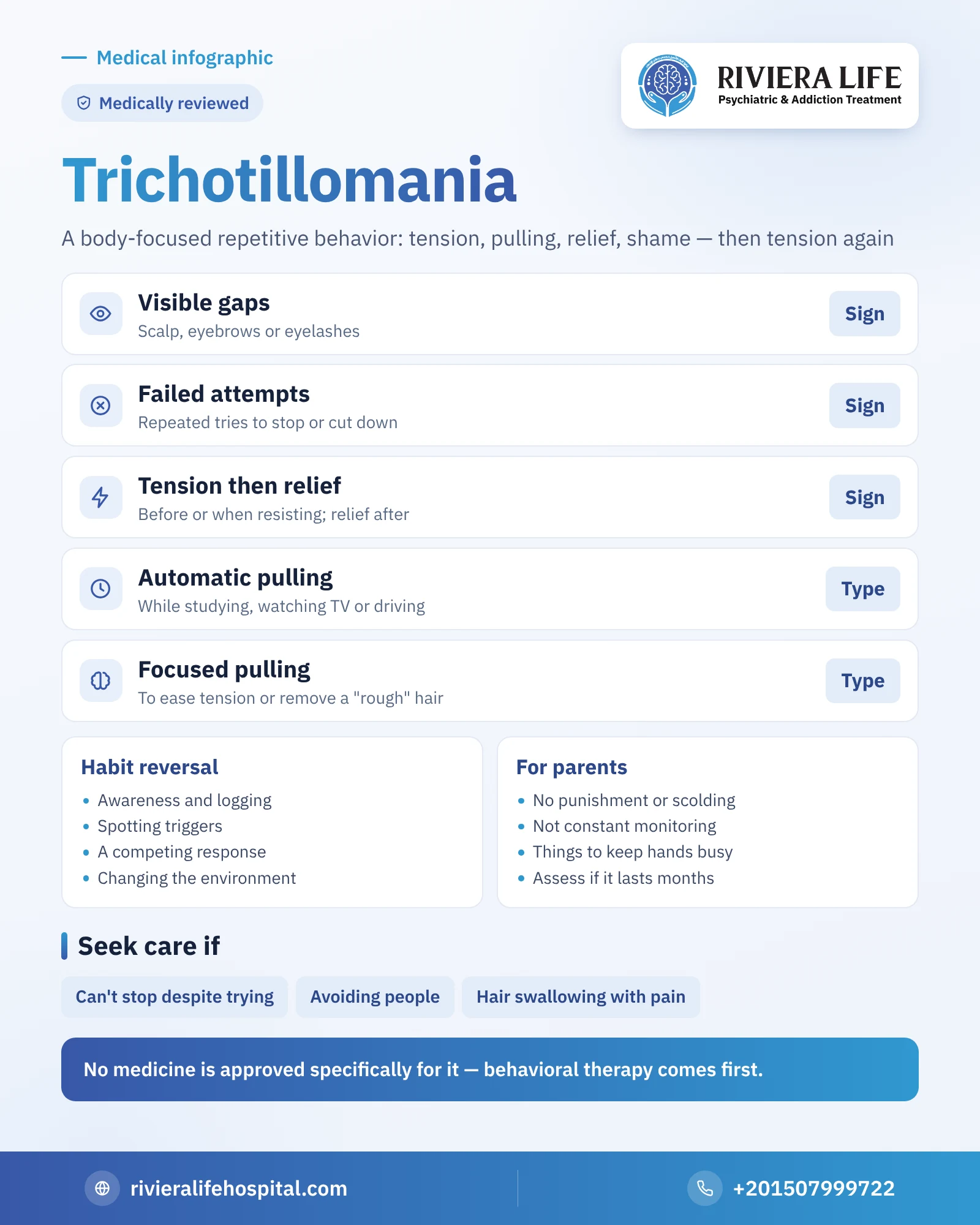
- Gaps or areas of thin hair on the head, usually on the side of the more-used hand.
- A clear loss in the eyebrows or eyelashes.
- Repeated attempts to stop or cut down without success.
- A feeling of tension before pulling, or while resisting the urge, and relief or pleasure afterwards.
- Rituals with the pulled hair: examining it, running it across the lips, biting it, and sometimes swallowing it.
- Hiding the problem with a headscarf, hats, haircuts or drawn-on eyebrows, and avoiding swimming pools and hairdressers.
- Clear distress or embarrassment, or effects on study, work and relationships.
Focused pulling and automatic pulling
Many describe two types: automatic pulling that happens without attention, while studying, watching television or driving, so the person suddenly discovers a pile of hair beside them. And focused pulling that the person intends, to relieve tension or get rid of a “rough” or “uneven” hair. Knowing your dominant pattern matters, because the treatment plan differs slightly between them.
Why does it happen? Causes and risk factors
No single cause is known, but research points to an overlap of several factors:
- Genetics: the disorder recurs in some families, and is more likely if a relative has OCD or a similar behavior.
- The brain: studies point to a role for the circuits that control habits and movement, and messengers such as serotonin and dopamine.
- Emotion regulation: many use pulling to calm anxiety, boredom or frustration, so over time it becomes an automatic way of soothing.
- Stress: exams, parents separating, bullying and moving to a new environment may trigger the onset or increase the severity.
- Age and sex: it usually begins between ten and thirteen, and is diagnosed more in females among adults.
Trichotillomania and the obsessive-compulsive spectrum
The American diagnostic manual places trichotillomania within the category of “obsessive-compulsive and related disorders”, because they share repetition and difficulty resisting. But the differences matter: in obsessive-compulsive disorder the compulsive act usually comes to extinguish a frightening thought, such as fear of contamination, and doesn’t bring pleasure. In hair pulling the drive is a physical sensation, and the act may be accompanied by a feeling of relief or even pleasure.
That is why traditional OCD treatment based on exposure and response prevention isn’t always enough; hair pulling needs a method designed for it. On the other hand, it differs from the motor tics of Tourette syndrome, even though some treatment methods are similar.
What isn’t trichotillomania
Before diagnosis the doctor rules out other causes of hair loss, such as alopecia areata, fungal infections of the scalp, thyroid problems and iron deficiency. They also distinguish it from ordinary hair removal for cosmetic reasons, or pulling in response to hallucinations or delusions in psychotic conditions. The dermatologist may use scalp examination with a dermatoscope, where hairs appear broken at different lengths.
Complications: more than just hair
- Permanent gaps if pulling is repeated from the same spot for years.
- Infections of the skin and follicles.
- Pain in the fingers and wrist from repetition.
- In those who swallow hair: a hairball in the stomach that may cause pain, vomiting and blockage, and needs urgent medical assessment.
- Isolation, embarrassment and low self-esteem, often accompanied by anxiety or depression.
Treatment: habit reversal training
The first recommended treatment is a cognitive behavioral method called habit reversal training, made up of steps the person learns with the therapist:
- Awareness: recording when, where and why pulling happens, and the sensation that precedes it.
- Monitoring triggers: knowing the risky situations, such as bed, studying or the mirror.
- A competing response: an act incompatible with pulling, such as clenching the fist or squeezing a rubber ball for a minute until the urge passes.
- Changing the environment: wearing light gloves or a plaster on the fingers, covering the hair, putting tweezers away, and dimming the light in front of the mirror.
- Support: someone close who encourages without criticism or irritating monitoring.
Acceptance and commitment therapy or dialectical behavior therapy is sometimes added to help the person tolerate the urge and difficult emotions without acting on them. You can read more about cognitive behavioral therapy.
Do medicines have a role?
There is no medicine approved specifically for trichotillomania, but the psychiatrist may turn to some medicines when it is accompanied by depression, anxiety or OCD, or when behavioral therapy alone isn’t enough, and their benefit varies. The decision here is the doctor’s alone after assessment, and no medicine is started or stopped without their follow-up.
Trichotillomania in children
In very young children pulling may appear temporarily and disappear on its own, especially if linked to a passing period of stress. In an older child or teenager, however, it needs attention. Advice for parents:
- Don’t punish, scold or slap the child’s hand, as this increases tension, pulling and hiding.
- Don’t turn it into constant monitoring; treat it as a problem you are solving together.
- Give the child things to keep their hands busy while studying and watching television.
- Watch for bullying at school, and talk to the school if needed.
- Seek an assessment from a child psychiatrist if it continues for more than a few months or clear gaps appear.
Trichotillomania in adults
Many adults have suffered in silence for years, and think they are alone. Seeking treatment is delayed because of embarrassment or the belief that it is an untreatable “habit”. The truth is that behavioral therapy works at different ages, and that temporary relapses during periods of stress are a normal part of recovery, not failure. Adults are also helped by treating the anxiety or depression that accompanies the condition, and by learning other ways to calm tension.
When should you ask for help?
Seek an assessment if you can’t stop despite trying, clear gaps appear, you start avoiding people and occasions, or the pulling is accompanied by persistent sadness or anxiety. And seek urgent medical care if you swallow hair and abdominal pain or repeated vomiting appears.
How can Riviera Life help you?
At Riviera Life, psychiatric consultants assess the pulling and what accompanies it, and set a behavioral treatment plan suited to the child or adult, involving the family when needed, in complete confidentiality. The first consultation is free, and you can get in touch on +201507999722.
Read also
- Obsessive-compulsive disorder
- OCD treatment
- Tourette syndrome and tic disorders
- Cognitive behavioral therapy
- Nail biting: its causes, harms and how to stop in children and adults
Questions many people ask
It is classified among the disorders related to OCD because it is repetitive and hard to resist, but it isn't OCD in the strict sense. The drive in it is a physical feeling of tension, not a frightening thought.
In most cases hair grows back after stopping, and may take months. But repeated pulling from the same spot for years may weaken the follicles and leave permanent gaps.
Pulling in young children is often temporary and disappears with time. Watch it without punishment, and consult a doctor if it continues for months or causes clear gaps.
It differs from person to person, and many start noticing improvement after weeks of regular habit reversal training. Temporary relapses are expected, and are dealt with by returning to the plan.
Yes, over time it may lead to a hairball forming in the stomach that causes pain, vomiting and blockage. Tell the doctor about it, and seek urgent care if abdominal pain appears.