Treating Tryptizol dependence means a medical plan to stop amitriptyline gradually in someone who has become used to it or misused it in search of sleep or numbness, together with treatment of the reason the medicine was started. The medicine doesn’t cause a high and isn’t classed among addictive substances in the usual sense, but stopping it suddenly after long use causes unpleasant symptoms, and an overdose is dangerous for the heart. This article is about dependence on the medicine and the steps to stopping safely; if you are looking for the medicine itself — its uses, the difference between Tryptizol 10 and 25, and its side effects — you will find it in our guide to Tryptizol.
More dangerous still, an overdose can be fatal because of its effect on the heart. In this article we explain when Tryptizol use turns into a problem, how to stop it safely under a doctor’s supervision, and when it becomes an emergency.
Does Tryptizol really cause addiction?
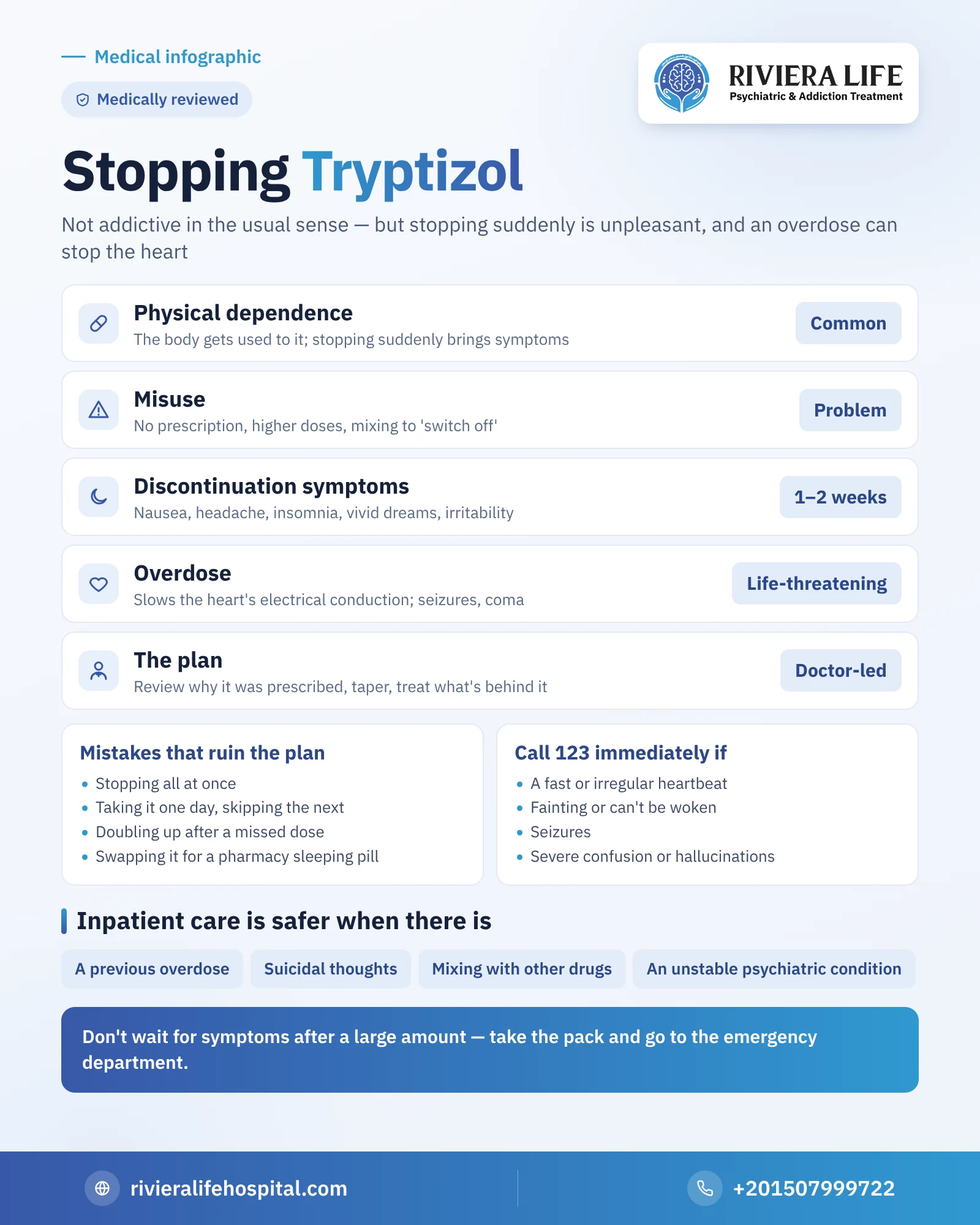
A precise answer needs three things to be distinguished. The first is physical dependence: the body gets used to the medicine after weeks or months, so if it is stopped suddenly, discontinuation symptoms appear. This happens with many psychiatric medicines and doesn’t mean the person is addicted.
The second is misuse: taking the medicine without a prescription, or at higher doses than prescribed, to switch off, to sleep at any cost, or to boost the effect of another substance. The third is a full substance use disorder, when someone loses control and continues despite the harm. This last picture is rare with Tryptizol alone, but it appears more in people with a history of other drugs or sedatives.
How does Tryptizol misuse begin?
The story we hear repeatedly in the clinic is simple: a young man with severe insomnia tries a tablet from a relative’s pack, sleeps heavily, goes back to it every night and then increases the amount when the effect weakens. There are other patterns we see in Egypt:
- Mixing it with tramadol, pregabalin or alcohol for a longer “heavy” feeling — a mix that multiplies sedation and danger.
- Using it to calm anxiety or sadness that has never been diagnosed, instead of seeing a psychiatrist.
- Staying on it for years after the reason for prescribing it has ended, without any review.
If the drug use includes tramadol, it is better to read tramadol addiction treatment, because the plan is different.
What are the symptoms of stopping Tryptizol suddenly?
Discontinuation symptoms usually appear within a few days of the last dose, and are clearer the higher the dose and the longer the use. The best-known include:
- Nausea, headache and a general feeling like flu.
- Insomnia and very vivid or disturbing dreams.
- Irritability, anxiety and mood swings.
- Dizziness, sweating and sometimes diarrhea.
These symptoms usually ease within about one to two weeks, and may last longer in some people. What matters is not to read a return of depression or the original pain as “withdrawal”; the doctor is the one who tells them apart. For the general picture of withdrawal from different substances, see drug withdrawal symptoms.
Why is a Tryptizol overdose so dangerous?
This is where the real problem lies. Tricyclic antidepressants, including amitriptyline, are among the most dangerous medicines when a large amount is taken, because they slow electrical conduction in the heart and can cause a fatal rhythm disturbance, as well as seizures, low blood pressure and coma. The situation may seem calm in the first hour and then deteriorate rapidly, which is why you don’t wait for symptoms to appear.
Call an ambulance immediately (123 in Egypt) if you see
After a large amount of Tryptizol, or mixing it with other substances, don't wait for any symptom — go to the emergency department straight away if you see:
- A fast or irregular heartbeat, or chest pain
- Fainting, or severe drowsiness that makes it hard to wake the person
- Seizures
- Slow or weak breathing
- Severe confusion or hallucinations with a dry mouth and dilated pupils
- Urinary retention with hot skin
Take the medicine pack with you to the emergency department, and tell the team the approximate time, the amount, and any other substances mixed in.
When does a Tryptizol user need specialist treatment?
Not everyone who takes Tryptizol needs an addiction treatment program. But a specialist assessment is necessary if one or more of these signs is present:
- They get the medicine from more than one pharmacy, or without a prescription.
- They raise the dose themselves, or take it during the day to escape reality.
- They mix it with drugs, sedatives or alcohol.
- They have tried to stop more than once and failed.
- They have taken a large amount before, or have had thoughts of harming themselves.
Steps to stopping Tryptizol safely
Reviewing the prescription and the reason for use
The doctor starts by understanding why the medicine was prescribed: depression, nerve pain, headaches or insomnia? And is the reason still there? Because stopping the medicine without treating the reason means it will come back quickly.
A gradual tapering plan
The doctor sets a schedule that reduces the dose in stages, and slows the pace if unpleasant symptoms appear. No single dose or duration suits everyone, which is why we don’t publish ready-made schedules; the plan is built on the current dose, the duration and the person’s health.
Treating what lies behind the medicine
If there is depression or anxiety, the doctor chooses the right alternative treatment; the details are in the best medication for depression and anxiety. And if insomnia is the driver, behavioral therapy for insomnia works better than any pill in the long term.
Follow-up after the last dose
Follow-up continues for weeks after stopping, to catch the return of the original symptoms early and to prevent a return to the medicine or its replacement with another substance.
Common mistakes that spoil the stopping plan
- Stopping all at once to prove willpower.
- Taking the medicine one day and skipping it the next, so the body swings between effect and discontinuation.
- Doubling the dose after forgetting one.
- Replacing it with a sleeping pill or painkiller from the pharmacy without advice.
- Combining it with medicines that raise serotonin without the doctor knowing, which can lead to serotonin syndrome.
Can you stop at home, or is a hospital stay needed?
Most people using Tryptizol at therapeutic doses can stop at home with a doctor’s plan and regular follow-up. An inpatient stay becomes the safer option in situations such as a previous overdose, suicidal thoughts, mixing it with other drugs that need to be withdrawn, or an unstable psychiatric condition. In these cases treatment is part of the dual diagnosis program, which treats addiction and mental illness together.
The family’s role while stopping Tryptizol
The family can do a lot without turning into watchdogs: keeping the medicine packs in a safe place and handing over only the daily dose if the doctor asks for this, going with the patient to appointments, and paying attention to any talk of hopelessness or wanting to die. That sign in particular can’t be put off, and calls for immediate contact with the doctor.
The right hospital for Tryptizol dependence: how to choose
The right hospital for treating Tryptizol dependence is one that understands the problem isn’t only the medicine but what drove someone to it, and that the heart risk in an overdose needs real medical readiness. Ask before you choose:
- Does the doctor assess why the medicine was prescribed in the first place before setting a stopping plan?
- Do they set an individual gradual tapering schedule instead of stopping suddenly?
- Is there a heart check and monitoring of vital signs for those who have taken large amounts?
- Do they treat accompanying depression, anxiety and insomnia at the same time?
- Do they deal with Tryptizol being mixed with tramadol, pregabalin or alcohol?
- Do they offer an assessment of self-harm risk and a clear safety plan?
And don’t trust any place that promises a guaranteed cure or an end to dependence within days.
Why Riviera Life for Tryptizol dependence treatment?
Here is how these standards are met at Riviera Life:
- Licensed by the Ministry of Health: a hospital licensed for psychiatry and addiction treatment.
- Consultants in psychiatry and addiction: they distinguish discontinuation symptoms from a return of the original depression or pain.
- Round-the-clock medical supervision: close monitoring for anyone who has taken a large amount or mixes the medicine with other substances.
- Individual gradual tapering: a stopping plan adjusted to each patient’s response.
- Fourteen years of experience: during which thousands of patients have recovered from drug and medicine addiction.
- Complete confidentiality: the patient’s data doesn’t leave the treating team.
- A family program and aftercare: to make the home safe and follow up after the last dose.
To stop Tryptizol safely, your first consultation is free; call at any time on +201507999722. We are based in Sheikh Zayed, Giza.
Read also
- Depression treatment: psychotherapy, medication and when you need hospital
- Serotonin syndrome and its danger signs
- Zolpidem addiction treatment and stopping sleeping pills
- The dual diagnosis program
- Tryptizol (amitriptyline): its uses, side effects and risks
Questions many people ask
Tryptizol doesn't cause a high and isn't an addictive substance in the usual sense, but the body gets used to it, so symptoms appear when it is stopped suddenly. The real problem begins when it is taken without a prescription, at higher doses or mixed with other substances.
They usually ease within about one to two weeks, and may last longer in people who used high doses for a long time. Gradual tapering on a doctor's plan makes them much milder.
Not necessarily. It may be a temporary discontinuation symptom, or a return of the original insomnia the medicine was prescribed for. The doctor tells the two apart and suggests treatment for insomnia that doesn't rely on pills.
It isn't advisable without medical supervision: combining them raises the risk of seizures, serotonin syndrome and heavy sedation. Anyone who mixes them regularly needs a specialist assessment.
Consultants in psychiatry and addiction, round-the-clock medical supervision, an individual gradual taper and treatment of accompanying depression and anxiety. Riviera Life in Sheikh Zayed offers these, and the first consultation is free.