Tryptizol is a brand name for amitriptyline, one of the oldest and most widely used tricyclic antidepressants. It is prescribed to treat depression, but many of the people who take it today don’t have depression at all: doctors prescribe it in low amounts for nerve pain, to prevent migraine, and sometimes for sleep problems.
And because it causes clear drowsiness, for some people it has become a “sleeping pill” taken without a prescription — and that is where the problems begin. In this article we explain its uses, its side effects, its danger to the heart in overdose, its interactions with alcohol and tramadol, and what older people need to know. We don’t give doses or instructions for use: starting, adjusting and stopping Tryptizol happen only with the doctor who prescribed it.
What is Tryptizol?
Amitriptyline is a medicine decades old, the classic example used in medical textbooks to explain the tricyclic family. Although newer medicines for depression have appeared, it hasn’t disappeared from prescriptions, because it has an advantage not all antidepressants have: proven effectiveness in easing some types of chronic pain. So you may find the same box in the hands of a patient with depression, a diabetic complaining of burning feet, and a woman suffering repeated migraine attacks.
Uses of Tryptizol
Depression
This is the original approved use, but it is usually no longer the first choice, and is kept for cases the doctor considers suitable, because its side effects are more numerous and its overdose more dangerous than modern antidepressants. We explain how the doctor chooses between classes in our article on choosing medication for depression and anxiety.
Nerve pain
Such as the nerve pain that accompanies diabetes, and the pain that remains after shingles. Smaller amounts than those used in depression are usually used here, set by the doctor.
Preventing migraine and tension headaches
It doesn’t stop a headache attack once it starts; it is used regularly to reduce the number and severity of attacks, at the neurologist’s discretion.
Insomnia
Because of its sedating effect, some doctors may prescribe it for sleep problems, especially when combined with pain or depression, but it isn’t a first-line treatment for insomnia, and behavioral treatment for insomnia remains the foundation.
Tryptizol 10 and Tryptizol 25: what’s the difference?
The number written next to the name is the amount of amitriptyline in a single tablet in milligrams, so the substance is the same in both and the difference is only in strength. So “Tryptizol 10” isn’t a milder medicine by nature, and “Tryptizol 25” isn’t a different medicine; the doctor chooses the strength that suits the reason for the prescription: low amounts are common in nerve pain and migraine prevention, while treating depression usually needs higher amounts that the doctor raises gradually.
The harms people ask about with Tryptizol 10 or 25 are the same in both cases, but they increase as the amount increases: drowsiness, dry mouth, constipation, weight gain and dizziness on standing. The real danger is taking many tablets at once, because its effect on the heart is linked to the total amount swallowed, not to the strength of the tablet. So don’t swap one strength for another, or add tablets together to reach a certain number, except on the doctor’s instructions.
How does Tryptizol work?
Amitriptyline prevents the reuptake of serotonin and noradrenaline in the brain, so their presence between nerve cells increases, and over time mood improves. The same pathways take part in “filtering” pain signals in the spinal cord, which explains part of its benefit in nerve pain. It also blocks histamine receptors, causing drowsiness, and blocks acetylcholine receptors, causing dry mouth and constipation. So the one medicine delivers both the benefit and the troublesome effects through the same door.
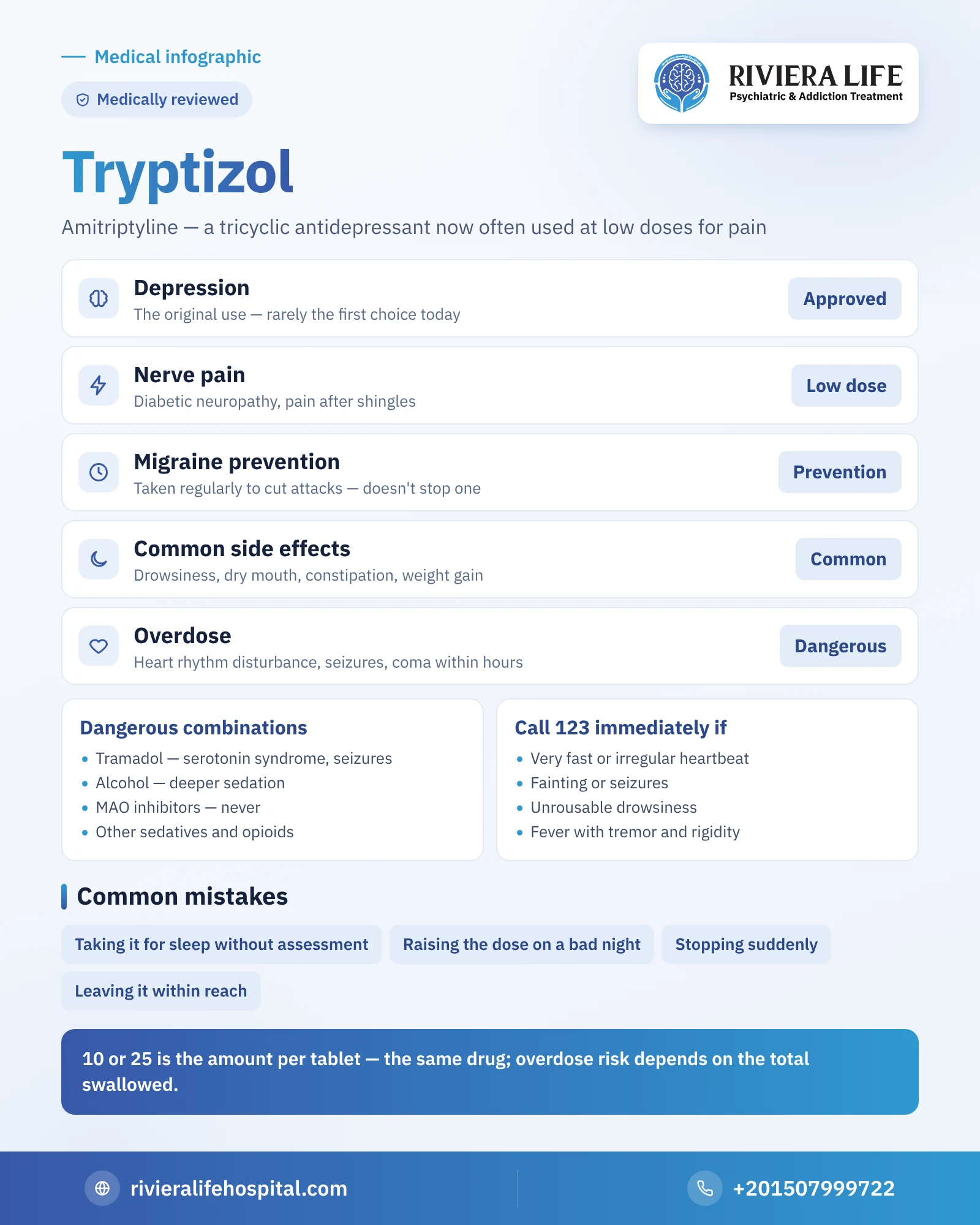
Common side effects of Tryptizol
- Drowsiness: the most common effect, and it may extend to the next morning at the start.
- Dry mouth: with an increased risk of tooth decay in the long term.
- Constipation: may be severe in some patients, especially older people.
- Weight gain: because of increased appetite, one of the things patients complain about most.
- Dizziness: especially on standing suddenly from a bed or chair.
- Others: blurred vision, difficulty urinating, sweating, a fast heartbeat, and effects on sexual function.
Many of these effects ease after weeks, and what continues, the patient discusses with their doctor. The patient shouldn’t drive or operate dangerous machinery before knowing how the medicine affects them.
Important warnings before using it
The doctor needs to know if you have heart disease or a rhythm disturbance, have had a recent heart attack, or have epilepsy, narrow-angle glaucoma, an enlarged prostate, liver disease, or a history of bipolar disorder. Like all antidepressants, it carries an official warning of increased suicidal thoughts in children, adolescents and young people up to roughly their mid-twenties, especially at the start of treatment. In pregnancy and breastfeeding, the doctor decides after weighing the benefits and risks; don’t stop the medicine suddenly if you discover you are pregnant, but contact the doctor immediately.
Tryptizol’s danger to the heart in overdose
This is the most dangerous thing about the medicine. Amitriptyline is one of the most toxic antidepressants when an excess amount is taken, because it disturbs heart rhythm, lowers blood pressure, and seizures and coma can occur within a few hours. The condition sometimes deteriorates quickly after a period in which the person seemed fine. That is why the medicine isn’t left within reach of children, or in the hands of someone going through an acute depressive crisis, and it is better for the family to keep the box during such periods. Poisoning is dealt with in the emergency department and intensive care, not at home.
Call an ambulance immediately on 123 if you see
After taking too much Tryptizol, or combining it with tramadol, alcohol or other medicines:
- A very fast or irregular heartbeat, or chest pain
- Fainting or a severe drop in blood pressure
- Seizures
- Deep drowsiness from which the person can’t be woken
- Confusion or hallucinations with dilated pupils
- A high temperature with tremor, rigidity and heavy sweating
Is Tryptizol a drug?
Tryptizol isn’t a drug in the usual sense: it is an antidepressant dispensed on prescription, and it doesn’t give the high or “buzz” that drug users look for. But the clear drowsiness and sedation it causes make some people think it is a sleeping pill or a mild drug, so they take it without a prescription or in large amounts — and that is where the danger begins: an overdose threatens the heart, and combining it with alcohol, tramadol or sedatives multiplies the danger to breathing and consciousness.
Why do some people misuse Tryptizol?
Amitriptyline doesn’t give a high like drugs do, but its sedating effect attracts some people: those looking for quick sleep without real treatment for insomnia, those trying to calm their anxiety themselves, and some who use other substances and use it to ease what they are going through — and this combination in particular multiplies the danger to the heart and breathing. Over time the person may find they can’t sleep without it, so they increase the amount themselves.
Here two things must be distinguished. Physical dependence means the body has adapted to the medicine, so discontinuation symptoms such as nausea, headache, malaise, disturbed sleep and irritability appear if it is stopped suddenly; this happens even with full adherence to the prescription, and is treated by gradual reduction. Misuse is a behavioral pattern: taking the medicine without medical need, in larger amounts, or with other substances. For anyone who has reached this stage, we explain the steps to stop safely and the treatment in our article on Tryptizol addiction treatment.
Tryptizol’s interactions with alcohol, tramadol and others
Alcohol
The two pile drowsiness on drowsiness, weakening concentration and balance, increasing the risk of falls and road accidents, and raising the danger of any overdose. We discuss the wider effect of alcohol in our article on the harmful effects of alcohol.
Tramadol
A widespread combination in Egypt, dangerous for two reasons: both raise serotonin, so serotonin syndrome may occur, and both lower the seizure threshold, increasing the likelihood of seizures. The details are in our article on serotonin syndrome and our article on the harmful effects of tramadol.
Other medicines
It is never combined with monoamine oxidase inhibitors. It needs caution with other antidepressants, triptan migraine medicines, sedatives, sleeping pills and opioids, sedating antihistamines, and medicines that affect heart rhythm. So show your full list of medicines to the doctor and pharmacist, including cold remedies and herbs.
Tryptizol and older people
Older people are more sensitive to the effects of amitriptyline, and medical sources usually advise avoiding it in them, or using it with great caution when safer alternatives are available. Drowsiness and dizziness can end in a fall and a broken hip, and the medicine can cause mental confusion that resembles or worsens dementia, urine retention especially with an enlarged prostate, severe constipation, as well as its effect on the heart. If the family notices that an older person has become more confused or unsteady after starting the medicine, that is information the doctor needs immediately.
Patients’ experiences with Tryptizol: what happens in the first weeks?
Most people who take Tryptizol for nerve pain or migraine start with a small amount at night, and the first thing they usually notice is drowsiness, which may extend into the morning as heaviness and difficulty waking during the first days. Dry mouth and constipation are also common, and some notice an increase in appetite and weight over time.
The benefit doesn’t come with the first tablet: easing nerve pain or reducing headache attacks usually needs weeks of regular use before it can be judged. That is why some patients stop early, believing it has no effect, while the doctor sees that it is still too early to judge.
The experiences written online differ because some of their authors take it for depression in higher amounts, so its side effects are more obvious. If morning drowsiness persists, or palpitations or severe dizziness on standing appear, the solution is to see the doctor, not to change the amount yourself.
Common mistakes with Tryptizol
- Taking it for sleep on a relative’s advice without assessing the cause of the insomnia.
- Increasing the amount on a difficult night without going back to the doctor.
- Combining it with tramadol or alcohol.
- Stopping it suddenly, then thinking the discontinuation symptoms prove the medicine is “addictive”.
- Leaving the box within reach of children or someone going through a psychological crisis.
How can Riviera Life help you?
If Tryptizol has become the only way you can sleep, or you take it without a prescription or with other substances, the first consultation at Riviera Life is free and confidential. A consultant psychiatrist assesses the real cause behind the insomnia, anxiety or pain, and sets a safe plan to adjust the medicine, with round-the-clock medical supervision if the case needs it.
More from our psychiatric medicines guide
- Depression: the complete guide
- Tryptizol addiction treatment
- Anafranil (clomipramine): uses and warnings
- Choosing medication for depression and anxiety
- Imipramine (Tofranil): depression, panic and bedwetting in children
- Nortriptyline (Motival): depression, nerve pain and warnings
- Doxepin: drowsiness, depression, overdose risk and warnings
- Maprotiline (Ludiomil): depression, seizure risk and warnings
Questions many people ask
It isn't originally a sleeping pill but an antidepressant, though drowsiness is one of its most prominent effects. It is only used for sleep if the doctor decides so after assessing the cause of the insomnia.
It can increase appetite and weight in many patients. The doctor can suggest solutions or alternatives if the gain becomes a problem.
It doesn't produce a high and isn't classed among substances that cause classic addiction, but stopping it suddenly can cause discontinuation symptoms, and some people misuse it for its sedating effect.
This combination is dangerous because it can cause serotonin syndrome and increases the likelihood of seizures. Don't combine them unless the doctor decides so knowing all your medicines.
Older people are more prone to dizziness, falls, confusion and urine retention with it, so doctors often prefer other alternatives or use it cautiously with close follow-up.