The short answer
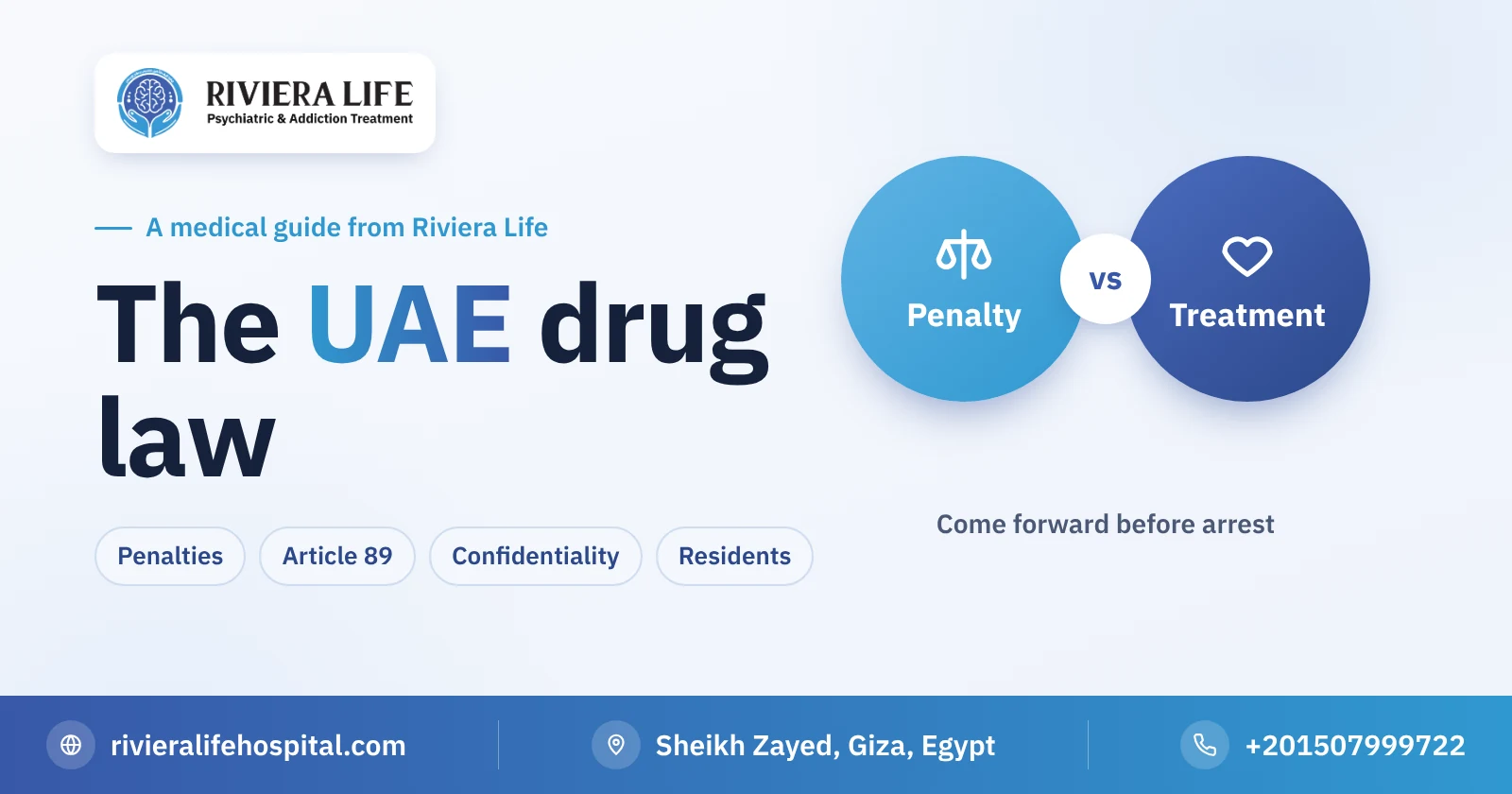
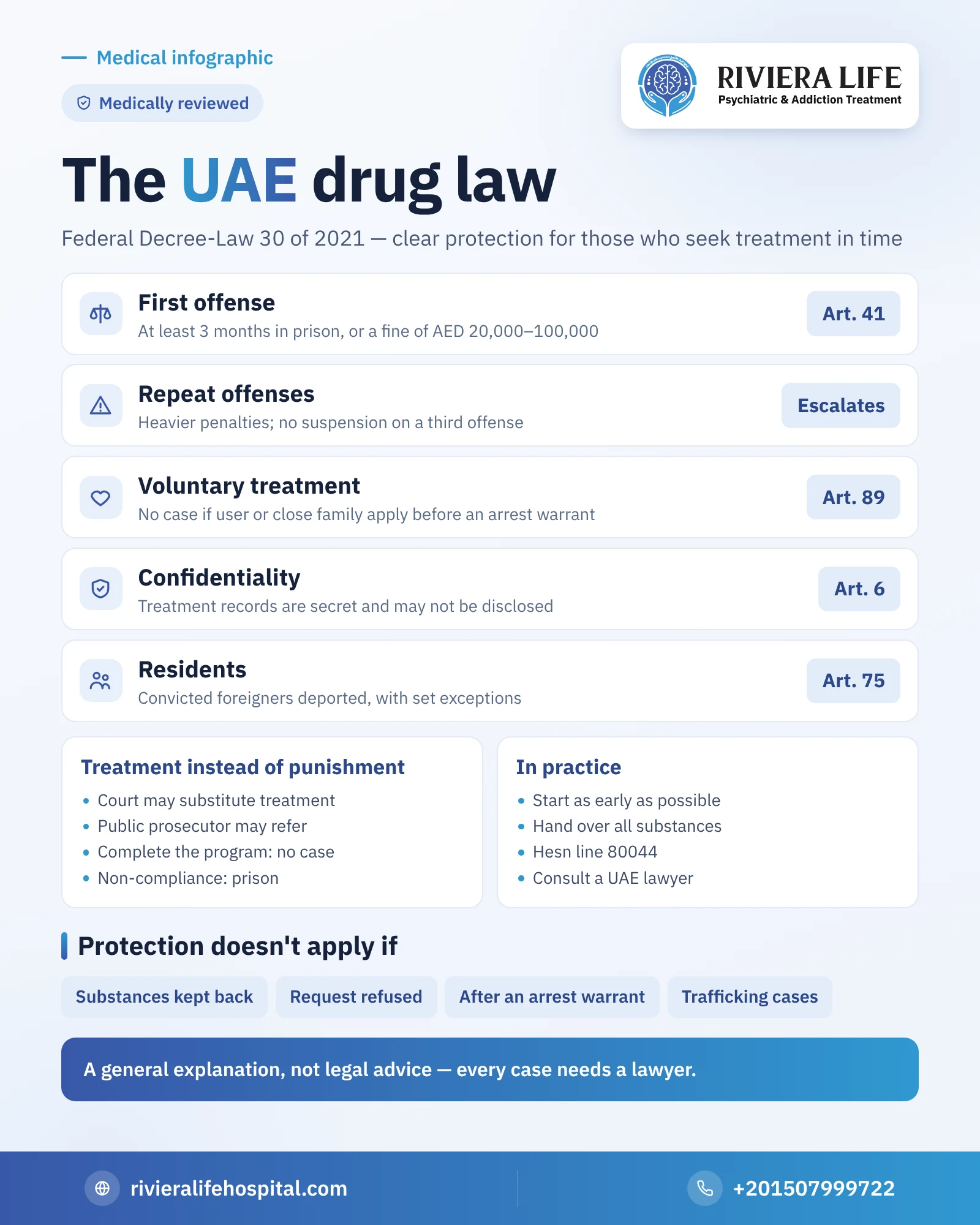
Drug cases in the UAE are governed by Federal Decree-Law No. 30 of 2021, in force since January 2022, with amendments announced in December 2025. The penalty for a first offense of use is imprisonment for no less than three months or a fine of 20,000 to 100,000 dirhams, with heavier penalties on repetition. Article 89 provides that no criminal case is brought against a user if they, their spouse or a relative up to the second degree apply for their admission to treatment before an arrest warrant is issued, handing over any substances in their possession. The court may substitute the penalty with admission to a treatment unit for a non-repeat offender, and orders the deportation of a convicted foreigner except in specific exceptions.
- The lawFederal Decree-Law 30 of 2021
- First offense of useAt least 3 months in prison or a fine
- Voluntary treatmentArticle 89: before an arrest warrant
“Will he be jailed if we take him for treatment?” and “Is a resident deported if drug use is proven?” are two questions that delay treatment in the UAE for months. In fact, UAE law clearly distinguishes between someone caught using and someone who seeks treatment themselves, and gives the second explicit protection. This article explains what the main articles say in simple language; it is a general explanation and doesn’t replace consulting a lawyer in the UAE for each particular case.
What law is in force?
Federal Decree-Law No. 30 of 2021 on combating narcotic drugs and psychotropic substances, which came into force on 2 January 2022. In December 2025, amendments to it were announced, including expanding treatment units run by federal, local and private health authorities, and toughening the penalty for anyone who dispenses or prescribes these substances without a sound medical basis.
The penalty for drug use in the UAE
Article 41 sets the penalty for using substances listed in the main schedules, or possessing them for use:
- First offense: imprisonment for no less than three months, or a fine of 20,000 to 100,000 dirhams.
- Reoffending within three years: imprisonment for no less than six months or a higher fine.
- A third or further offense: a heavier penalty, up to at least two years’ imprisonment with a fine.
Article 42 deals with cannabis, with similar penalties starting at three months’ imprisonment or a fine. Suspension of the sentence isn’t permitted for a third offense. Trafficking and promotion carry much heavier penalties, which this article doesn’t cover.
Article 89: voluntary treatment without a criminal case
This article is the most important thing the family needs to know. It provides that no criminal case is brought against a user of narcotic drugs or psychotropic substances if they come forward of their own accord, or their spouse or a relative up to the second degree comes forward, to the treatment unit, the public prosecution or the police before an arrest warrant is issued, asking for their admission to treatment. In the consolidated text, the request may also be made by a guardian, or by an educational institution in coordination with child protection authorities and with the guardian’s consent. The period of admission for treatment doesn’t exceed one year.
Article 90 sets out cases in which this protection doesn’t apply, most notably if the person keeps narcotic substances without handing them over to the unit or the prosecution, or if the prosecution rejects the request. So timing and complete handover of substances are practical conditions that mustn’t be taken lightly.
Confidentiality
Article 6 provides that all data and information relating to the affairs of addicts and users admitted to a treatment unit are considered secret, and their disclosure or publication is prohibited. This means that requesting treatment doesn’t turn into a record seen by employers or society.
Treatment instead of punishment after arrest
- Article 45: in non-repeat cases, the court may substitute the penalty with admission to a treatment unit, after hearing the opinion of the competent committee.
- Article 92: the public prosecutor may refer the user to the unit, and no case is brought against someone who completes the treatment program.
- Article 91: someone who doesn’t comply with the treatment plan is sentenced by the court to imprisonment of no less than one year, from which the treatment period is deducted.
Residents and deportation
Article 75 provides that the court orders the deportation of a foreigner convicted under this law, with exceptions including being the spouse or first-degree relative of a citizen at the time of the offense, or deportation causing serious harm to a family residing in the country that is able to bear the costs of their treatment. The essential difference here is between conviction and a voluntary request for treatment before prosecution; a resident who comes forward for treatment in time protects themselves from the entire criminal route.
What does this mean in practice?
- The earlier the start, the clearer the legal protection.
- The family shouldn’t keep substances at home thinking this protects their son; handover is a condition.
- The “Hesn” line, 80044, is a suitable starting point for anyone who doesn’t know which body to turn to.
- Anyone with a previous case or a special residency situation needs to consult a lawyer before taking any step.
To learn about the available treatment providers and the steps to begin, read addiction treatment in the UAE.
How can Riviera Life help you?
If a family in the UAE is torn between local treatment and travel, Riviera Life’s remote medical consultation helps them understand the patient’s needs before any legal or practical step, and those who choose Egypt find a program that begins with safe withdrawal and ends with a follow-up plan after their return. The first consultation is free and confidential on +201507999722.
Read also
- Addiction treatment in the UAE: centers and the Hesn line
- Drug penalties in Saudi Arabia and treatment without prosecution
- Kuwait’s drug law and voluntary treatment
- Bahrain’s drug law and voluntary treatment
- The law and addicts in Egypt
Questions many people ask
Imprisonment for no less than three months or a fine of 20,000 to 100,000 dirhams, with heavier penalties for repeat offenses.
Yes. Article 89 provides that no case is brought if the user, their spouse or a relative up to the second degree applies for their admission to treatment before an arrest warrant is issued, handing over any substances in their possession.
The court orders the deportation of a convicted foreigner under the law, with specific exceptions; someone who comes forward voluntarily for treatment before prosecution doesn't face a case in the first place.