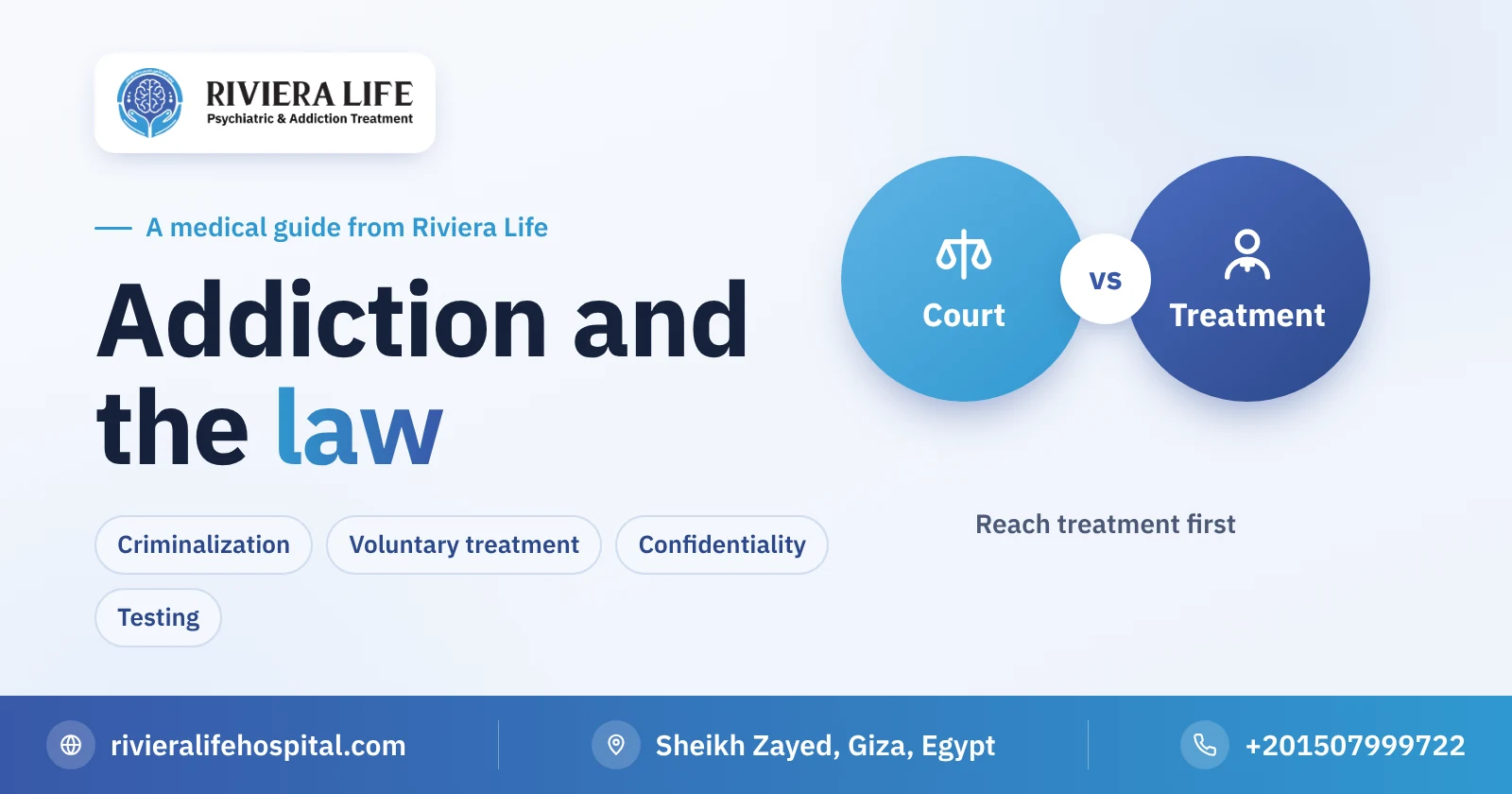
The relationship between the law and addicts in Egypt frightens many families: will my son be jailed if he goes for treatment? Will the hospital report him to the police? Will an employee be dismissed if use appears in a test? In short, using and possessing drugs is a crime under Egyptian law, but the law itself includes a well-known principle that encourages treatment, which is not bringing a criminal case against someone who comes forward for treatment of their own accord. This article provides simplified general information to help you understand the picture, and isn’t legal advice, as each case has details determined by a specialist lawyer.
Is drug use a crime in Egypt?
Yes. The Narcotics Control Law, Law No. 182 of 1960 and its successive amendments, regulates everything related to narcotic substances: importing, cultivating, trading, possessing and using them. The law criminalizes possession and use without medical grounds, and the penalty becomes heavier the closer the act comes to trading and distribution.
In recent years many synthetic substances have been added to the narcotics schedules, such as types of synthetic cannabis known on the street as strox and voodoo. Some medicines, such as tramadol, pregabalin and sedatives, are also subject to controls on dispensing, and possessing them without a prescription may fall under the law.
In February 2026 the Supreme Constitutional Court ruled unconstitutional the decisions of the head of the Egyptian Drug Authority amending the narcotics schedules, because this power belongs to the Minister of Health under the law, so the Minister of Health issued Decree No. 44 of 2026 replacing the schedules. The ruling doesn’t mean substances such as ice and shabu have become permitted; it concerned the competent authority and the degree of severity, and assessing its effect on a particular case remains for the lawyer. The details are in the ice guide.
Use, possession and trafficking: a big difference in the eyes of the law
| Act | How the law generally views it |
|---|---|
| Use or possession for personal use | A crime, with the possibility that the court orders the user placed in a treatment facility instead of punishment |
| Possession with intent to trade | A much more serious crime with severe penalties |
| Importing, smuggling and cultivation | Among the most serious crimes in the law, with penalties that may reach the highest degrees |
| Coming forward for treatment voluntarily | No criminal case is brought for use, according to the principle the law contains |
Determining the description of the act and its penalty is a matter for the prosecution and the court, and we don’t give specific penalties here because they differ with the substance and the circumstances.
Treatment instead of punishment: what happens to those who seek treatment voluntarily?
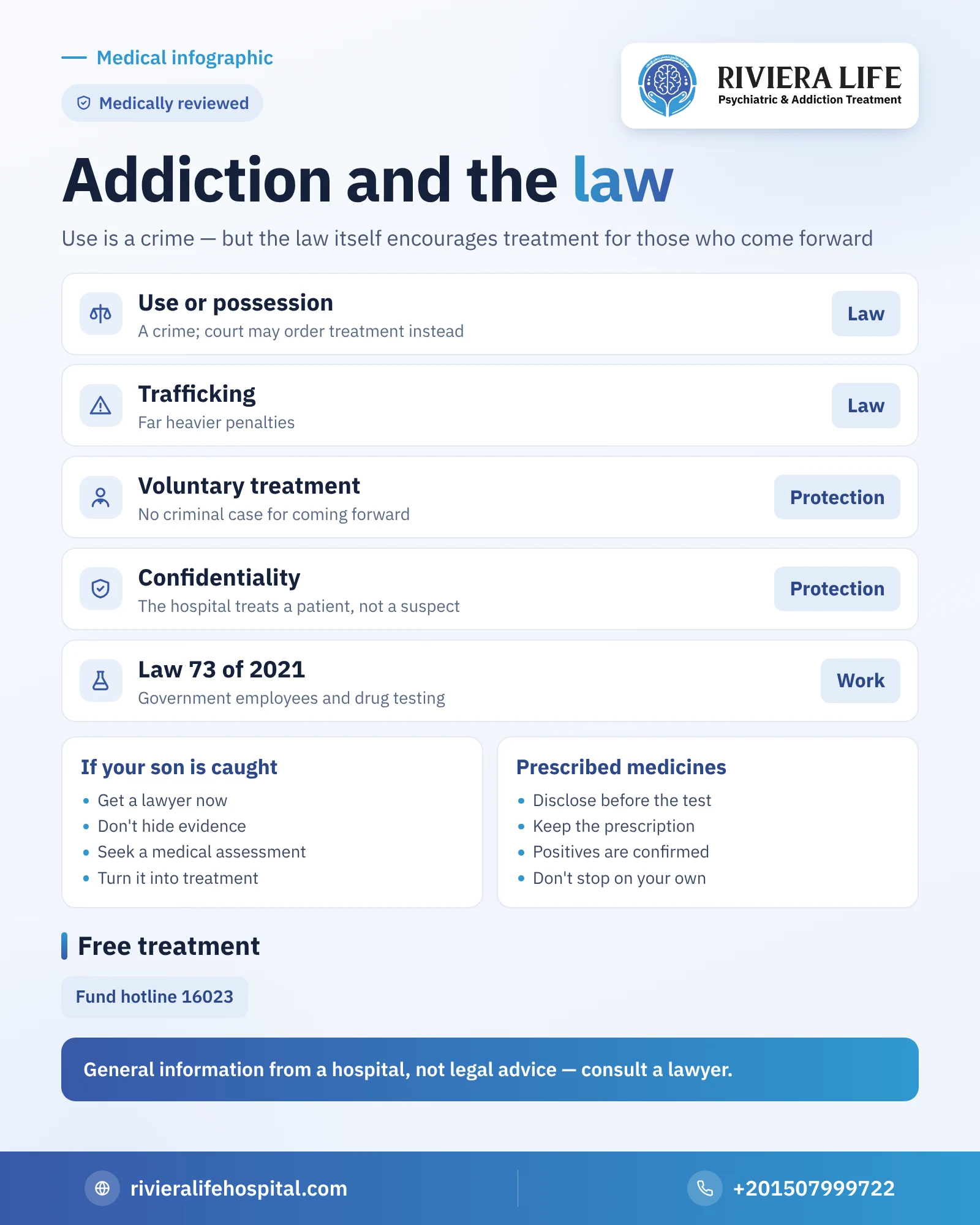
Egypt’s narcotics law contains a provision preventing a criminal case being brought against a drug user if they come forward of their own accord to a treatment body to be treated. Legal and press coverage also states that the same ruling extends to cases where the spouse, a parent or a child requests treatment for the user. Alongside this, the law allows the court in use offences to order the user placed in a treatment facility instead of imposing the penalty.
The idea is clear: the state wants the patient to reach treatment before reaching the courtroom. But note that this protection relates to use, doesn’t erase other crimes such as trafficking, and the situation may differ if proceedings had already begun before treatment was sought. That is why the right question in any specific case is directed to a lawyer.
The free government treatment route starts with the hotline 16023, which we explained in detail in the article on free addiction treatment in Egypt.
Does the hospital report to the police? Confidentiality in treatment
This is the question that most delays families from treatment. The rule in medicine is the confidentiality of medical information: the doctor is obliged to protect the patient’s secrets, and a licensed hospital doesn’t treat an addiction patient as a suspect but as a patient. The hospital has no role in reporting a patient who came seeking treatment.
There are limited exceptional cases regulated by law, such as an official request from a judicial authority, or a grave and imminent danger to someone’s life. Otherwise the data stays within the medical file and isn’t given to an employer or any other party without the patient’s permission.
Drug testing for government employees
Egypt issued Law No. 73 of 2021 on the conditions for holding or continuing in jobs, and its application began in late 2021. According to what has been published about the law and its executive regulations, it covers workers in the state administrative apparatus and its affiliated bodies, and rests on several points:
- A drug test is a condition for appointment, and is also carried out before promotion or taking certain posts.
- Surprise tests are carried out on workers at their workplaces.
- If the first sample is positive, confirmatory tests are carried out, and the employee may be suspended temporarily on half pay until the result appears.
- Proven use by the confirmatory test may lead to termination of service, as may refusing the test without an acceptable excuse.
Officials of the Fund for Drug Control have stated more than once that an employee who comes forward for treatment voluntarily before a testing campaign at their workplace is treated free and confidentially without accountability. To understand the types of tests themselves, read the article on drug testing.
Drivers and roadside testing campaigns
The Fund for Drug Control regularly announces surprise testing campaigns on drivers, in cooperation with traffic departments, focusing especially on school bus, public transport and highway drivers. According to what is announced, proven use may lead to withdrawal of the driving license and referral of the driver to investigating authorities.
The reason is understandable: a driver under the influence of hash or tramadol puts dozens of lives at risk. If you are a driver struggling with a substance, early voluntary treatment protects you and others before the problem becomes an accident.
Prescribed medicines? Tell the doctor and the committee
Some prescribed medicines may affect the result of the initial test, such as some opioid painkillers and sedatives. That is why the announced procedures state that the person discloses the medicines they take before the test, and that a positive result is confirmed with a more precise test. Always keep the prescription, and don’t stop or change a prescribed medicine yourself for fear of the test. And if you suspect your use of a prescribed medicine has turned into dependence, the article on prescription drug addiction helps you tell the difference.
My son was caught with drugs: what does the family do?
- Get a lawyer immediately: only they can assess the legal position and its options.
- Don’t try to hide evidence or interfere with the proceedings: this may harm the son and expose you to accountability.
- Ask for a medical assessment: a report proving the son is an addiction patient who needs treatment may be useful, and the lawyer decides how it is used.
- Separate anger from treatment: being caught is a hard moment, but it may be the beginning of the road if it turns into a real treatment plan.
For those managing this situation with a teenage son, the article on teen addiction offers ways of talking and treatment options suited to his age.
Why does seeking treatment early protect the whole family?
Every extra day of use raises the chances of being caught, an accident, dismissal from work or debts. In contrast, voluntary treatment opens a safe legal door, preserves the job in many cases, and stops the crisis reaching parties outside the home. The family that moves early chooses the road, and the family that waits usually has it chosen for them.
Important note: this isn’t legal advice
Everything above is general information we gathered from published sources to help you understand the general framework, and laws and their regulations may change or be interpreted in different ways. We are a hospital for psychiatry and addiction treatment, not a legal body. Before any decision concerning a case, a job or an official procedure, consult a lawyer specializing in drug cases.
For the practical side of workplace testing and licenses, from the committee’s steps to disclosing medicines, see drug testing for employees and licenses in Egypt.
How can Riviera Life help you?
Our role is entirely medical: assessing and treating the case in complete confidentiality inside a hospital licensed by the Ministry of Health, under the round-the-clock supervision of consultants in psychiatry and addiction treatment. The first consultation is free, and the family can start it alone to understand the options. Contact us on +201507999722; we are based in Sheikh Zayed, Giza.
Read also
- Free addiction treatment in Egypt: the hotline and the steps
- Treating an addict against their will: when is it justified and legal?
- Drug testing: its types and how it is read
- Drug street names among young people in Egypt
- Driving under the influence of drugs: the dangers, the law and what families do
- Is a psychiatric patient responsible for their actions? Medicine, law and the family
- Kuwait’s drug law and voluntary treatment
Questions many people ask
Egypt's narcotics law includes the principle of not bringing a criminal case against a user who comes forward for treatment of their own accord, and each case has details a lawyer determines.
Under Law 73 of 2021, proven use by a confirmatory test may lead to termination of service, and the Fund for Drug Control announces that whoever seeks treatment voluntarily before a testing campaign is treated without accountability.
It is published that legal protection extends to a spouse or direct relatives requesting treatment for the user, and it is best to check the details with a lawyer before any official step.
Some painkillers and sedatives may affect the initial test, so disclose your medicines and keep the prescription, and positive results are confirmed with a more precise test.
No, it is general information from a medical hospital, and any decision concerning a case or a job needs consultation with a specialist lawyer.