The short answer
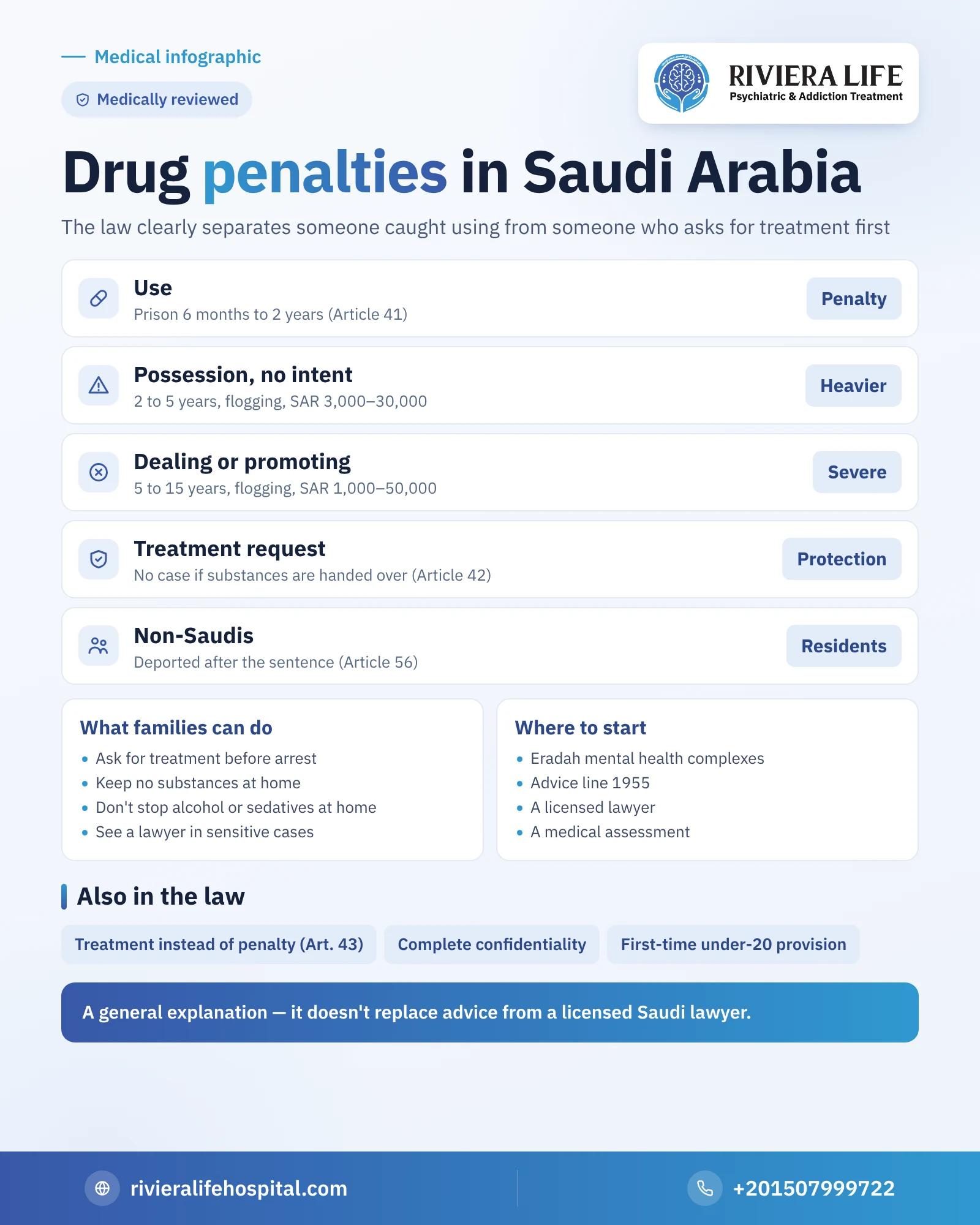
Drug cases in Saudi Arabia are governed by the Narcotics and Psychotropic Substances Control Law issued by Royal Decree No. M/39 dated 8/7/1426 AH. The penalty for use or personal use other than in licensed circumstances is imprisonment from six months to two years, and the penalty becomes much heavier for possession, dealing and smuggling, reaching death as a discretionary (ta’zir) punishment. But Article 42 provides that no case is brought on account of use or addiction if the user comes forward himself, or one of his ascendants, descendants, spouse or relatives applies for his treatment, on condition that he hands over the substances he has or points to where they are. A non-Saudi who is convicted is deported after the sentence is carried out.
- The lawRoyal Decree M/39 of 1426 AH
- Penalty for usePrison from 6 months to 2 years
- Treatment requestArticle 42: no case if substances are handed over
“Do I report him to the police or get him treated?”, “Will my son be imprisoned if we take him to hospital?” and “My husband is an addict and refuses treatment; what protects me and my children?” These questions recur in many Saudi homes, and delay the decision for months out of fear of the legal consequences. The truth is that the Saudi law draws a clear distinction between someone caught using and someone who asks for treatment beforehand, himself or through his family. This article explains the main articles in simple language; it is a general explanation that doesn’t replace consulting a licensed Saudi lawyer in each specific case.
Which law governs drug cases in Saudi Arabia?
The Narcotics and Psychotropic Substances Control Law, approved by the Council of Ministers by its Resolution No. 152 dated 12/6/1426 AH and issued by Royal Decree No. M/39 dated 8/7/1426 AH, consists of 74 articles. The law defines the offenses and their penalties, the bodies responsible for arrest and investigation, and the provisions on treatment and aftercare, and it is accompanied by schedules of narcotic and psychotropic substances that may be amended. Its implementing regulations were issued in 1431 AH.
The penalty for drug use in Saudi Arabia
Article 41 provides that anyone who uses narcotic or psychotropic substances, or uses them personally, other than in the circumstances licensed by law, is punished by imprisonment for no less than six months and no more than two years. The article makes the penalty heavier if the user works in drug control or in a job connected with these substances, or if he used them during work or came to work under their influence.
These provisions include scheduled medicines if they are used without a prescription, such as preparations containing pregabalin, which the Saudi Food and Drug Authority has listed since 2015 among controlled preparations. To learn the names circulating among young people and what they refer to, see our article on drug street names in Saudi Arabia.
The penalty for possession, dealing and smuggling
Here the position changes completely, as the law distinguishes between the user and someone who possesses or trades in the substances:
| The act | The penalty as set by the law |
|---|---|
| Use or personal use | Prison from 6 months to 2 years |
| Possession or transport without intent to deal or use | Prison from 2 to 5 years, with flogging and a fine of SAR 3,000 to 30,000 |
| Possession with intent to deal or promote | Prison from 5 to 15 years, with flogging and a fine of SAR 1,000 to 50,000 |
| Smuggling, or promoting after a previous conviction | Up to death as a discretionary punishment, or at least 15 years in prison with flogging and a fine of no less than SAR 100,000 |
Whether possession was for use or for dealing is a matter assessed by the investigation authorities and the judiciary according to the quantity, circumstances and evidence. That is why keeping a large quantity at home, thinking this is less harmful than the user going out to buy, may put the whole family in a difficult legal position.
Article 42: treatment without a case being brought
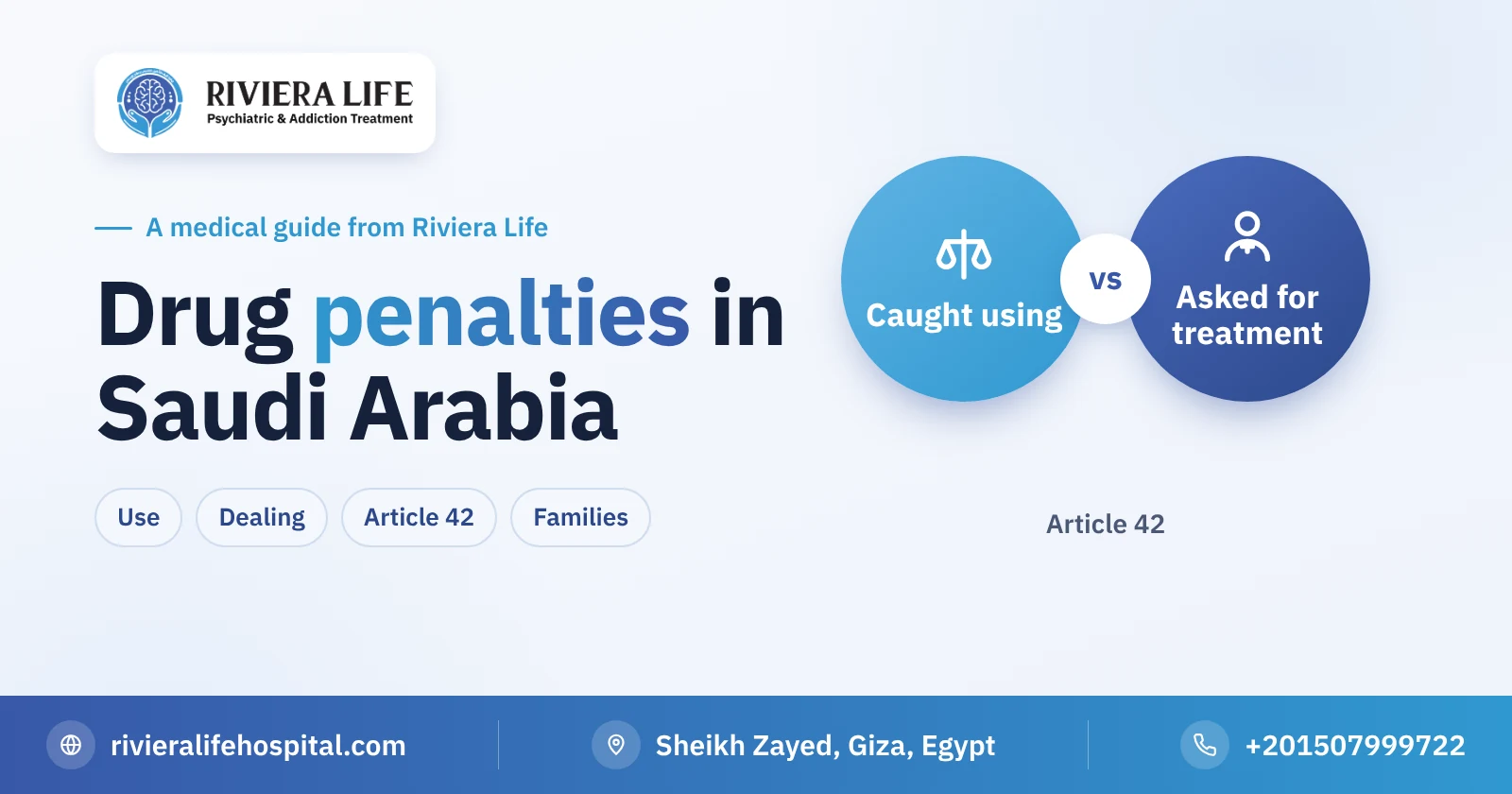
This is the most important article for any family. It provides that no case is brought on account of using, consuming or being addicted to narcotic or psychotropic substances if the user comes forward himself, or one of his ascendants, descendants, spouse or relatives comes forward, applying for his treatment. The condition is that he hands over any narcotic or psychotropic substances in his possession, or points to where they are. The Public Prosecution has confirmed this meaning on more than one occasion, most recently in June 2025.
The article also includes a provision allowing the investigation to be closed the first time for someone caught using if he is under twenty, the incident wasn’t combined with another crime, wasn’t linked to a traffic accident resulting in death, and he didn’t show violent resistance on arrest.
The practical conclusion is that the legally safest route is for the treatment request to come before arrest, and to be accompanied by handing over whatever substances the user has.
Treatment instead of punishment after arrest
Even after proceedings have started, the door to treatment isn’t closed. Article 43 allows, instead of imposing the penalty on the addict for use, an order placing him in one of the facilities designated for this purpose, and the implementing regulations define the cases in which this is permitted, the body that issues the order and the conditions for discharge. Doctors follow the condition of the person placed there and submit reports to a specialized committee that decides whether he has recovered or needs a longer period.
Confidentiality: will the patient be exposed?
The law provides that the addict is treated in complete confidentiality, and punishes anyone who discloses information about the patient or his case with imprisonment for no more than three months or a fine of no more than SAR 30,000. This protection is intended to encourage families to ask for treatment without fear of stigma.
Residents and deportation
Article 56 provides for deporting a non-Saudi from the Kingdom after the sentence imposed on him is carried out, and not allowing him to return, except as permitted by Hajj and Umrah regulations. That is why a resident suffering from addiction has even more need than others to ask for treatment early, before any arrest, and to consult a lawyer about his particular situation.
My husband or brother is an addict and refuses treatment: what does the law say?
Many wives and sisters ask: do I report him to the police, or ask for his treatment? The law explicitly allows the second route, as a spouse and relatives may apply for treatment under Article 42, and then no case is brought on condition that the substances are handed over or their location pointed out. Reporting use without asking for treatment, however, may open a criminal case.
If the patient refuses treatment, what to do differs according to his condition:
- If he poses an urgent danger to himself or to those at home, such as threats, violence or hallucinations, the priority is protecting the family and calling emergency services.
- If there is no urgent danger, requesting treatment through the competent bodies such as the Eradah complexes for mental health or the 1955 advice line of the National Committee for Narcotics Control is a suitable start to learn the available steps.
- If there is a family case, such as maintenance, divorce or custody, these are matters governed by the personal status law and need a specialist lawyer.
In our article on treating an addict against his will we explain when treatment without the patient’s consent is medically justified, and how it is done safely.
What does this mean in practice for the family?
- Starting early protects both legally and medically; asking for treatment before arrest is the safest position.
- The family shouldn’t keep any substances at home; handing them over is a condition of protection, and their presence in quantity may change how the case is described.
- Stopping alcohol, sedatives or pregabalin suddenly at home may be dangerous; withdrawal needs medical supervision.
- Anyone with a previous case, working in a sensitive job, or who is a resident needs to consult a lawyer before any step.
To learn the treatment providers available inside the Kingdom, government and private, read addiction treatment in Saudi Arabia.
How can Riviera Life help you?
If a Saudi family is hesitating between treatment inside the Kingdom and traveling, Riviera Life’s remote medical consultation helps it understand the patient’s needs before any legal or practical step, and those who choose Egypt find a program that starts with safe withdrawal under medical supervision and ends with a follow-up plan after returning. The first consultation is free and confidential on +201507999722.
Read also
- Addiction treatment in Saudi Arabia: government and private routes
- Kuwait’s drug law and voluntary treatment
- Drug penalties in the UAE and voluntary treatment
- Bahrain’s drug law and voluntary treatment
Questions many people ask
Imprisonment for no less than six months and no more than two years under Article 41, and the penalty is heavier for those working in drug control and for anyone who uses during work.
Under Article 42 no case is brought if the user, or one of his ascendants, descendants, spouse or relatives, applies for his treatment, on condition that he hands over the substances he has or points to where they are.
Yes, Article 56 provides for deporting a non-Saudi after the sentence is carried out and not allowing him to return except as permitted by Hajj and Umrah regulations.