The short answer
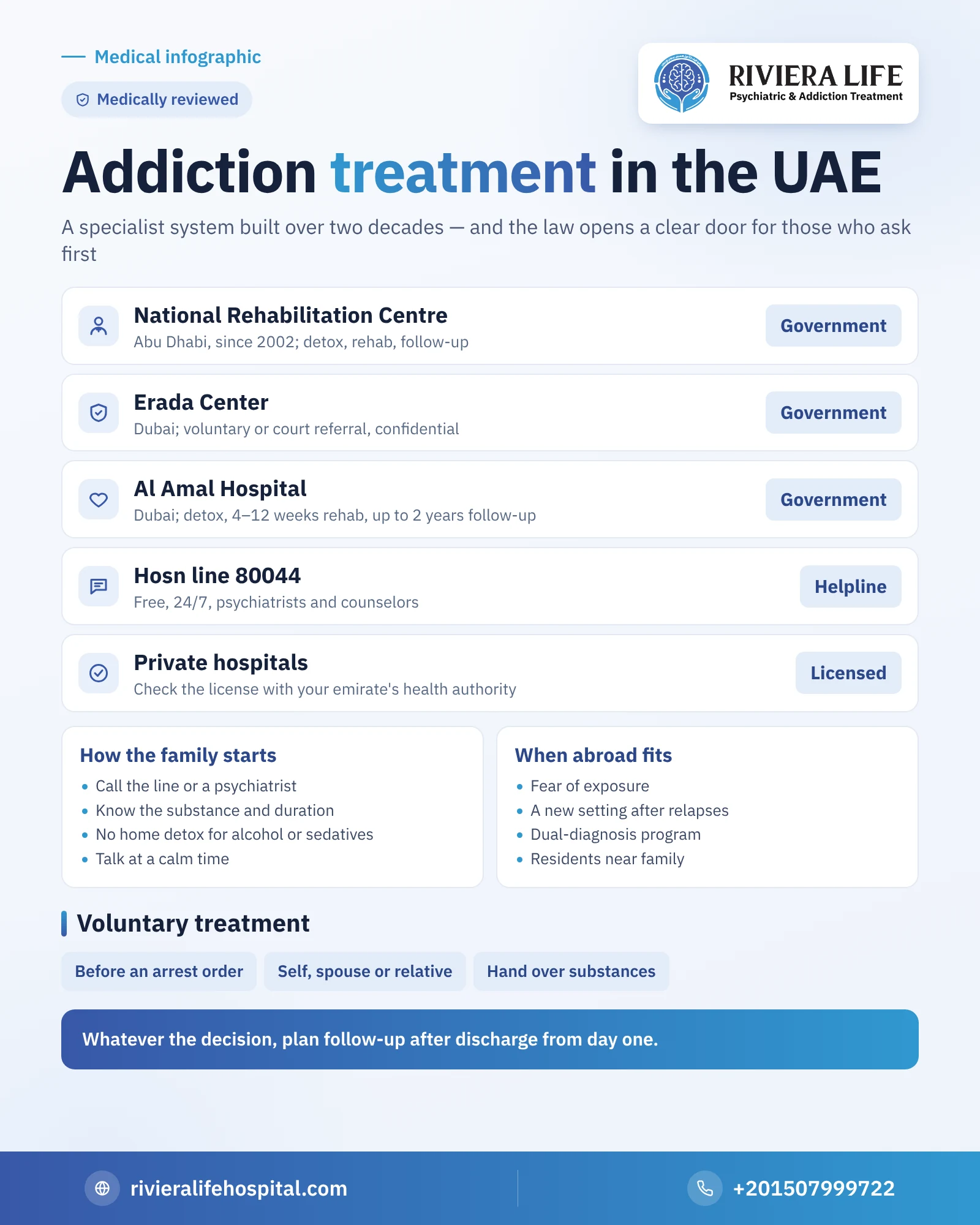
Addiction treatment in the UAE is available through specialist government bodies, the most prominent being the National Rehabilitation Centre in Abu Dhabi and the Erada Center for Treatment and Rehabilitation in Dubai, alongside the free “Hosn” line 80044, which works around the clock to provide confidential advice and guidance. Federal law encourages early treatment, as no criminal case is brought against the user if they, their spouse or a relative up to the second degree apply for their treatment before an arrest order is issued, on condition that they hand over the substances in their possession. Treatment outside the UAE deserves consideration in specific cases, not as a rule.
- Government bodiesThe National Rehabilitation Centre and Erada
- Advice lineHosn 80044, around the clock
- Voluntary treatmentBefore an arrest order, with substances handed over
In many Emirati and resident homes, the conversation about addiction starts with two questions at once: where do we go? And does going expose us to accountability or deportation? The honest answer is that over the last two decades the UAE has built a specialist treatment system, and that the law opens a clear door for those who ask for treatment before they are pursued. This guide presents the available bodies, how the family starts, and when treatment in another country is a sensible option. All of this concerns drug addiction treatment in the UAE for citizens and residents alike, with some legal considerations differing for residents.
Addiction treatment hospitals and centers in the UAE
Addiction treatment hospitals and centers in the UAE are spread between specialist government bodies in Abu Dhabi and Dubai, a government psychiatric hospital offering addiction programs, a national advice line, and licensed private hospitals and clinics. These are the most prominent.
The National Rehabilitation Centre in Abu Dhabi
Founded in 2002, it works in prevention, treatment, rehabilitation and scientific research; it is a World Health Organization collaborating centre and currently belongs to the “PureHealth” network. It provides detox, psychological rehabilitation and follow-up, and receives cases from across the emirates.
The Erada Center for Treatment and Rehabilitation in Dubai
A public institution established by Law No. 5 of 2019 in the Emirate of Dubai, it receives those who come forward for treatment voluntarily and those referred to it by court decision. Its founding law provides for the confidentiality of all information and data concerning its beneficiaries and residents.
In July 2026 the national digital recovery platform “Masar” was launched with the participation of four government bodies; it creates a single electronic record for each person in recovery from admission to reintegration into society, follows their adherence to the treatment plan and involves the family, with emphasis on the highest standards of confidentiality and privacy.
Al Amal Hospital in Dubai
The Emirates Health Services provides addiction treatment programs at Al Amal Hospital in Dubai, starting with a medical assessment on admission, then detox lasting roughly one to two weeks, followed by inpatient rehabilitation of 4 to 12 weeks depending on the substance and the degree of addiction, then outpatient follow-up that may extend from 3 months to two years. The hospital has programs dedicated to teenagers, women and those with a co-occurring psychiatric disorder, alongside cognitive behavioral therapy, group therapy, relapse-prevention programs and family support.
The “Hosn” line 80044
A free line working around the clock, run by the federal body responsible for combating narcotics, which lets you speak with psychiatrists and counselors who assess the case and guide you to a treatment plan, while keeping the caller’s data confidential. It is suitable for a family that doesn’t know where to start.
Private hospitals and clinics
Private hospitals and clinics for psychiatry and addiction treatment are available in the UAE, and the patient can start with an outpatient assessment if their condition allows, or with a stay for detox in an equipped facility. Before starting, check the facility’s license with the health authority in your emirate: the Department of Health in Abu Dhabi, the Dubai Health Authority, or the Ministry of Health and Prevention in the other emirates, and use the checklist for choosing an addiction treatment hospital.
Voluntary treatment and the law in brief
This matter is regulated by Federal Decree-Law No. 30 of 2021, to which amendments were announced in December 2025. The most important thing the family needs to know is that asking for treatment before an arrest order is issued protects the user from criminal prosecution, whether they come forward themselves or their spouse or a relative up to the second degree does, to the treatment unit, the Public Prosecution or the police, provided they hand over any substances in their possession. The law makes the data of those admitted for treatment a secret that may not be disclosed. For residents there is an important specific point concerning deportation on conviction. The details and full articles are in our article on drug penalties in the UAE and voluntary treatment.
How does the family start, step by step?
- Call the advice line or a licensed psychiatrist for a confidential initial assessment.
- Gather what you know: the type of substance, the duration of use, whether more than one substance is mixed, and whether there are psychological symptoms such as suspicion or depression.
- Don’t start a home withdrawal from alcohol, sedatives or pregabalin, as withdrawal here may be a medical danger.
- Talk to the patient at a calm time, and present treatment as an opportunity, not a punishment. You will find practical ways in how do I help someone addicted to drugs.
- After the assessment the level of care is determined: outpatient follow-up, or a stay for detox followed by rehabilitation.
When is treatment outside the UAE a suitable option?
- When fear of being exposed in a narrow social circle is a real barrier that prevents starting.
- When the patient needs a completely different environment for a while after repeated relapses.
- When there is a co-occurring psychiatric disorder that needs an integrated dual diagnosis program.
- For non-citizen residents who prefer treatment near their extended families in their home country.
Outside these cases, treatment inside the UAE remains a strong option, because the family is close and follow-up is easier. Whatever the decision, the plan must include from the first day how follow-up will continue after discharge.
Drug addiction treatment in Egypt for patients from the UAE
There is no need to book a ticket before the family knows what the case actually needs. The first step is a confidential call in which the doctor asks about the substance, the duration and the symptoms, and suggests the level of care and an estimated duration. After that the family arranges travel themselves, and one of its members attends the assessment to understand the plan from the start. On discharge, remote follow-up is coordinated, and it can be linked with a psychiatrist in the UAE. You will find the practical arrangements in detail in addiction treatment in Egypt for Gulf patients.
How can Riviera Life help you?
The Riviera Life team starts with families in the UAE, citizens and residents, with a confidential assessment call that determines whether the case can be treated locally or needs a program in Egypt, then sets a plan that includes safe withdrawal, rehabilitation and treatment of any co-occurring psychiatric disorder, with online follow-up after returning. The first consultation is free and confidential on +201507999722.
Read also
- Drug penalties in the UAE and voluntary treatment
- Addiction treatment in Egypt for Arab patients: a guide by country
- Addiction treatment in Saudi Arabia
- Paper drugs: forms and harms
Questions many people ask
The most prominent are the National Rehabilitation Centre in Abu Dhabi and the Erada Center for Treatment and Rehabilitation in Dubai, alongside the free Hosn line 80044 for advice and guidance around the clock.
No criminal case is brought against the user if they, their spouse or a relative up to the second degree apply for treatment before an arrest order is issued, on condition that they hand over the substances in their possession.