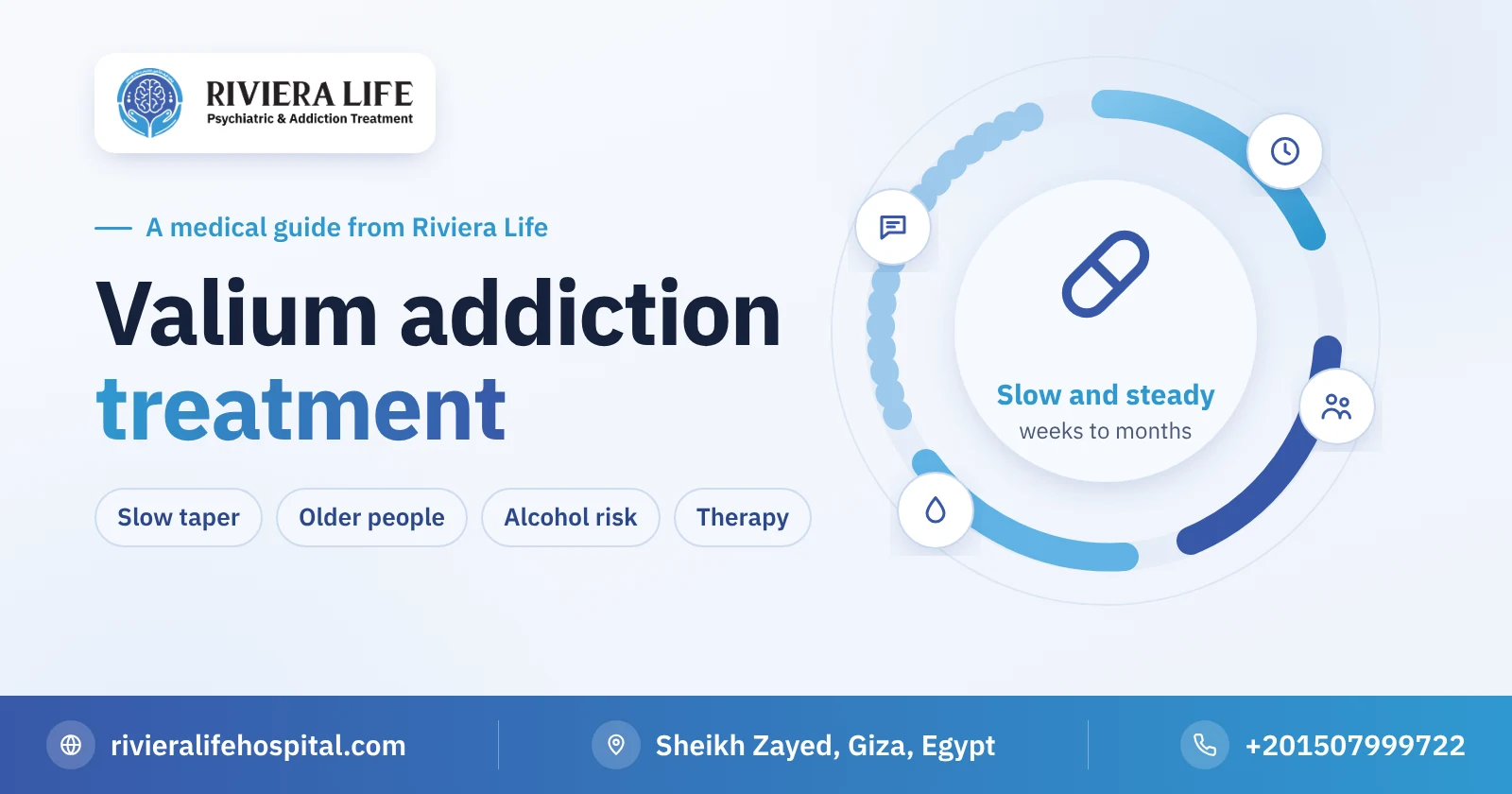
Valium addiction treatment is possible and safe when done with a slow, gradual reduction under medical supervision, along with treating the anxiety, insomnia or muscle tension for which the medicine was started, then follow-up that prevents a return to it. Valium is the best-known trade name for diazepam, one of the longest-acting benzodiazepines, as the substance turns in the body into active metabolites that remain for days.
This property makes withdrawal from it calmer than from many sedatives, but it makes its symptoms delayed and long. The two most dangerous things the treatment team faces are older people who have been taking it for many years, and those who mix it with alcohol. In all cases, Valium is only adjusted or stopped with the treating doctor.
Why does Valium need a special treatment plan?
Diazepam is an old and widely used medicine, and so its patients come with different stories from others. Some are men and women over sixty who were prescribed the medicine many years ago for anxiety, sleep or back muscle spasm, and it then became a fixed part of their day without anyone reviewing it. Some used it to calm themselves after drinking, or took it with alcohol to strengthen the effect. And there are those who got it originally as part of treatment for alcohol withdrawal and then continued on it after the need ended. Each of these paths has different treatment priorities, which is why the plan always starts with understanding the story before the numbers.
What sets diazepam apart pharmacologically?
After diazepam is taken, the liver converts it into other active substances, the most notable known as desmethyldiazepam, and these metabolites stay in the body longer than the original medicine itself, possibly several days. With daily use the substance and its metabolites build up gradually. This build-up is clearer in older people and people with liver disease, because their bodies clear the medicine more slowly, so they show drowsiness, confusion and unsteadiness that may be mistaken for normal ageing. For the same reason, withdrawal symptoms are delayed after stopping, and then last longer.
The medical uses of Valium
Valium has legitimate medical uses, the most important being the short-term treatment of severe anxiety, relaxing spasms and muscle tension in some neurological conditions, controlling seizures, and sedation before some medical procedures. Doctors also use it inside hospitals to ease the symptoms of alcohol withdrawal. These uses are usually short-term and targeted, and the problem starts when a temporary prescription turns into a daily habit for years.
The stages of Valium addiction treatment
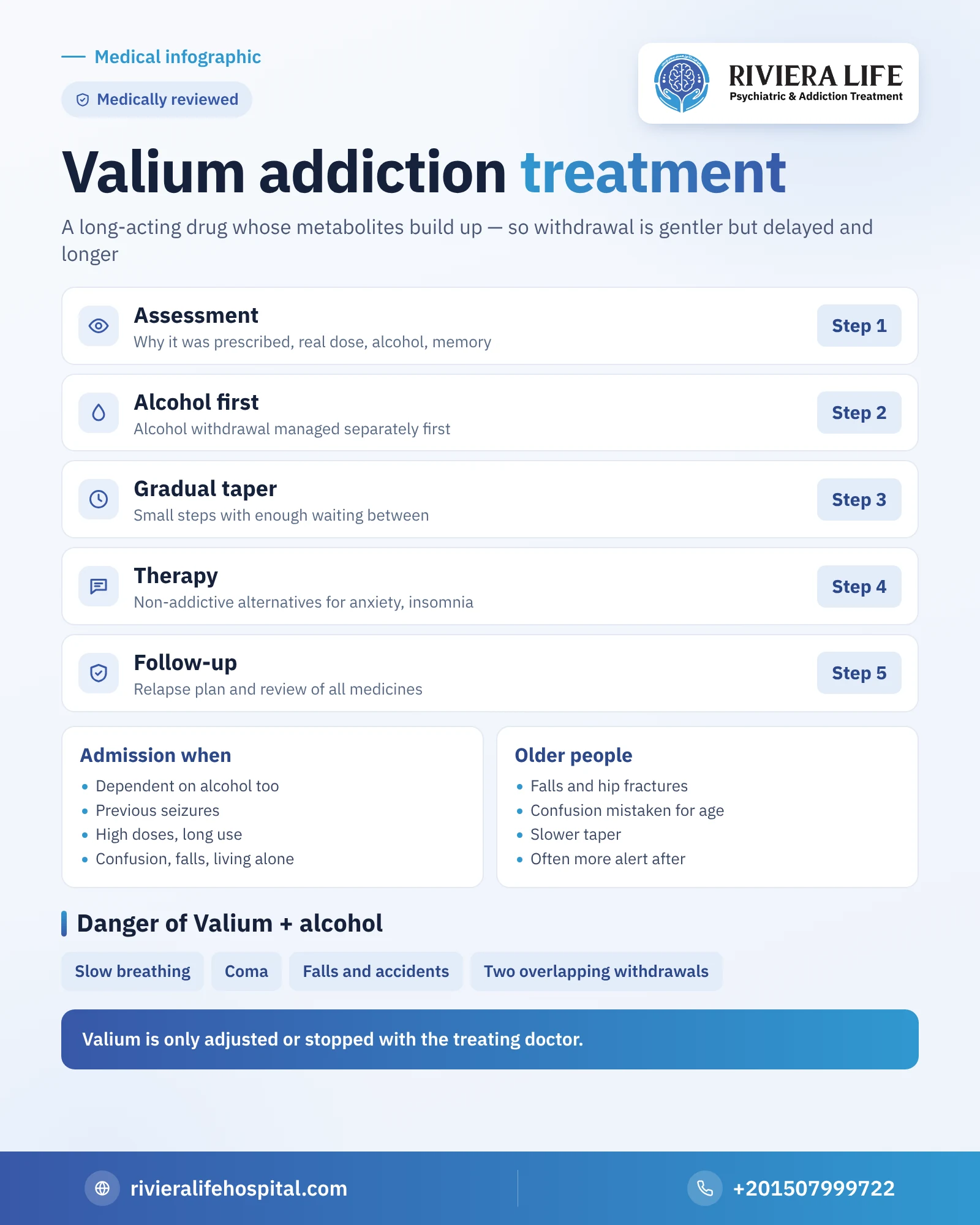
- Assessment: the reason for the original prescription and its duration, the actual dose, the patient’s relationship with alcohol, and general health and memory.
- Treating alcohol first, if present: alcohol withdrawal needs separate medical management before focusing on the sedative.
- Gradual withdrawal: slow reduction in stages, adjusted according to the response.
- Psychological therapy: alternatives for anxiety and insomnia that don’t cause dependence.
- Follow-up: a plan to prevent return, and a review of all the medicines the patient takes.
Assessment: questions that differ from other sedatives
In addition to the usual questions about dose and duration, the doctor asks here: who first prescribed Valium and why? Is the reason still present? Does the patient drink alcohol, even in amounts they see as small? Have they fallen recently, or have episodes of forgetting repeated? What other medicines do they take, especially painkillers and sleeping pills? In older people it may need an assessment of memory, balance and liver function, because some of what seems like weak memory may improve clearly after the medicine is reduced.
Valium and alcohol: the most dangerous mix
The paradox is that diazepam is used medically to treat alcohol withdrawal, but combining them outside that setting is a real danger. Both depress the nervous system, and together they may slow breathing and cause coma, and multiply the risk of falls, road accidents and memory loss. Someone dependent on both faces two overlapping withdrawals, and both may cause seizures. That is why these patients usually need admission under medical supervision, which starts by dealing with the alcohol and then moves to withdrawing the sedative. The details of alcohol withdrawal and its danger signs are in the article on alcohol withdrawal symptoms, and its treatment plan in the article on alcohol addiction treatment.
Gradual withdrawal of diazepam
Because diazepam itself is long-acting, it is usually reduced directly without needing to switch to another medicine, and it is in fact one of the medicines doctors sometimes turn to when withdrawing shorter-acting sedatives. The plan proceeds in small steps with enough waiting time, because the active metabolites remain for days, and the effect of each reduction isn’t complete until after a while.
With older people the steps are usually slower, with monitoring of balance, sleep and memory. The process may take weeks to months. We don’t present any schedules or doses here, as the plan is individual and set and adjusted by the doctor. We explained the principles of slow withdrawal of long-acting medicines and their delayed symptoms in detail in the articles on Rivotril addiction treatment and Rivotril withdrawal symptoms, so we won’t repeat them here.
Psychological therapy: life without the sedative
A patient used to Valium for years has usually lost confidence in their ability to calm down or sleep without a pill. Psychological therapy rebuilds this confidence:
- Cognitive behavioral therapy: for anxiety and insomnia, it teaches the patient to understand their symptoms and deal with them instead of escaping them.
- Relaxation techniques: breathing exercises and muscle relaxation, which are particularly useful for those who started the medicine because of muscle spasm or physical tension.
- Treating accompanying depression: common in long-term users, and leaving it untreated pushes towards returning.
- Treating alcohol addiction: if present, within the same program, not in a separate track.
Older people: treatment that needs gentleness
An older patient who has taken Valium for twenty years isn’t an “addict” in the way people imagine, but they are exposed to real harms: falls and hip fractures, confusion, weak memory, and interactions with other medicines. Reducing the medicine in them is done slowly and with the family’s participation, sometimes in coordination with their internist. Many families notice, once withdrawal is complete, that the patient has become more alert and present than they had been for years. The long-term harms of this family of medicines are explained in the article on the harms of benzodiazepines.
When is admission necessary?
Admission is usually the safest option when there is dependence on alcohol along with Valium, previous seizures, high doses and long use, confusion and repeated falls in an older person living alone, or depression with thoughts of self-harm. Stable cases without mixing may be managed with regular outpatient follow-up.
The right hospital for Valium addiction treatment: how to choose
The right hospital for Valium addiction treatment is the place that understands a long-acting medicine whose metabolites build up, can treat accompanying alcohol, and deals with older people gently and safely. Ask before you decide:
- Does a specialist doctor set a slow withdrawal plan that takes diazepam’s active metabolites into account?
- Can the team manage alcohol and sedative withdrawal together safely?
- Is there round-the-clock medical supervision to deal with seizures or confusion?
- Is there experience in dealing with older people and the risks of falls and memory?
- Does it offer psychological treatment for anxiety, insomnia and depression, not just stopping the medicine?
- Does the plan include the family and follow-up after discharge?
And beware of any place that promises you a guaranteed cure rate or getting rid of Valium within a few days.
How Riviera Life meets these standards
At Riviera Life these criteria take the following form:
- Official license: a hospital licensed by the Ministry of Health for psychiatry and addiction treatment.
- Specialist consultants: consultants in psychiatry and addiction treatment who set an individual diazepam withdrawal plan.
- 24-hour medical supervision: continuous follow-up when alcohol and sedative withdrawal overlap.
- Care suited to older people: slower withdrawal with monitoring of balance, sleep and memory.
- Integrated psychological therapy: for anxiety, insomnia and accompanying depression.
- Fourteen years of experience: thousands of cases recovered from sedative and alcohol addiction.
- A family program and aftercare: support for the family and follow-up after discharge.
- Complete confidentiality: the patient’s data and condition aren’t shared with any party.
The first consultation is free. Contact us around the clock on +201507999722, or visit us in Sheikh Zayed, Giza.
More from the benzodiazepines guide
- Benzodiazepines: the complete guide
- Benzodiazepine addiction treatment
- Rivotril addiction treatment
- Alcohol addiction treatment
- Diazepam (Valium): uses, how it works and side effects
Questions many people ask
Because diazepam turns into active metabolites that stay in the body for days, so the effect of each reduction is delayed, and the doctor needs to leave enough time between steps.
Yes in most cases, with a slower reduction and monitoring of balance and memory. Many notice an improvement in alertness and concentration once withdrawal is complete.
Both depress the nervous system, so combining them raises the risk of slow breathing, coma and falls, and someone dependent on both usually needs admission under medical supervision.
Stable cases without mixing may be managed with regular outpatient follow-up, but dependence on alcohol with it, seizures or confusion usually need admission.
Look for a slow taper planned around diazepam's active metabolites, 24-hour supervision, the ability to treat accompanying alcohol, and care for older people. Riviera Life in Sheikh Zayed, licensed by the Ministry of Health, meets these criteria, and the first consultation is free.