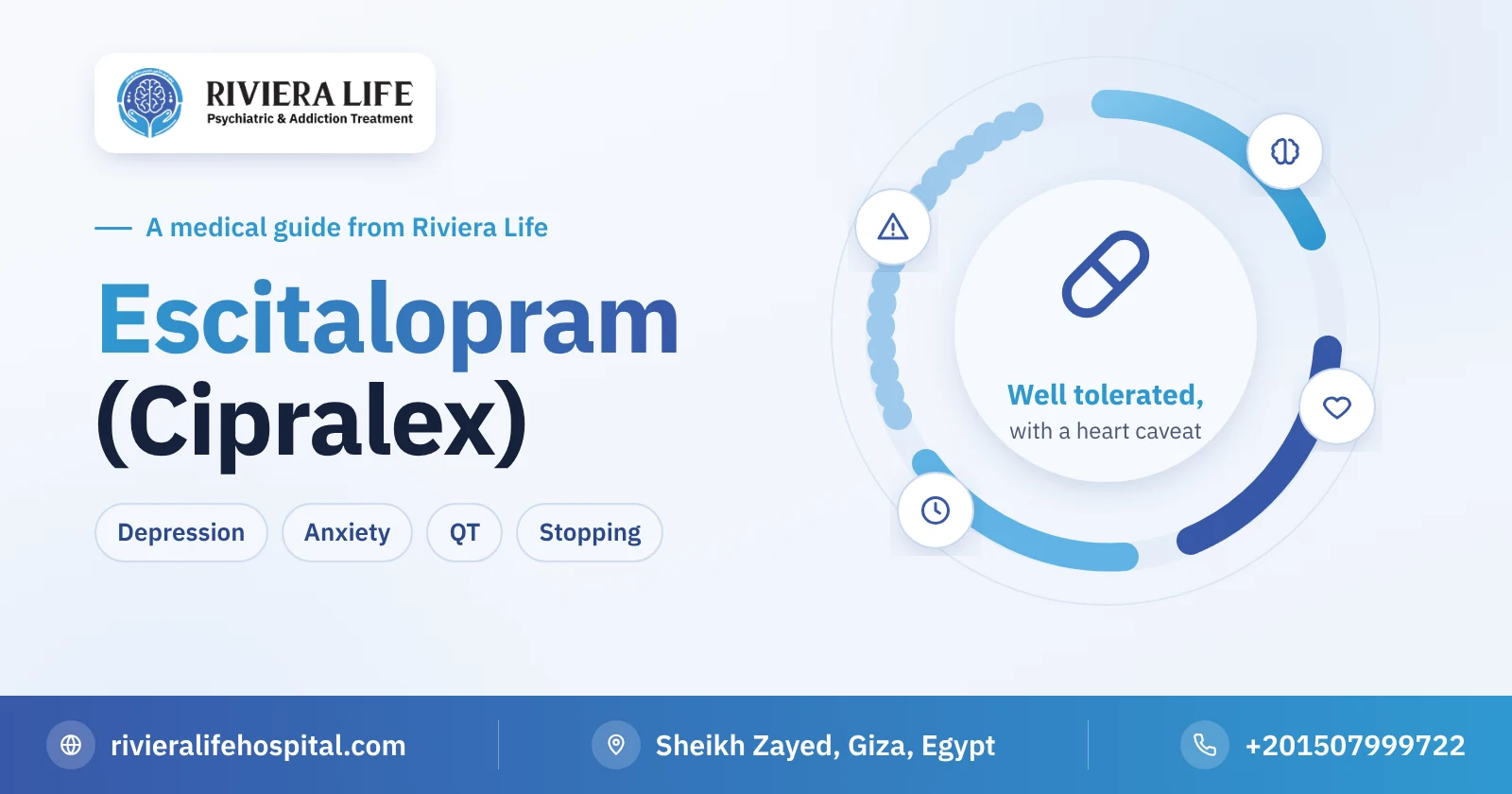
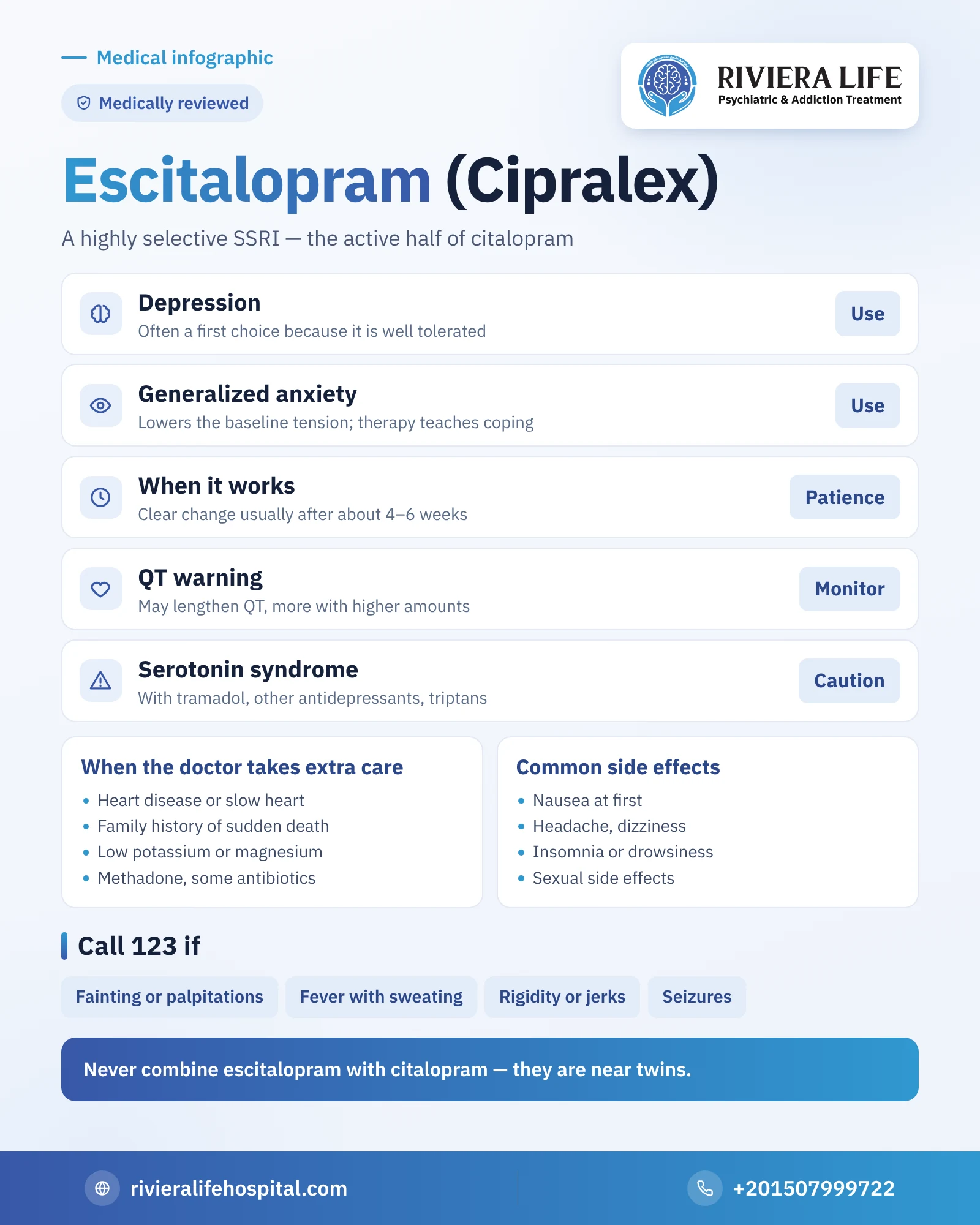
Escitalopram is an antidepressant from the selective serotonin reuptake inhibitor class, best known in Egypt by the brand name Cipralex. Psychiatrists prescribe it for depression and generalized anxiety disorder, and in some countries for panic attacks, social phobia and OCD. Many patients tolerate it well, but like others it needs weeks for its effect to appear, and it carries a specific warning relating to heart rhythm that patients often ask about. In this article we explain what escitalopram is, how it works, the story behind this warning, and when to seek help immediately. The article doesn’t mention doses; starting, adjusting and stopping the medicine are done only with the psychiatrist.
What is escitalopram?
To understand escitalopram you need to know its older brother: citalopram. The citalopram molecule exists in two identical forms, like a right and left hand, and one of them does most of the therapeutic work. Escitalopram is this active form alone after being separated. The result is a highly selective medicine for serotonin, meaning it barely affects other receptors, which explains why many patients find it easy to tolerate. Its place among the other medicines is explained in our article on antidepressants.
Cipralex and brand names in Egypt
The original name in Egypt and Europe is Cipralex, from Lundbeck, while in the United States it is known as Lexapro. Egyptian pharmacies have many equivalent names containing the same substance from local companies. And because escitalopram and citalopram are similar names, they are sometimes confused; they aren’t exactly the same thing, are never combined, and one is only swapped for the other by the doctor’s decision.
What is escitalopram used for?
Depression
This is the main use, and it is often one of the first choices because it is easy to tolerate. It works best with psychotherapy, as we explain in our article on depression treatment.
Generalized anxiety
Anxiety that lasts months and extends to everything: work, health and family. Here the medicine helps lower the baseline level of tension, while psychotherapy teaches the patient how to deal with their thoughts. The details are in our article on anxiety treatment.
Other anxiety disorders
In Britain and other countries it is also used for panic disorder, social phobia and OCD, and the doctor decides its suitability for each case.
How does escitalopram work?
Escitalopram closes the pump that returns serotonin into the nerve cell, so the transmitter stays available for longer. Over the weeks, the receptors and circuits linked to mood and fear adapt, and it is this adaptation that produces improvement, not the initial rise in serotonin. And if you are comparing it with sertraline, both are from the same class, and the choice between them depends on the diagnosis, other medicines, heart history and previous side effects, not on one being absolutely stronger.
When does escitalopram start working?
Sleep or tension may improve slightly within the first two weeks, but a clear difference in mood and anxiety usually takes about four to six weeks, and may take longer. In the first days, some anxiety patients may feel a temporary increase in tension or insomnia. This doesn’t mean the medicine doesn’t suit you, but it is worth telling the doctor. Patience here is part of the treatment, and judging after a week is unfair to the medicine.
Common side effects
- Nausea, the most common at first.
- Headache and dizziness.
- Insomnia or drowsiness.
- Excessive sweating.
- Diarrhea or constipation.
- Weak sexual desire, delayed ejaculation or difficulty reaching orgasm.
Most of these effects ease within two to four weeks. Sexual effects, however, may persist, and deserve a frank conversation with the doctor instead of stopping secretly.
Escitalopram and the heart: what is the QT warning about?
On an ECG there is an interval called the QT interval, which reflects the time the heart muscle needs to get ready again between one beat and the next. Some medicines lengthen this interval slightly, and in rare cases this may lead to a serious rhythm disturbance causing severe palpitations or fainting. Citalopram and escitalopram are among the medicines with which this effect has been observed, and it increases with the amount.
This doesn’t mean the medicine is dangerous for everyone who takes it; the majority aren’t affected. But the doctor takes more care in certain cases:
- A personal or family history of heart rhythm disorder, unexplained fainting, or early sudden death in the family.
- Heart disease, or a slow heartbeat.
- Low potassium or magnesium, as happens with repeated vomiting or some diuretics.
- Taking other medicines that lengthen the QT interval, including some antipsychotics, some antibiotics and methadone.
- Older people.
In these cases the doctor may request an ECG or salt tests before starting or during treatment. Your role is to mention all your medicines, and to report any palpitations, severe dizziness or fainting.
Other important warnings
- Suicidal thoughts in young people: an official warning covering antidepressants for those under roughly twenty-four, especially at the start or after a dose change. Any worrying change calls for the doctor immediately, the mental health hotline on 16328, or an ambulance on 123.
- Bleeding: more likely with blood thinners, aspirin and anti-inflammatory painkillers.
- Bipolar disorder: it may uncover a manic episode in someone predisposed.
- Low sodium: more evident in older people.
- Epilepsy and narrow-angle glaucoma: need assessment before starting.
Overdose and serotonin syndrome
An overdose of escitalopram may combine two effects: heart rhythm disturbance and symptoms of excess serotonin. The danger increases when it is mixed with alcohol or other medicines. Serotonin syndrome may occur when it is combined with tramadol, other antidepressants, triptan migraine medicines or St John’s wort, and its details are in our article on serotonin syndrome.
Call an ambulance on 123 immediately if you see
After taking an excessive amount of escitalopram, or when combining it with another medicine that raises serotonin or affects heart rhythm:
- Fainting, severe palpitations or an irregular heartbeat
- A high temperature with heavy sweating and shivering
- Muscle rigidity or repeated involuntary jerks
- Agitation, severe confusion or hallucinations
- Seizures
Escitalopram, alcohol and drugs
Alcohol increases dizziness and drowsiness and weakens the treatment’s effect on depression, so it is better avoided. Tramadol carries the risk of both serotonin syndrome and seizures. Methadone combined with escitalopram brings two risks: lengthening of the QT interval and increased serotonin, so someone receiving methadone treatment needs careful monitoring. Cocaine and stimulants strain the heart and raise serotonin. And escitalopram isn’t combined with monoamine oxidase inhibitors. Someone with both anxiety and drug use needs an assessment covering both, as in the dual diagnosis program.
Escitalopram, pregnancy and breastfeeding
It can be used during pregnancy if the doctor judges the benefit greater than the risks, and passing symptoms may appear in the newborn if it was used near delivery, which is why delivery in a hospital is usually advised. The decision remains the doctor’s after reviewing your case. And if you learn you are pregnant during treatment, don’t stop it suddenly; contact your doctor.
Stopping escitalopram, and does it cause addiction?
Escitalopram doesn’t cause addiction; there is no high, no craving and no need to increase the amount. But stopping suddenly may cause dizziness, nausea, irritability, insomnia and a sensation like an electric tingle in the head. So the doctor reduces it gradually over weeks or months after a sufficient period of stability. The details of these symptoms and how they differ from the illness returning are in our article on antidepressant withdrawal symptoms.
If you are taking Cipralex and haven’t felt a difference, the heart question worries you, or you want to stop safely, book your free first consultation with a consultant psychiatrist at Riviera Life, and we will review the whole plan with you in complete confidentiality.
More from our psychiatric medicines guide
- Psychiatric medicines: the complete guide
- Antidepressants: their types and how they work
- Sertraline (Lustral)
- Anxiety treatment: psychotherapy and medicines
- Citalopram (Cipram): uses, the heart warning and the difference from Cipralex
Questions many people ask
Cipralex contains escitalopram, the active form separated from the citalopram molecule. The two medicines are close but not identical, and are only combined or swapped by the doctor's decision.
Not every patient. The doctor usually requests it when there is heart disease, a family history of rhythm disorders, other medicines affecting the heart, or in older people.
Weight may change in some patients with long-term use, but it isn't among the antidepressants most linked to weight gain. Discuss it with your doctor if you notice a troublesome change.
No, it doesn't work as a fast sedative, but needs regular use for weeks for its effect to appear. Dealing with acute anxiety attacks is discussed with the doctor.
Some addiction treatment medicines, such as methadone, may increase the risk of heart rhythm disturbance or serotonin syndrome with it. The doctor must know all your medicines to decide and monitor.