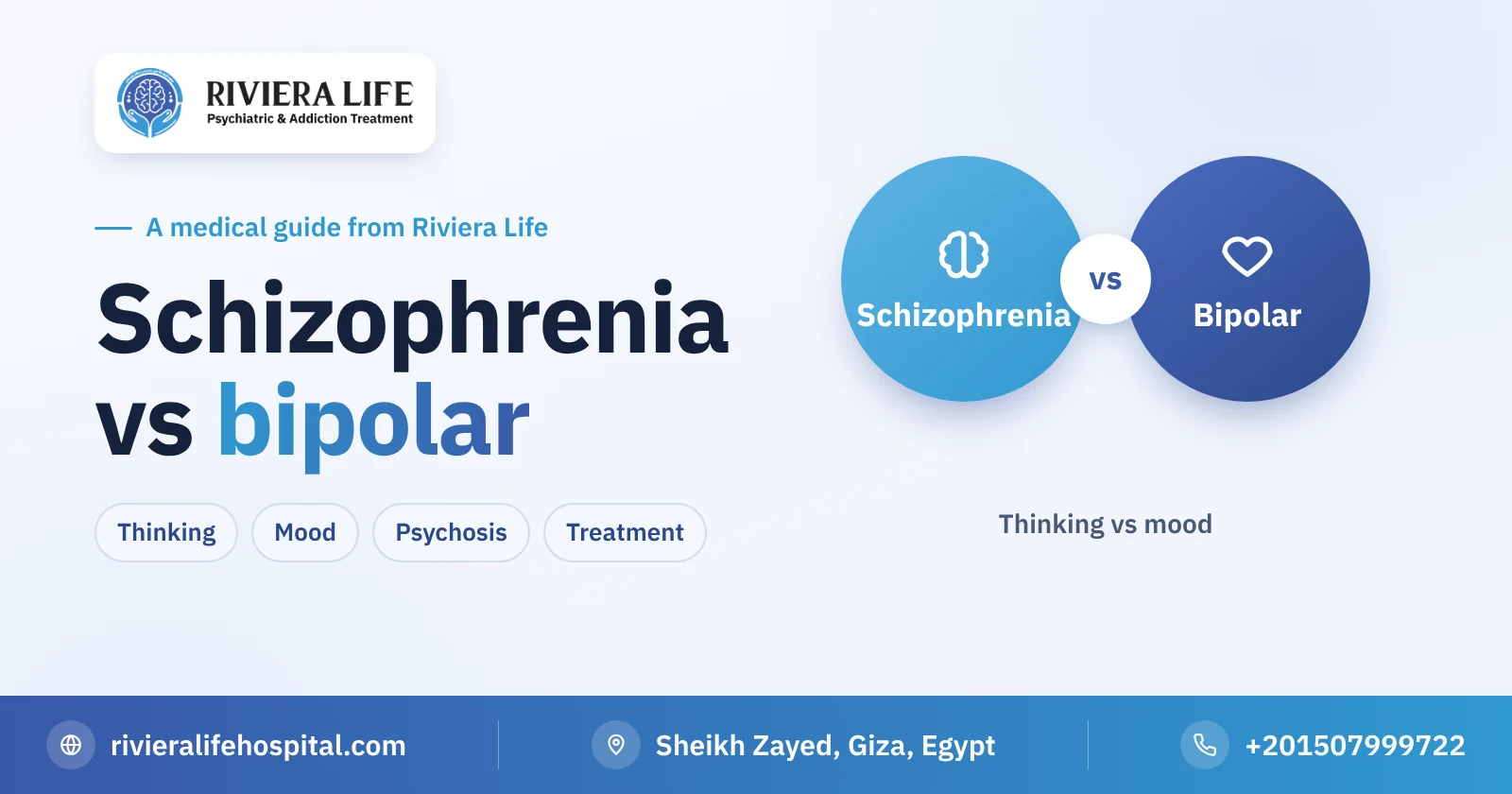
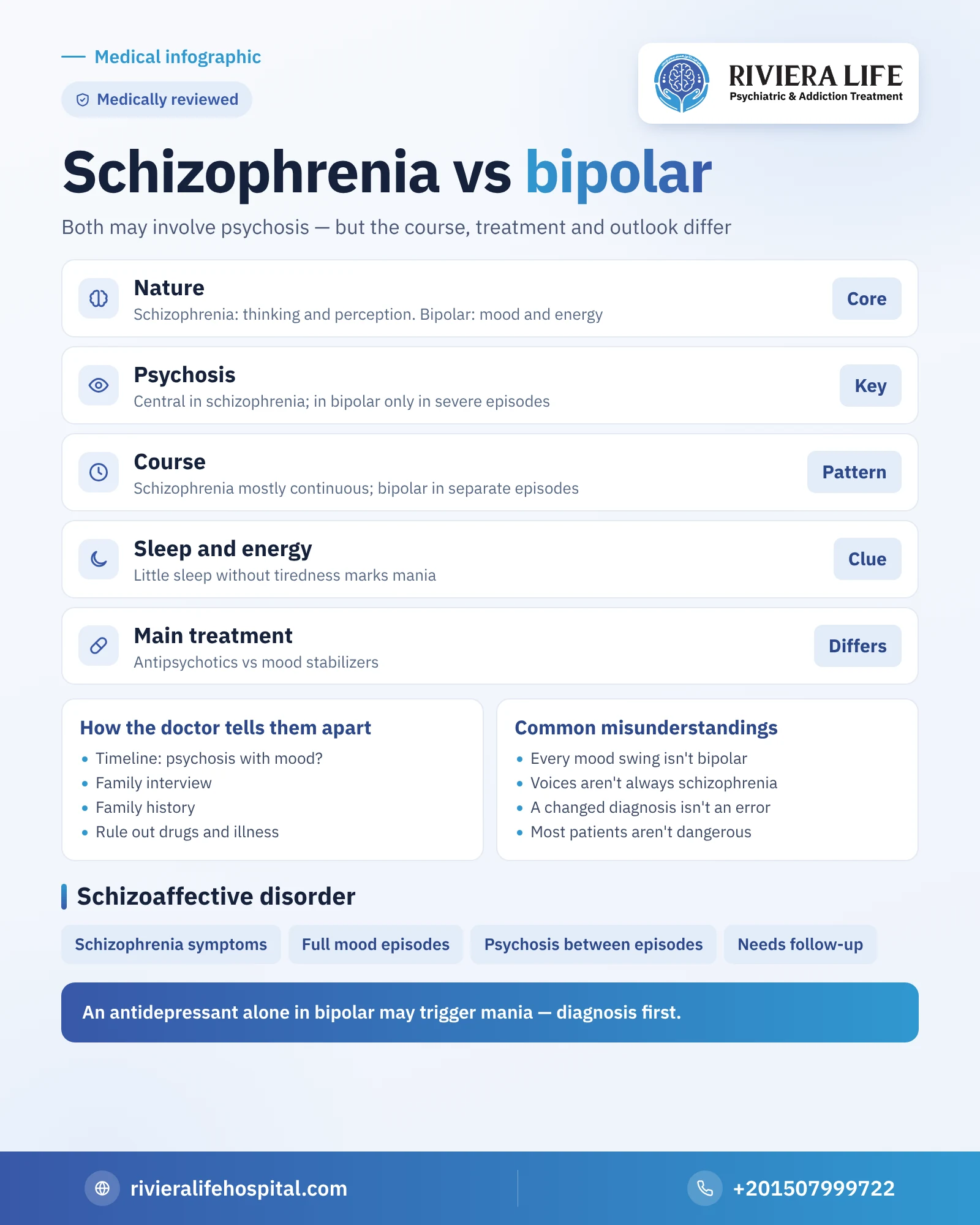
The difference between schizophrenia and bipolar disorder is that schizophrenia is a disorder of thinking and perception that continues even when mood settles, whereas bipolar disorder is a mood disorder in which episodes of mania or excessive activity alternate with episodes of depression. Both may share psychotic symptoms such as hallucinations and delusions, which is why things get confused even for doctors in the first episode. Here we set out the differences in a table and in daily life, how the doctor reaches the diagnosis, and why treatment differs.
Why do people confuse them?
People hear about a “mental disorder” and put both conditions in one basket. In reality there is a genuine overlap between them: both may carry psychosis, both usually begin in late adolescence or the twenties, both may be linked to genetics, and both need long-term treatment. But the course, treatment and outlook differ, which is why telling them apart matters.
A quick comparison in a table
| Point of comparison | Schizophrenia | Bipolar disorder |
|---|---|---|
| Nature of the disorder | A disorder of thinking, perception and emotional expression | A disorder of mood and energy |
| The most prominent symptom | Hallucinations, delusions, disorganized speech and withdrawal | Episodes of mania or hypomania alternating with depression |
| Are the symptoms episodic? | Usually continuous to varying degrees, with periods of improvement | Separate episodes with periods of near-normal functioning in between |
| Psychosis | The core of the illness, appearing outside any mood episode | May appear only during severe mania or depression |
| Sleep and energy | Disturbed sleep is common but isn’t central | Little sleep without tiredness is a distinctive sign of mania |
| Negative symptoms | Common: flat emotion, little speech and low motivation | Less between episodes, and the depression involves sadness rather than flatness |
| Main treatment | Antipsychotics with rehabilitation and support | Mood stabilizers with antipsychotics depending on the case |
This table is for general understanding only, as the diagnosis isn’t made by matching symptoms, but by the doctor’s assessment of the whole history.
What does schizophrenia look like in daily life?
A young man who was a top student begins to withdraw from his friends, says the neighbors are talking about him, his speech becomes broken, he neglects his hygiene and sits silent for hours. This picture is typical: a change in thinking and perception with withdrawal and lethargy. His mood may be stable or flat, with no clear enthusiasm or sadness. The full details are in our article on schizophrenia symptoms.
What does bipolar disorder look like in daily life?
An employee slept two hours a night for three nights while fully energetic, talks fast, and spends her savings on a new project, then weeks later sinks into sadness and exhaustion so heavy she can’t get up. Here it is the mood that swings, and the episodes have a beginning and an end. The signs of both episodes are explained in our article on bipolar disorder symptoms.
When psychosis appears in bipolar disorder
In severe mania the patient may believe they are a prophet or have special powers, and may hear voices. This looks like schizophrenia on the surface. The difference is that these ideas come with raised mood and activity and recede when the episode is treated, and they usually match the mood: the delusion is one of grandeur in mania and of guilt or poverty in depression. If psychosis continues for long weeks without disturbed mood, the doctor is more likely to consider schizophrenia or schizoaffective disorder.
Schizoaffective disorder: the middle ground
Some patients combine symptoms of schizophrenia with full mood episodes, which doctors call schizoaffective disorder. In it, psychosis continues in periods free of any mood episode. This classification shows that the boundaries between the two disorders aren’t a solid wall, and that the doctor sometimes needs to observe the course over months before settling on the diagnosis.
How does the doctor tell them apart?
- The timeline: did the psychosis come with the mood, or before and after it and independently of it?
- The interview with the family: what relatives noticed about sleep, spending and behavior before the episode.
- Family history: the presence of mood or psychotic conditions among relatives.
- Ruling out other causes: drugs, alcohol, thyroid disease, epilepsy and some medicines may mimic the symptoms.
- Follow-up: the diagnosis may change over time, which doesn’t mean the first doctor was wrong but that the picture has become clearer.
No blood test or scan settles the diagnosis, but they are done to rule out physical causes. Among the important substance-related causes are drugs such as hashish and stimulants, whose effect we explained in our article on drug-induced psychosis.
Why does telling them apart matter for treatment?
Treatment is directed according to the disorder. In schizophrenia, antipsychotics are the cornerstone, with rehabilitation and family support. In bipolar disorder, mood stabilizers are the foundation, and antipsychotics may be added in mania or psychosis. Using an antidepressant alone in bipolar disorder may push some patients toward mania, which is why it shouldn’t be given without an accurate diagnosis. Choosing and adjusting medicine is the doctor’s decision alone, and isn’t changed based on someone else’s experience. The details of treatment are in our articles on schizophrenia treatment and bipolar disorder treatment, and on psychosis medicines specifically in antipsychotics.
Outlook and living with each
Both are chronic disorders that can be controlled. Many bipolar patients live long periods of stability between episodes with regular treatment, and schizophrenia patients may improve a great deal with adherence to treatment and rehabilitation, with results varying from person to person. The most important shared factor is staying on treatment, avoiding drugs, regular sleep and family support. For families caring for a patient with either, there are two practical articles: dealing with someone with schizophrenia and dealing with someone with bipolar disorder.
When should you seek an assessment?
Ask for a psychiatrist’s assessment if voices or fixed suspicions appear, or a sharp change in sleep, behavior and spending, or noticeable withdrawal for weeks, or thoughts of self-harm. Don’t wait for the label to become clear; what matters is starting the assessment early. Early intervention improves results in both conditions.
Seek urgent help immediately if you see
Call an ambulance on 123 or go to the nearest emergency department if you see:
- Thoughts or talk of ending life — you can also call the mental health hotline on 16328
- Voices ordering harm to oneself or others
- Severe mania with dangerous behavior or not sleeping for days
- Refusing food and drink, or severe confusion
Genetics and shared factors
The two disorders share a role for genetics, and cases of schizophrenia and others of bipolar disorder may appear in the same family, which suggests a partly shared biological predisposition. But genetics is a predisposition, not fate, and factors interact with it such as severe stress, drug use, especially hashish and stimulants, disturbed sleep, and complications around birth. Having an affected relative doesn’t mean you will develop it, but it is a reason to see a doctor if early symptoms appear. The causes of each disorder are covered separately in the causes of schizophrenia and the causes of bipolar disorder.
Common mistakes in understanding the difference
- Thinking that everyone whose mood swings is “bipolar”; normal swings between happiness and sadness aren’t a disorder. The disorder is episodes lasting days that change sleep, behavior and functioning.
- Thinking that everyone who hears voices is “schizophrenic”. Voices may appear in severe depression, mania, trauma and after drugs.
- Thinking a changed diagnosis means the doctor made a mistake. Some diagnoses become clear over time.
- Thinking a patient with either is “dangerous”. The vast majority harm no one, and treating them with fear increases their isolation.
How can Riviera Life help you?
If you or a relative are unsure between the two diagnoses, Riviera Life’s consultant psychiatrists in Sheikh Zayed offer a comprehensive assessment in complete confidentiality, with round-the-clock medical supervision when needed, a family program and aftercare. The first consultation is free on +201507999722.
More from our schizophrenia guide
- Schizophrenia: the complete guide
- Types of schizophrenia
- The difference between bipolar disorder and borderline personality
- The causes of schizophrenia and risk factors
Questions many people ask
The two disorders are different, but the diagnosis may change with follow-up if it becomes clear that the psychosis was continuing outside mood episodes. This is a correction of the diagnosis, not a transformation.
This can happen in severe mania or depression in some patients, and it usually recedes when the episode is treated.
A disorder that combines symptoms of schizophrenia with full mood episodes, in which psychosis continues even in the absence of a mood episode.
Some antipsychotics are shared, but the plan differs. Bipolar disorder relies on mood stabilizers and schizophrenia on antipsychotics, and the decision is the doctor's.
Research indicates a partial overlap in genetic predisposition, but having an affected relative doesn't inevitably mean developing it.