Carbamazepine, best known by the name Tegretol, is an old, well-tried medicine used in epilepsy and trigeminal neuralgia, and in some treatment plans for mania and preventing mood swings. Its strength is its broad effect, and its weakness is its many interactions with other medicines and its need for regular blood tests. This article explains its uses, effects, the tests required and the important warnings without any doses, as starting, adjusting and stopping the medicine is the doctor’s decision only.
What is carbamazepine?
Carbamazepine works by slowing the sodium channels in nerve cells, reducing the excess electrical signals that cause epileptic seizures and nerve pain. This same effect calms excessive brain activity in some patients with mania. It is available as ordinary tablets, extended-release tablets and syrup, and in Egypt it is known by several brand names including Tegretol, so ask the pharmacist about the available alternatives. It isn’t considered an addictive substance, and isn’t used for pain relief or sleep.
The main uses
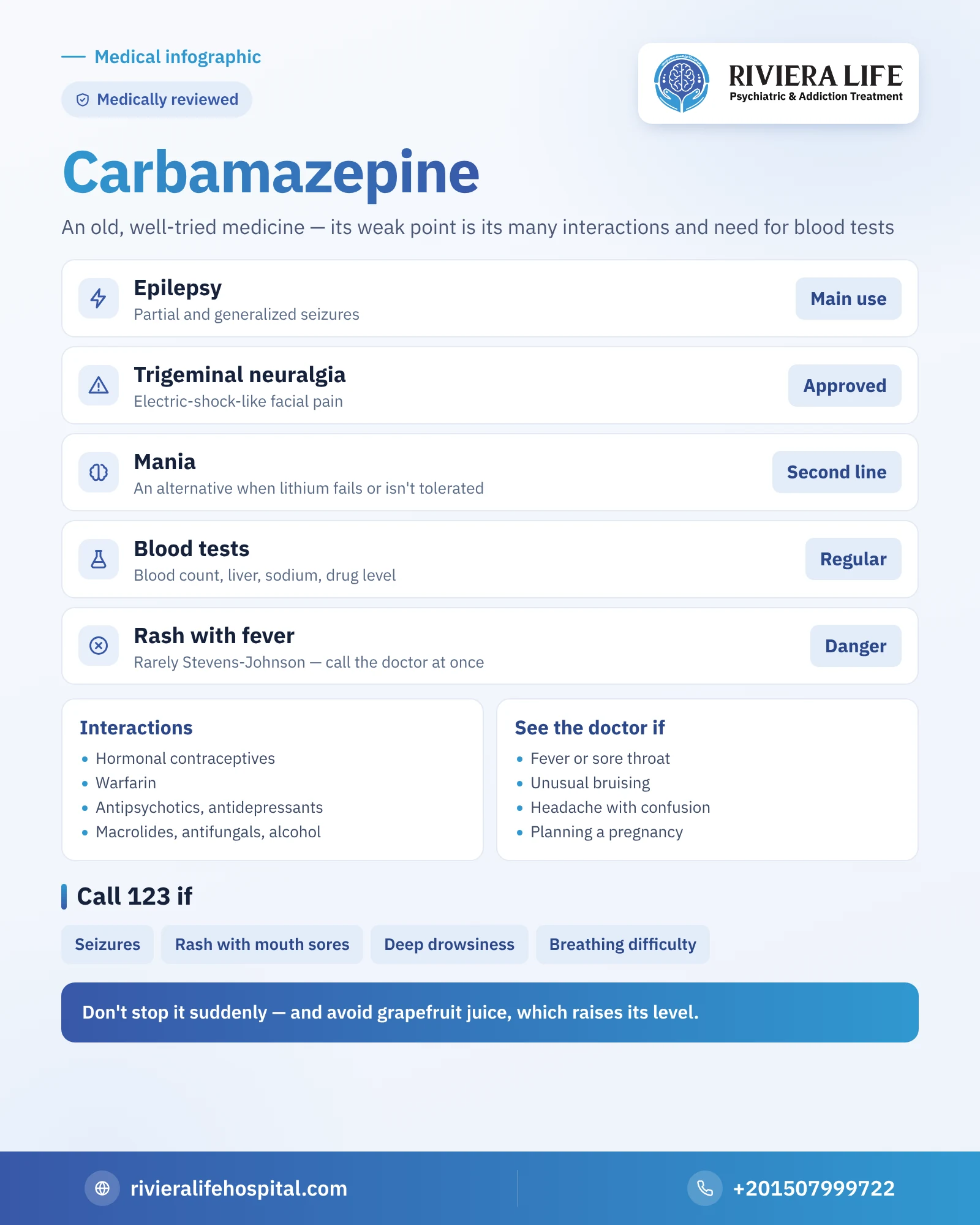
- Epilepsy: partial seizures and generalized tonic-clonic seizures; it is one of the traditional options.
- Trigeminal neuralgia: sudden facial pain like an electric shock; an approved indication.
- Mania in bipolar disorder: used in some countries as an alternative treatment when lithium doesn’t work or the patient can’t tolerate it.
- Preventing mood swings: within specific maintenance plans; it is used less today than newer medicines.
- Other uses: nerve pain of various kinds sometimes, and some cases of alcohol withdrawal in certain circumstances, according to the doctor’s judgment.
Carbamazepine in bipolar disorder
Carbamazepine is no longer the first choice for most doctors in this disorder; it has been replaced by medicines such as quetiapine, lithium, valproate and other antipsychotics. But it remains a useful alternative for those who didn’t respond to others or couldn’t tolerate them. Some doctors note that it helps in rapid cycling of mood swings in some patients. With its many interactions, the doctor needs to review everything the patient takes before adding it to the plan. You will find the general picture of options in our article on bipolar disorder treatment.
Why does it need blood tests?
Because the medicine may affect the blood, the liver and the body’s salts, the doctor requests tests before starting and at intervals afterwards. Common examples:
- Complete blood count: because the medicine may lower white blood cells or platelets, and in very rare cases cause aplastic anemia.
- Liver function: because the liver breaks it down, and its enzymes may rise.
- Sodium: it may fall in some patients, especially older people, causing headache, confusion and nausea.
- The drug level in the blood: in some cases, because the difference between a beneficial level and a troublesome one isn’t large.
Tell the doctor immediately if fever, a recurring sore throat, mouth ulcers, easy bruising and bleeding, severe pallor or yellowing of the eyes appear, as they may be signs of a problem with the blood or liver.
Genetic testing before starting
There is a gene called HLA-B*1502 that is more common among certain Asian ancestries, and is linked to a higher risk of a severe skin reaction with carbamazepine. That is why some bodies recommend testing for it before starting in people of these ancestries. Another gene is linked to sensitivity to the medicine in other groups. The doctor decides whether you need the test; not every patient does.
Skin rash
Most rashes are mild, but the medicine is among those known to sometimes cause Stevens-Johnson syndrome, a rare and serious reaction. Call the doctor immediately if a rash appears with fever, ulcers in the mouth or eyes, or peeling of the skin. Don’t wait for it to go away on its own, and don’t try to treat it with creams.
Common side effects
- Dizziness and drowsiness, especially in the first weeks or when the amount is increased.
- Unsteadiness and loss of balance.
- Double vision or blurred vision.
- Nausea and vomiting.
- Headache.
- Dry mouth and changes in appetite.
Many of these effects ease after weeks, or by dividing the medicine as the doctor directs. Don’t drive or operate dangerous machinery before you know how it affects you. And avoid grapefruit juice because it raises the level of the medicine in the blood.
Many interactions: what are the most important to watch for?
Carbamazepine is an “enzyme-inducing” medicine; that is, it activates the liver so it speeds up the breakdown of many other medicines, and even its own breakdown, so monitoring is needed. Examples:
- Hormonal contraceptive pills: their effectiveness may weaken, so don’t rely on them alone without consulting the doctor.
- Anticoagulants such as warfarin: their effect may decrease and test results change.
- Antipsychotics and antidepressants: their level may fall, including cariprazine, whose effect may weaken.
- Certain antibiotics (such as macrolides), some antifungals and antidepressants: may raise the level of carbamazepine and increase its side effects.
- Other epilepsy medicines: the interaction is mutual and needs adjusting.
- Alcohol: increases drowsiness and dizziness and threatens mood stability.
Tell every doctor and pharmacist what you take before any new medicine, even supplements and herbs.
What does the patient do daily to keep use safe?
A safe medicine is an organized medicine. Put the tablets in a weekly box, set a fixed time for them each day, and keep a small sheet with the names of all your medicines to show every doctor and pharmacist. Keep to blood test appointments even when you feel well, as some changes can’t be felt. Don’t swap one brand for another without telling the doctor, because absorption differs slightly between brands, and this matters in a medicine with a narrow safety range. If you fall ill with severe vomiting or diarrhea, tell the doctor, because you may lose the medicine before it is absorbed. Finally, pay attention to any sudden fever or sore throat in the first weeks, and don’t consider it just a cold.
Pregnancy and women of childbearing age
Carbamazepine is linked to an increased risk of birth defects, including neural tube defects. That is why every woman of childbearing age should discuss it with the doctor before planning a pregnancy, and not stop the medicine on her own, because epileptic seizures in pregnancy are also dangerous. The doctor weighs the balance, and may change the medicine or add folic acid according to his plan. And remember what was said above about the weakened contraceptive pill.
When should you see the doctor without delay?
- With any fever, sore throat or mouth ulcers.
- When bruising or unusual bleeding appears.
- With recurring headache and confusion, as sodium may be low.
- When adding a new medicine or stopping an old one.
- When planning or discovering a pregnancy.
Don’t stop it suddenly
Stopping carbamazepine suddenly may cause seizures in patients with epilepsy, and may bring back mood episodes in others. If you have a problem with the medicine, go to the doctor so he can set a plan to reduce or switch it. And if you forget a tablet, ask the pharmacist or doctor and don’t double the amount.
Call an ambulance on 123 immediately if you see
While using carbamazepine or after taking an excess amount of it:
- Seizures or loss of consciousness
- A skin rash with fever, ulcers in the mouth and eyes, or peeling skin
- Severe confusion or deep drowsiness that is hard to wake from
- A very slow pulse or irregular heartbeat
- Difficulty breathing or swelling of the face
- Yellowing of the eyes with abdominal pain
How can Riviera Life help you?
If you take carbamazepine with other medicines and fear interactions, or suffer from a mood disorder whose plan needs reassessing, the door of Riviera Life’s consultant psychiatrists is open, with complete confidentiality. The first consultation is free on +201507999722.
More from our bipolar disorder guide
Questions many people ask
It is used in epilepsy and trigeminal neuralgia, and in some treatment plans for mania and mood swings by the doctor's decision.
Because it may affect blood cells, the liver and the sodium level. Tests detect changes early, before their symptoms appear.
Yes, it may weaken the effectiveness of hormonal pills because it speeds up their breakdown in the liver. Discuss a more suitable method with the doctor.
No, it may cause seizures or a return of mood swings. Reducing or switching is done with the doctor's plan.
It is linked to an increased risk of birth defects, so a woman should discuss it with her doctor before planning a pregnancy and not stop the medicine on her own.