Cariprazine is a newer-generation antipsychotic, sold in some markets as Reagila and in others as Vraylar. Doctors prescribe it primarily for schizophrenia, and in some countries for manic and depressive episodes in bipolar disorder. What sets it apart is that it affects dopamine in a “partial” way different from most medicines in its class, and that its effect lasts weeks after stopping because the body clears it very slowly. Here we explain what patients and families should know about it without any doses, as starting, adjusting and stopping the medicine is the treating doctor’s decision alone.
What is cariprazine?
Cariprazine belongs to the atypical antipsychotics, and is known scientifically as a “partial agonist” at dopamine D2 and D3 receptors, with a stronger preference for D3, and also a partial agonist at serotonin 5-HT1A receptors. Put more simply: instead of closing the dopamine gates completely as older medicines do, it works as a regulator that raises activity if it is low and reduces it if it is excessive.
Excess dopamine in certain pathways is linked to hallucinations and delusions, and too little dopamine in other pathways is linked to blunted emotion and weak motivation. The medicine comes in capsules taken once a day according to the doctor’s plan. You will find the general picture of this class in our article on antipsychotics.
Approved uses
The approved indications differ from country to country, and this matters so you aren’t surprised when you compare the medicine’s leaflet with what you read online:
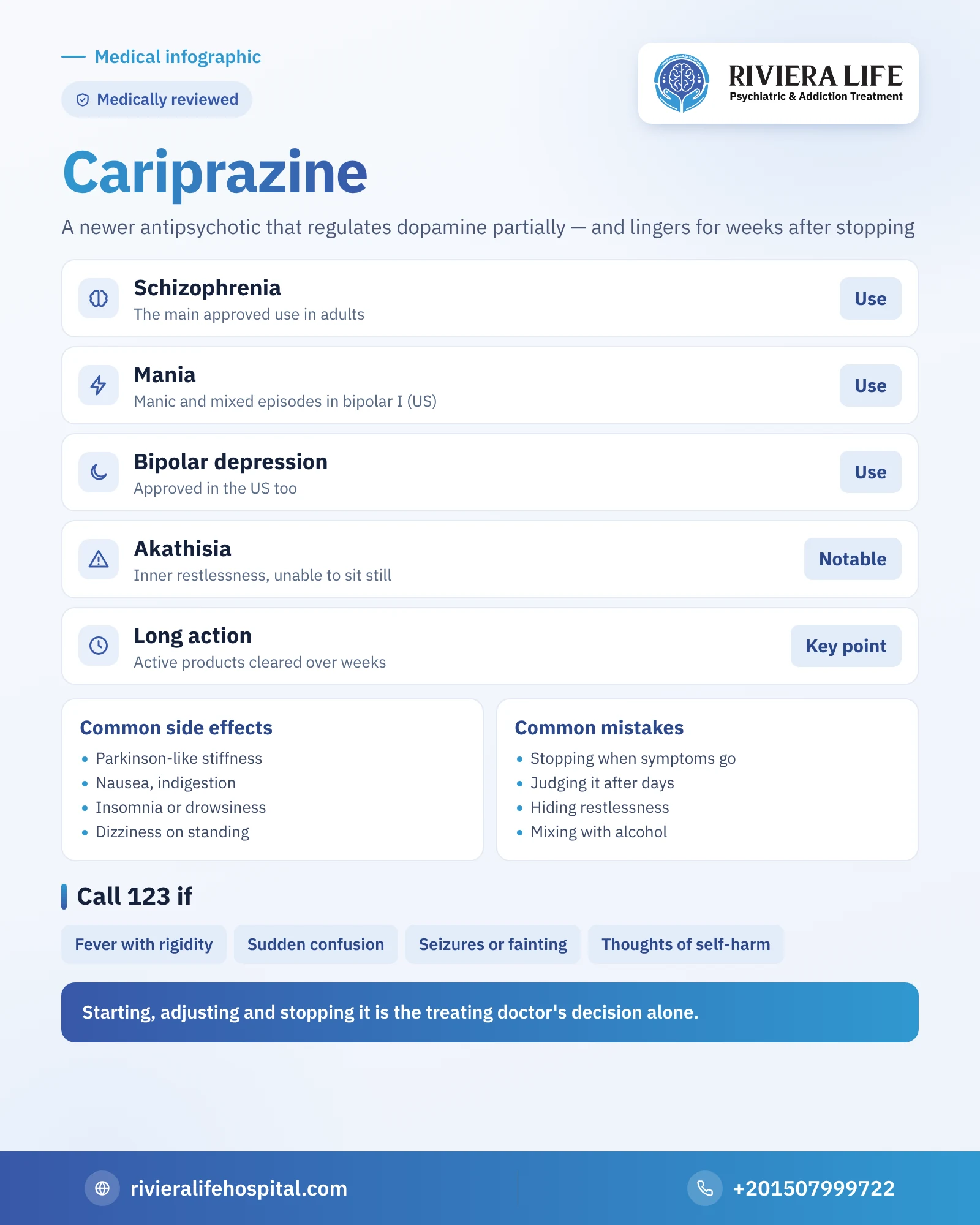
- Schizophrenia in adults: the main use, approved in Europe and in most countries where the medicine has been registered.
- Mania and mixed episodes in bipolar disorder (type I): approved in the United States.
- Bipolar depression: also approved there after studies conducted on patients in a depressive episode.
- Added to an antidepressant in major depression: when an antidepressant alone isn’t enough, also an approved indication in the United States.
As for its availability in Egypt and its brand names, these change as medicines are registered in the market, so ask the pharmacist or your doctor what is available rather than relying on one name. Any use outside these indications remains the doctor’s judgment after weighing benefit and risk.
How does it differ from other antipsychotics?
The difference that patients and doctors notice is often summed up in three points. The first is that drowsiness and sedation are less in many people compared with medicines such as quetiapine and olanzapine. The second is that the effect on weight, sugar and fats tends to be lighter, although some patients also gain weight, so measurement isn’t neglected.
The third is that its effect on the hormone prolactin is limited, so menstrual problems, milk secretion and reduced desire are less common with this partial-dopamine class compared with older medicines. On the other hand, another problem appears more clearly: akathisia, which we discuss shortly. There is no absolutely “better” medicine; the choice depends on the symptoms, what has been tried before, the state of the heart, liver and sugar, and what the body tolerates. The article on risperidone, for example, compares with a different style of weighing.
Negative symptoms: why are doctors interested in it?
In schizophrenia it isn’t only about hallucinations. There are “negative symptoms”: blunted emotion, little speech, loss of interest in people and work, and withdrawal from life. These symptoms are harder to treat than hallucinations because most medicines don’t improve them much.
Studies have been conducted on cariprazine comparing it with another medicine in patients dominated by negative symptoms, and it is reported to have shown benefit in this respect, so some doctors put it among the options when negative symptoms are the most prominent problem. This doesn’t mean it returns the patient fully to their previous state, as improvement is gradual and needs psychological, family and social support alongside it. To understand the illness itself in more depth, read schizophrenia treatment.
Common side effects
- Akathisia: an inner feeling of being unable to sit or stay still, pushing the person to walk and move constantly. It is the most notable effect with this medicine.
- Parkinson-like symptoms: muscle stiffness, tremor, slow movement.
- Nausea, vomiting and indigestion.
- Insomnia or drowsiness: either may appear, depending on the person.
- Weight gain: often less than some medicines in its class, but possible.
- Dizziness on standing up quickly.
Many of these effects ease with the doctor adjusting the plan, adding a supporting treatment, or changing the medicine’s timing. Don’t change anything yourself, and tell the doctor frankly what you feel, because a patient who hides restlessness finds themselves abandoning the medicine later.
Akathisia: how do you recognize it and why does it matter?
A young man of twenty-five started cariprazine after a psychotic episode, and after two weeks he was getting up from his seat every two minutes, couldn’t bear sitting at a family gathering, and told his mother he “couldn’t rest his body”. The family thought the illness had returned or that he was anxious, but the doctor recognized the well-known sign.
This restlessness is very distressing and may push the person to stop the medicine on their own, so if you see it, tell the doctor as soon as possible. The doctor has options: adjusting the plan, adding a treatment against the symptoms, or switching to another medicine. And if the restlessness is accompanied by severe despair or thoughts of self-harm, call the mental health hotline on 16328 or an ambulance on 123 without delay.
The extended effect: why doesn’t it disappear immediately on stopping?
Cariprazine is converted in the body into active substances that remain a long time, and clearing them is estimated to take weeks. So two things matter. The first is that the medicine’s effect, good or bad, may not appear fully in the first days, so the doctor monitors the patient for weeks before judging. The second is that some side effects may be delayed in appearing or in disappearing after stopping.
This isn’t to be read as a license to stop the medicine whenever the patient wishes. Stopping an antipsychotic suddenly may bring symptoms back weeks later, when the patient has forgotten they stopped, and the link between the two is missed by the family. Every change must go through the doctor. Our article on how psychiatric medicines leave the body covers this general aspect.
Important interactions and warnings
- Medicines that slow its breakdown in the liver: such as some antibiotics and antifungals, so its level in the blood rises.
- Medicines that speed its breakdown: such as carbamazepine and some tuberculosis medicines, so its effect weakens.
- Alcohol, sedatives and opioids: increase drowsiness and dizziness and depress breathing in large amounts.
- Older people with dementia: antipsychotics carry an official warning of an increased risk of death in them, so they aren’t used without careful weighing.
- Pregnancy and breastfeeding: information is limited, and the decision is the doctor’s after weighing the risk of the illness against the risk of the medicine.
- New urges: tell the doctor if a new, pressing urge to gamble, shop, eat or similar appears, as these are known warnings for the partial-dopamine class.
Call an ambulance on 123 immediately if you see
While using cariprazine or any antipsychotic:
- High fever with severe muscle stiffness
- Severe confusion or a sudden change in consciousness
- Heavy sweating with palpitations and fluctuating blood pressure
- Continuous involuntary movements of the face or tongue
- Seizures or fainting
- Thoughts of self-harm or ending life
Common mistakes
- Stopping the medicine because the symptoms disappeared, then relapsing weeks later.
- Judging it after a few days, even though its full effect needs weeks.
- Hiding restlessness from the doctor, so the patient abandons the medicine instead of having it adjusted.
- Combining it with alcohol or sedatives “to ease the symptoms”.
- Sharing the medicine with a relative who has similar symptoms, as choosing this medicine needs an individual assessment.
How can Riviera Life help you?
If you or a family member are taking an antipsychotic and feel restlessness or effects you can’t tolerate, or the family has fears of a relapse, we offer psychiatric assessment by consultants in psychiatry and addiction treatment, round-the-clock medical follow-up when needed, a family program, and complete confidentiality. The first consultation is free, and you can reach us on +201507999722 or visit us in Sheikh Zayed, Giza.
More from our antipsychotics guide
- Schizophrenia: the complete guide
- Antipsychotics: first and second generation
- Quetiapine
- Bipolar disorder treatment
Questions many people ask
It is an atypical antipsychotic, used in some countries for manic and depressive episodes in bipolar disorder. It is only prescribed after a doctor's assessment.
Akathisia, a feeling of being unable to stay still, along with nausea, insomnia and Parkinson-like symptoms. Tell the doctor so the plan can be adjusted rather than abandoning the medicine.
Because the body clears it and its active products slowly, which takes weeks. This doesn't mean stopping suddenly is safe.
It may increase weight in some patients, but often less than some medicines in its class. The doctor measures weight, sugar and fats regularly.
It isn't advised, as alcohol increases dizziness and drowsiness, weakens psychological stability and spoils the results of treatment.