The effect of a father’s addiction on his children begins before they understand the meaning of the word addiction. A child picks up the tension, the broken promises and the absence, and this may appear as anxiety, falling grades, aggression or excessive silence. Children of addicted fathers are more prone than others to psychological problems and to substance use in the future, but this isn’t an inevitable fate. The presence of one steady, safe adult changes a lot. This article is addressed to the mother, or to the grandfather, grandmother or anyone who cares for the children, so they know what the children are going through and how to protect them.
And if it is the child himself who is searching, there is an article written directly for him: my father is an addict.
What does a child live through in a home with addiction?
The hardest thing about this home isn’t the substance itself, but the inability to predict. The father may be tender and cheerful one day, then absent, angry or asleep all the next day. The child learns to watch his father’s face when he comes in to know what kind of day it will be. Added to this is the secret. The child hears that he mustn’t tell anyone, so he grows up carrying something he doesn’t understand and can’t talk about. In many homes this comes with financial strain, quarrels between the parents, and the mother being busy managing the crisis, so less time is available for the children themselves.
The effect by age
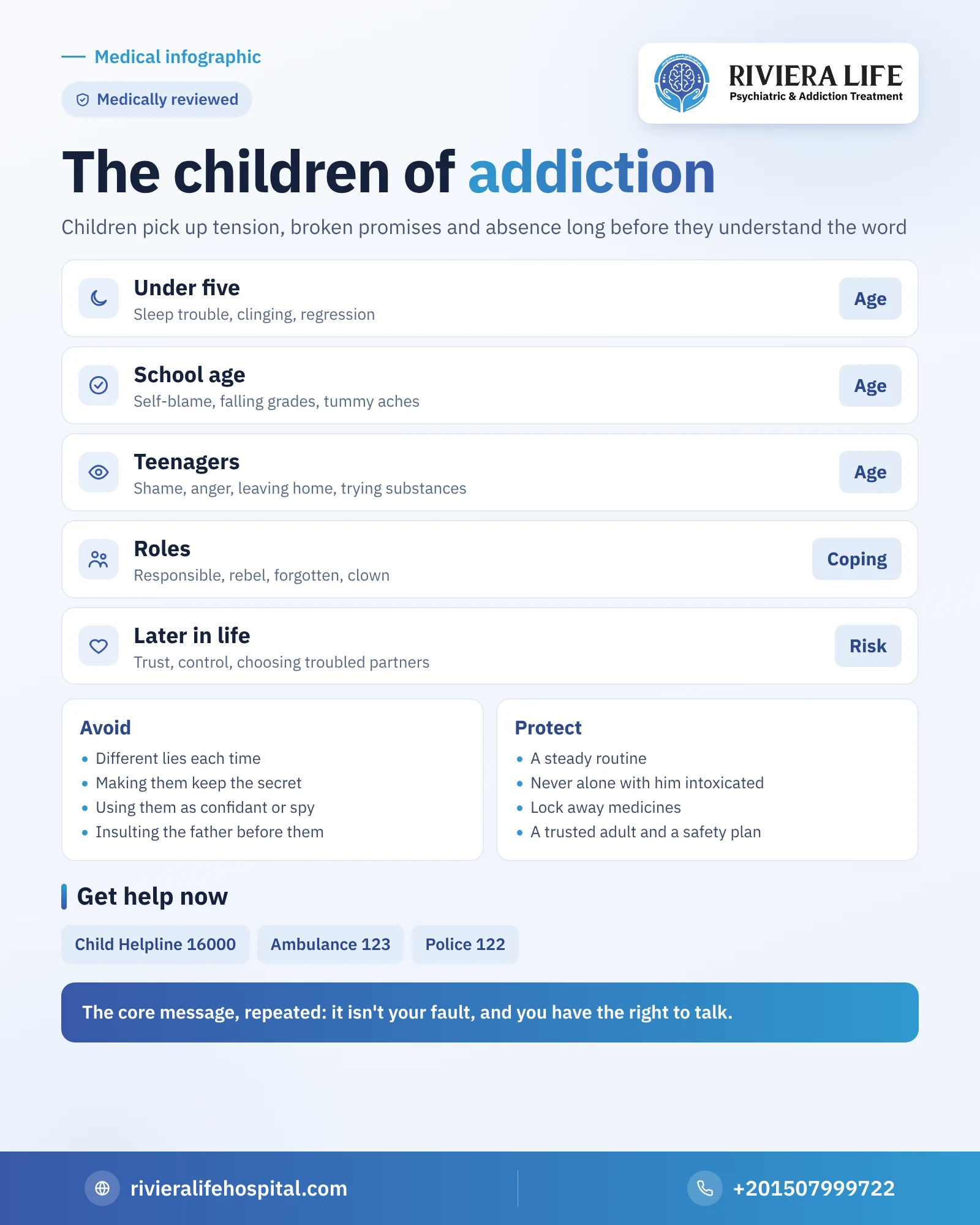
From birth to five
A young child doesn’t understand what is happening, but is affected by the lack of regular care and the tension around them. This may show as disturbed sleep, excessive crying, intense clinging to the mother, delay in some skills, or returning to behaviors they had left behind, such as bedwetting.
School age
The child begins searching for an explanation, and often concludes that he is the cause: if he were calmer or cleverer, his father wouldn’t drink or get angry. His achievement may fall, he may become aggressive with classmates, complain of repeated headaches and stomach aches, or avoid inviting friends home.
Adolescence
The teenager understands almost the whole picture, and is ashamed of it. He may be angry with his father, or with his mother for not leaving him, may withdraw from home and spend his time outside, and may try cigarettes or substances himself. Some teenagers do the opposite, becoming more perfect than necessary and carrying the worries of the whole home.
Roles children take on
Family therapists describe roles children adopt to adapt to the home. They aren’t diagnoses, but they help the mother understand what she sees:
- The responsible child: looks after siblings, reassures mother and excels at school. Seems fine, but carries a burden beyond their age.
- The rebellious child: problems at school and constant stubbornness. Draws attention away from the father, and is often blamed for the tension at home.
- The forgotten child: quiet and asks for nothing. No one notices them, so they don’t get what they need.
- The clown: makes everyone laugh to ease tension, and hides sadness behind jokes.
One child may move between more than one role. The quiet child and the high-achieving child need attention just as much as the rebel.
Do children inherit addiction?
The risk is higher, but not inevitable. Genetic predisposition plays a role, and the environment adds to it: seeing the substance as a solution, chronic tension and weak supervision. Public health bodies classify living with a parent who uses substances among adverse childhood experiences linked to later health and psychological problems. But many children of addicts grow up healthy, and what often makes the difference is a supportive adult, a stable routine, and a chance to talk about what they feel. This is what a mother can build even if she can’t change the father. For a broader understanding of risk factors at home, read parenting mistakes and addiction.
Effects that may appear when they grow up
Some effects only appear in young adulthood or after marriage. The child may find it hard to trust people, have an intense need to control everything, or a fear of conflict that makes them agree to what they don’t want. They may repeat the same choice, attaching to a partner with an addiction or who needs rescuing. Anxiety and depression rise in some. These patterns can be treated at any age, and it is best to catch them early.
How do you explain to the child what is happening?
Silence doesn’t protect the child, because they know something is wrong, and fill the gap with worse imagination or self-blame. What is needed is a simple truth suited to their age, without details they don’t need:
- For the young child: “Daddy has an illness that makes him act strangely sometimes. It isn’t because of you, and I’m here with you”.
- For school age: explain that addiction is an illness that makes a person lose control over using a substance, and that children don’t cause it and can’t stop it.
- For the teenager: be frank, allow them to be angry, and don’t ask them to defend their father or attack him.
And repeat the core message more than once: what is happening isn’t your fault, and you have the right to talk about it.
Mistakes the other parent makes unintentionally
- Lying to the child with different stories each time to justify the father’s absence or state.
- Making them carry the secret and warning them against talking to anyone, even the teacher or doctor.
- Making them the friend to whom the mother complains about her marriage.
- Using them as a messenger between the parents or a spy on the father.
- Constantly insulting the father in front of them, as they love their father despite everything.
- Being completely occupied with the father until everyone forgets the children’s needs.
Many of these patterns are part of the codependency we explained in the article on the effect of addiction on married life.
Protecting the child in daily life
- Keep a steady routine for sleep, food and school as far as possible; steadiness makes up for some of the chaos.
- Don’t leave the children in the father’s care while he is under the influence, and don’t let them ride in the car with him.
- Keep medicines and substances out of their reach.
- Give the older child a simple plan: a safe place in the house, a person’s number to call, and when to call the ambulance.
- Find them another adult they trust: a grandparent, an uncle or a teacher.
- Tell the school enough for them to understand the change in behavior, without details.
When does the home become unsafe?
If tension turns into violence, or the child is subjected to physical, psychological or sexual abuse or severe neglect, their safety comes before any other consideration. Signs that call for action include: bruises without a convincing explanation, clear fear of staying with the father, a sudden sharp change in the child’s behavior, or the child talking about things inappropriate for their age. Don’t investigate with the child yourself; listen, reassure them and ask for specialist help.
Get help immediately
In Egypt you can call:
- The Child Helpline 16000 with any suspicion of harm to or neglect of a child
- The ambulance on 123 if the father is unconscious or breathing with difficulty
- The police on 122 with threats or violence inside the home
When does a child need psychotherapy?
Not every child in this home needs treatment, but assessment is important if you notice sadness or anxiety lasting for weeks, repeated nightmares, a sharp drop in schoolwork, aggression or self-harm, complete withdrawal, or starting to try cigarettes or substances in adolescence. Treatment helps the child name their feelings and understand that what is happening isn’t their fault, and gives the mother tools to deal with them. We explained the types of these disorders in the article on mental illness in children.
When the father starts treatment
The father entering treatment doesn’t erase what happened immediately. The children may stay cautious for a while, and the teenager may be angry that everyone celebrates his father while no one asked him what he lived through. It helps here for the children to take part, according to their ages, in family sessions led by a therapist, and for the father to rebuild trust with small, consistent actions rather than big promises. For the wife’s dealings with the father himself there is a separate guide in the article on my husband is an addict.
How can Riviera Life help you?
At Riviera Life the father isn’t treated alone. The hospital offers a family program that helps the mother and children understand the illness and reorganize the home, and our consultant psychiatrists can assess the child or teenager if signs needing follow-up appear. The first consultation is free, and everything said in it is completely confidential. The hospital is licensed by the Ministry of Health, has fourteen years of experience, and is located in Sheikh Zayed, Giza, with round-the-clock medical supervision and aftercare after treatment. To get in touch: +201507999722.
More from the addiction and family guide
- My father is an addict
- My husband is an addict
- The effect of addiction on married life
- The family rehabilitation program for addiction treatment
Questions many people ask
No. The risk is higher than others because of heredity and environment, but many children of addicts grow up healthy, especially with a supportive adult and a stable routine.
Yes, with a simple truth suited to their ages and without details, stressing that the illness isn't their fault and that they have the right to ask and talk.
Signs include constant anxiety, nightmares, falling grades, aggression or intense withdrawal, and taking on responsibilities beyond their age.
They aren't left with him while he is under the influence of a substance, and they don't ride in the car with him in that state. With any suspicion of harm to the child, you can call the Child Helpline on 16000.
Not all of them, but assessment is important if sadness or anxiety persists, behavior problems appear, or a teenager starts using.