Parenting mistakes don’t create addiction on their own, but some of them raise the likelihood that the son turns to drugs when he grows up. The most prominent are harshness and excessive control, or the complete opposite: neglect and leniency without limits. Added to them is the child seeing their parents turn to cigarettes or pills whenever life gets hard for them, the absence of warmth, frequent comparison and shaming, and money given without follow-up. The reassuring side is that these mistakes can be corrected at any age. This article deals with what comes before use, that is, the home in which the child grows up, and what really protects them.
Does upbringing alone create an addict?
No. In addiction genetics, personality, mental disorders, friends and easy access to the substance all overlap. A child may grow up in a cohesive home and then stumble, and another may grow up in difficult circumstances and come through. But the way of upbringing is among the few factors parents can change, and its effect shows in specific things: the son’s ability to calm himself, his confidence that he can tell his parents, and how much the parents know about what is happening in his life.
The purpose of reading about these mistakes isn’t self-flagellation. Most parents fall into some of them out of fear, tiredness or repeating what they themselves were raised on.
The first mistake: harsh control
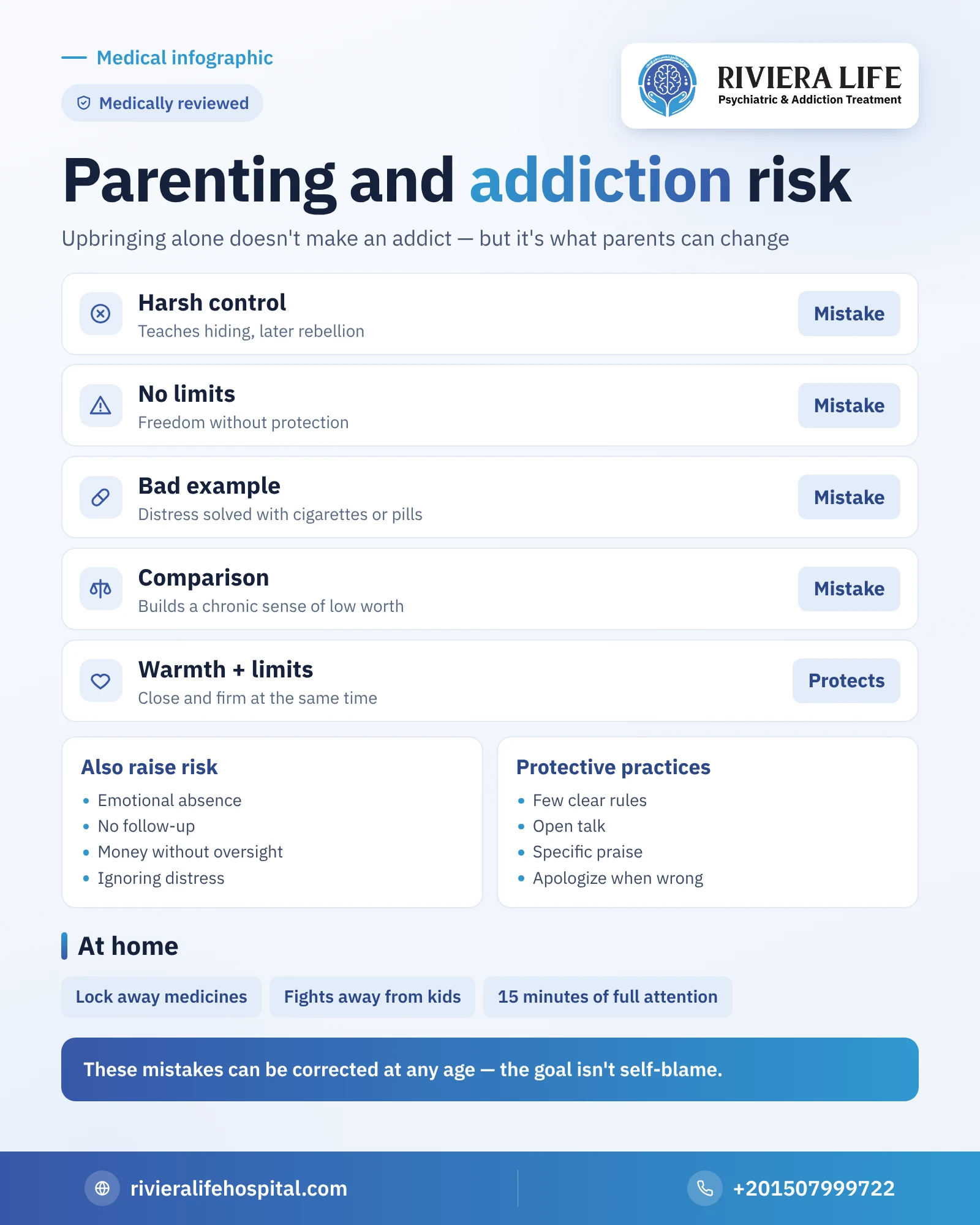
Orders without explanation, physical punishment or shouting at every mistake, and suffocating supervision that prevents the son from making any decision. This style seems firm, but it teaches the child one thing: to hide. The son who fears his father’s reaction won’t tell him that a friend offered him a pill, and won’t ask for help when he gets into trouble. With adolescence fear often turns into rebellion, and use itself may become a means of defiance or escape from pressure at home.
The second mistake: neglect and leniency without limits
At the other extreme is a home with no rules. No times for coming back, no one asks about friends, and every violation passes without comment because the parents are busy or want to avoid disagreement. The child feels free here, but it is freedom without protection, and many teenagers interpret the absence of limits as an absence of care. Studies link weak family supervision with an increased likelihood of early experimenting.
The example: what the child sees at home
A child learns from what they see more than what they hear. A father who smokes then warns his son against cigarettes sends two contradictory messages, and the child believes the action. More dangerous than smoking is the child seeing one of their parents take a sedative tablet “to be able to sleep”, or a strong painkiller for every headache, or hearing the phrase “I won’t be able to get through the day without…”. So they learn early that distress is treated with a substance.
- Keep prescribed medicines in a locked place, and get rid of what is no longer used, as the medicine cabinet is among the first things a teenager tries, as in the article on prescription drug addiction.
- Don’t make your son buy your cigarettes or fetch your medicines.
- If you smoke, tell him frankly that you wish you hadn’t started, and begin a serious attempt at quitting smoking.
- Let him see you deal with tension in other ways: walking, talking, prayer or rest.
Emotional absence: present in body, absent in feeling
A father may provide everything materially, and travel or work long hours to secure his children’s future, but not know what saddens his son or what frightens him. And a mother may be at home all day with her eyes on the phone or on never-ending burdens. A child who finds no one to listen looks for a sense of acceptance elsewhere, and may find it with a group that welcomes them on condition that they share what it does. A quarter of an hour a day of full attention, without screens or advice, makes a bigger difference than parents expect.
Comparison and shaming
“Look at your cousin”, “your sister is smarter than you”, “you’re a failure”. Sentences repeated in many homes without attention to their effect. Constant comparison usually doesn’t motivate a child, but convinces them that they are less than others. And shaming in front of relatives and guests adds a feeling of shame. Over time a chronic feeling of low worth forms, which is among the motives many people in recovery mention when they tell why they liked the effect of the substance the first time: that it made them feel, for hours, that they were fine.
Lack of follow-up: where is your son now?
Follow-up isn’t spying. It is knowing where your son spends his time and with whom, knowing his friends’ names and meeting some of their parents, and having reasonable times for coming back. The phone also needs a clear age-appropriate agreement, agreed on early rather than imposed suddenly after a crisis. A teenager who knows their parents care about the details of their day thinks twice before going to a place they can’t talk about.
Money without oversight
A large allowance whose uses aren’t asked about, a payment card in a teenager’s hand, or compensating for absence with gifts and cash. Money alone doesn’t create addiction, but it removes an important obstacle to reaching the substance, and eases entry into groups that spend on nights out. Better is a fixed allowance suited to age and real needs, and a calm conversation if the request suddenly increases or things disappear from the house.
Ignoring psychological distress
A child who can’t concentrate or sit still, a teenager who has suddenly withdrawn and isn’t sleeping, or a girl whose anxiety increases before every exam. Many parents interpret this as being spoiled or bad manners, and respond with punishment. But untreated anxiety, depression and hyperactivity make the substance seem a quick solution when the teenager tries it. We explained this relationship in the article on ADHD and addiction. And early assessment by a child and adolescent psychiatrist isn’t a stigma, but prevention.
Open conflicts in front of the children
Disagreement between spouses is natural, but repeated shouting and insults in front of the children and each threatening the other with leaving make the home psychologically unsafe. The effect increases when the child is asked to take sides, used as a messenger between the parents, or hears one of them constantly disparaging the other. The same happens after divorce when the children become a battlefield. A child living with this chronic tension looks for anything to calm them, and in adolescence may find calm in the substance. What is required isn’t that you never disagree, but that the disagreement is kept away from the children, and that they see it end in a solution.
Practices that protect your son
The style linked with the lowest rates of use in studies combines two things: clear warmth, and clear limits. That is, being close and firm at the same time. In practice:
- A few understandable rules: their reasons explained and applied consistently, with consequences known in advance rather than a momentary outburst.
- Open talk: your son knows he can tell you his mistake without you exploding in his face.
- Specific praise: praise effort and good behavior, not grades alone.
- Regular shared time: a family meal or a fixed weekly activity.
- Parental agreement: neither cancels the other’s decision in front of the children, even after separation.
- Repairing mistakes: if you shouted or were unfair, apologize. This teaches him how a person takes responsibility.
As for what to tell your son about drugs at each age stage, that is the subject of the article on drug prevention. And if you have already started noticing worrying signs, read how do I know if my son is using.
How does Riviera Life help you?
Some families come before use has even started, because they are worried about a son’s irritability or withdrawal, or because there is a history of addiction in the family. The consultants in psychiatry and addiction treatment at Riviera Life assess the situation, and set a plan that includes the son and his family together, and the family program offers practical training for parents in limits and communication. The first consultation is free and completely confidential, and the hospital is licensed by the Ministry of Health with fourteen years of experience in Sheikh Zayed, Giza. Call at any time: +201507999722.
More from the prevention guide
- Drug prevention
- Drug prevention in schools
- Teen addiction
- The effect of a father’s addiction on the children
Questions many people ask
Usually not. Harshness teaches the child to hide, so they don't tell their parents about an offer or a predicament, and it may push them to rebel in adolescence.
Children learn from their parents' behavior more than their words, and seeing cigarettes or pills as a way of dealing with distress entrenches this idea in them.
The style that combines warmth and closeness on one side, and clear rules and calm follow-up on the other.
Addiction has many causes, including genetics, mental disorders and friends. Blaming yourself doesn't help, and what matters now is seeking assessment and taking part in treatment.
There is no fixed figure, but a set allowance that suits their real needs is best, with a calm conversation if their request for money suddenly increases.