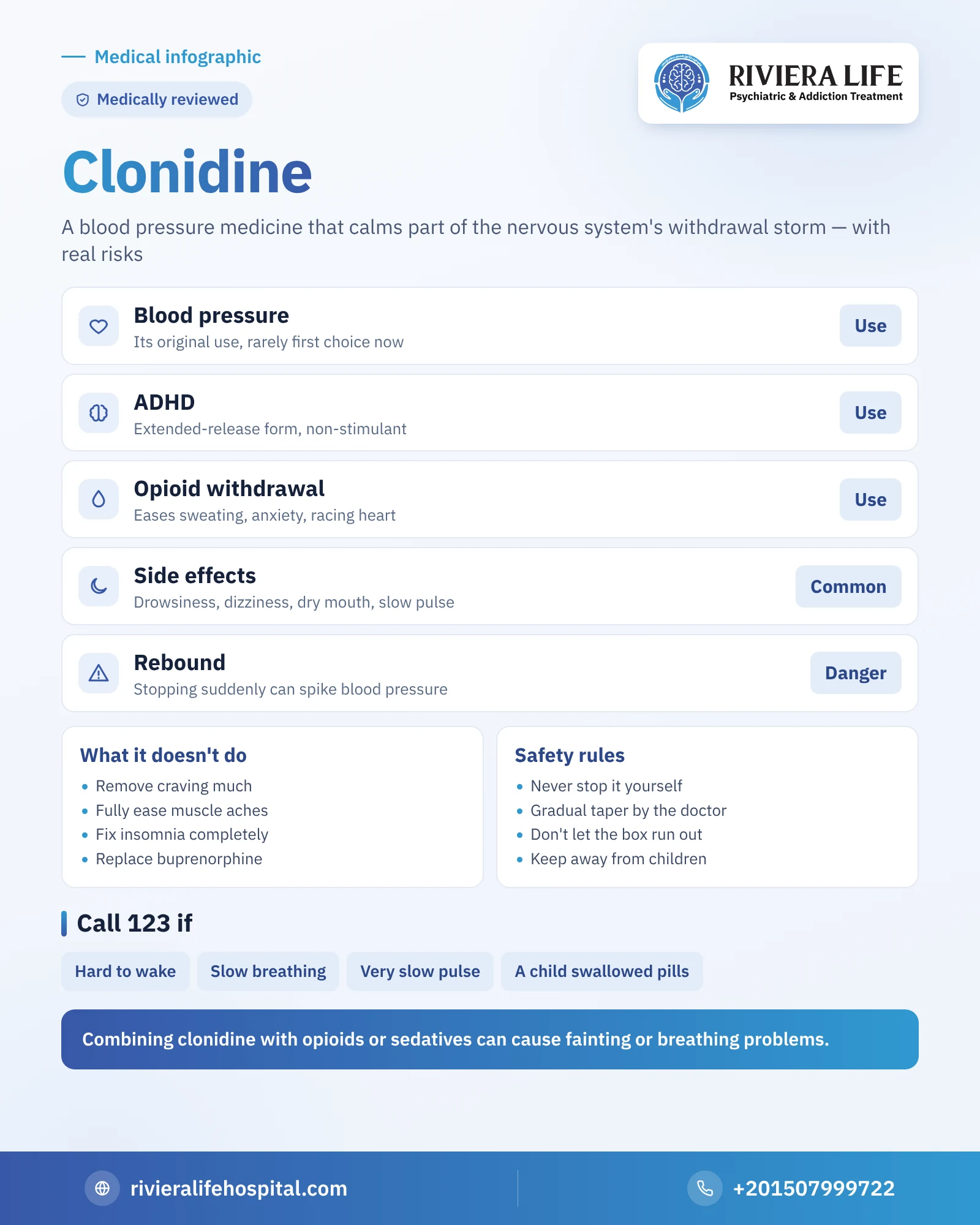
Clonidine is an old medicine originally made to treat high blood pressure; doctors then discovered that it calms part of the nervous system’s “storm” that occurs on stopping opioids, so it became one of the well-known supporting medicines in medically supervised detox. Its extended-release form is also used to treat attention-deficit/hyperactivity disorder in children.
The most important things to know about clonidine are that it may lower blood pressure and cause drowsiness, that stopping it suddenly may raise blood pressure dangerously, and that some opioid users misuse it. Here we explain its role and risks without doses, because starting, adjusting and stopping it is the doctor’s decision alone.
What is clonidine?
Clonidine belongs to the class of central alpha-2 receptor agonists. Simply put, it acts on centers in the brainstem, reducing the activity of the sympathetic nervous system, the system responsible for the “fight or flight” response: a racing heart, raised blood pressure, sweating and tension. When this system calms down, blood pressure falls and the heartbeat slows. It is available as tablets, as skin patches in some countries, and as extended-release tablets dedicated to ADHD.
Uses of clonidine
- High blood pressure: its original use, although it is often no longer the first choice today.
- ADHD: the extended-release form is approved for children from age six, alone or with stimulants, within a plan that includes behavioral therapy.
- Tics and Tourette syndrome: the doctor may turn to it to ease motor tics.
- Opioid withdrawal symptoms: an off-label use, but common and well known in detox programs.
- Other uses: such as hot flushes, and as an aid in alcohol, sedative or smoking withdrawal, as the doctor judges.
How does clonidine ease opioid withdrawal symptoms?
When the body gets used to heroin, tramadol or other opioids, the drug suppresses a center in the brain called the “locus coeruleus”, and the brain compensates by increasing this center’s activity. On sudden stopping, the suppressed activity is released all at once: sweating, runny nose and eyes, chills, a racing heart, anxiety, abdominal cramps and diarrhea. Clonidine calms this same center, clearly easing these “sympathetic” symptoms.
But it is important to know its limits: it doesn’t greatly ease the urgent craving to use, nor fully treat muscle and bone aches or insomnia, so it is usually combined with other medicines for specific symptoms and with psychological support. And it doesn’t replace therapeutic opioid medicines such as buprenorphine in cases that need them. As for the time course of withdrawal and what the patient goes through day by day, you will find it in our article on opioid withdrawal symptoms.
Why is it given under medical supervision in withdrawal?
Because a patient in withdrawal may already be exhausted and dehydrated from vomiting and diarrhea, which makes them more sensitive to a drop in blood pressure. In hospital, the team measures blood pressure and pulse before almost every dose, postpones it if blood pressure is low or the heart slow, monitors fluid intake, then reduces the medicine gradually after withdrawal ends. This precision isn’t available when a person takes clonidine at home to try to “come off” alone, then stands suddenly, gets dizzy and falls. That is why it is part of integrated opioid addiction treatment, not a substitute for it.
What does the patient expect during withdrawal with clonidine?
A patient in his thirties, who has used tramadol for years, comes in for detox expecting the medicine to wipe out all symptoms. In the first days he does notice that sweating, tremor, anxiety and chills are milder than what he went through in his previous attempts at home. But he still feels pain in his legs, insomnia and some diarrhea, so the team gives him other medicines for these specific symptoms.
He may feel some dizziness and drowsiness, so he is asked to get out of bed slowly and drink fluids. As the peak of withdrawal ends, the doctor starts reducing clonidine gradually instead of stopping it suddenly, then the plan moves on to psychotherapy and relapse prevention. This realism in expectations protects the patient from frustration and from leaving treatment halfway.
Clonidine and ADHD
In ADHD, clonidine is classified among the non-stimulant medicines. The doctor may prefer it when the child doesn’t tolerate stimulants, when there are tics, or when insomnia, impulsiveness and anger are a prominent part of the picture, and sometimes it is added to a stimulant. Its effect is slower and calmer than stimulants, and takes weeks to become clear. The full picture of treatment options is explained in our article on ADHD treatment. The doctor monitors the child for drowsiness at school, blood pressure and pulse, and the family needs to keep to the timings, because forgetting for several days and then going back suddenly isn’t safe.
Common side effects
- Drowsiness and tiredness, especially in the first weeks.
- Dizziness on standing because of low blood pressure.
- Dry mouth and constipation.
- Headache and nausea.
- A slow heartbeat.
- Skin irritation where the patch is placed, if used.
Following the doctor’s instructions, getting up slowly from sitting, and drinking water reduce many of these effects. Tell the doctor if drowsiness leads to a decline at work or in study.
Rebound blood pressure: the danger of stopping suddenly
This is the most important point in the article. The body adapts to clonidine, so if it is stopped suddenly after regular use, blood pressure may surge to levels higher than before the medicine, with palpitations, tension, headache, tremor, nausea, flushing and chest tightness. This may be dangerous for someone with heart or blood vessel disease. Therefore:
- Never stop the medicine on your own, even if you feel you no longer need it.
- Stopping is by a gradual reduction set by the doctor.
- Don’t let the box run out before the doctor’s appointment, especially before travel or holidays.
- Tell any doctor treating you, including the anesthesiologist before any surgery, that you take clonidine.
Misuse of clonidine with opioids
Addiction to clonidine alone is rare, but the medical literature records its misuse among some users of opioids or sedatives, who combine it with them seeking deeper sedation, to prolong the effect, or to ease withdrawal symptoms between doses without supervision. This combination is dangerous: the depression from the opioid together with the low blood pressure and slow heart from clonidine may lead to fainting, loss of consciousness or difficulty breathing. And if you find clonidine tablets with someone who doesn’t have blood pressure problems and isn’t under treatment, it may be a sign of use that needs assessment.
Interactions and warnings
- Sedatives, alcohol, opioids and pregabalin: increase drowsiness and depression of the nervous system.
- Blood pressure and heart medicines: especially beta-blockers, as combining and stopping them need careful arrangement by the doctor.
- Children: a young child swallowing tablets from an adult’s box may cause serious poisoning, so keep the medicine closed away.
- Pregnancy and breastfeeding: the decision is the doctor’s after weighing up.
Call an ambulance on 123 immediately if you see
After taking an extra amount of clonidine, combining it with opioids or sedatives, or after stopping it suddenly:
- Severe drowsiness or difficulty waking
- Slow or interrupted breathing
- A very slow pulse or fainting
- A sudden severe headache with chest pain after stopping the medicine
- Confusion or sudden weakness on one side of the body
- A child swallowing any amount of the tablets
How can Riviera Life help you?
At Riviera Life, clonidine is used, when the doctor decides so, within a complete detox program under round-the-clock medical supervision, with regular measurement of blood pressure and pulse, gradual reduction, a psychotherapy plan and aftercare. If you are trying to quit opioids alone, or using clonidine without follow-up, the first consultation is free and confidential, and you can get in touch at any time on +201507999722.
More from our addiction treatment medicines guide
Questions many people ask
It doesn't treat the addiction itself, but eases some of the physical symptoms of withdrawal such as sweating, anxiety and a racing heart. Treatment needs a complete medical and psychological plan.
It isn't advised without a doctor, because low blood pressure and dizziness are common with the dehydration that accompanies withdrawal. It is better for withdrawal to be done under medical supervision that measures blood pressure and pulse.
No, it is a non-stimulant medicine, and may cause drowsiness rather than alertness. The doctor sometimes chooses it when stimulants don't suit the child.
Blood pressure may rise and rebound symptoms appear. Contact your doctor to tell you how to return to your plan safely, and don't double the amount yourself.
Addiction to it alone is rare, but the body adapts to it so it isn't stopped suddenly, and it is sometimes misused with opioids, which is dangerous.