Codeine addiction treatment usually starts with a question that doesn’t occur to the family: why did this medicine start in the first place? Most people dependent on codeine didn’t buy it looking for a high, but for recurrent headaches, toothache or a cough, then the tablet or the bottle of syrup became part of the day. That is why a successful plan combines gradual withdrawal under medical supervision, a liver check for those who overused combination tablets, treatment of the original cause, and rehabilitation that prevents return. The article also covers treating cough syrup addiction, because it has details that differ from tablets.
From prescription to dependence: what does the case look like at the start of treatment?
Codeine patients reach the clinic in recurring forms. A woman in her thirties who has taken combination painkiller tablets every day for two years for a headache that no longer leaves her. A university student who drinks a bottle or more of cough syrup a night with friends. A man who had an operation on his back and stayed on the painkiller after the reason for prescribing it had ended. What these cases share is that the person doesn’t see themselves as “an addict”, and tries to stop alone then returns after two days because of anxiety, insomnia and body aches.
As for what codeine is, and why its effect differs from person to person because it turns into morphine in the liver, we explained it in detail in the article on codeine. Here we focus on the practical steps of treatment.
When does codeine use need specialist treatment?
Not everyone who took codeine for a week after a tooth extraction needs a treatment program. But specialist treatment becomes necessary when signs appear such as:
- Daily use that continues after the pain or cough that started it has gone.
- Gradually increasing the amount to get the same effect.
- Moving between pharmacies or doctors to get the medicine, or hiding bottles and strips.
- Withdrawal symptoms when it is late: yawning, runny nose, muscle aches, diarrhea and irritability.
- Exceeding the safe limit of the paracetamol or anti-inflammatory contained in the tablet itself.
- Combining it with sleeping pills, pregabalin or alcohol.
The stages of codeine addiction treatment
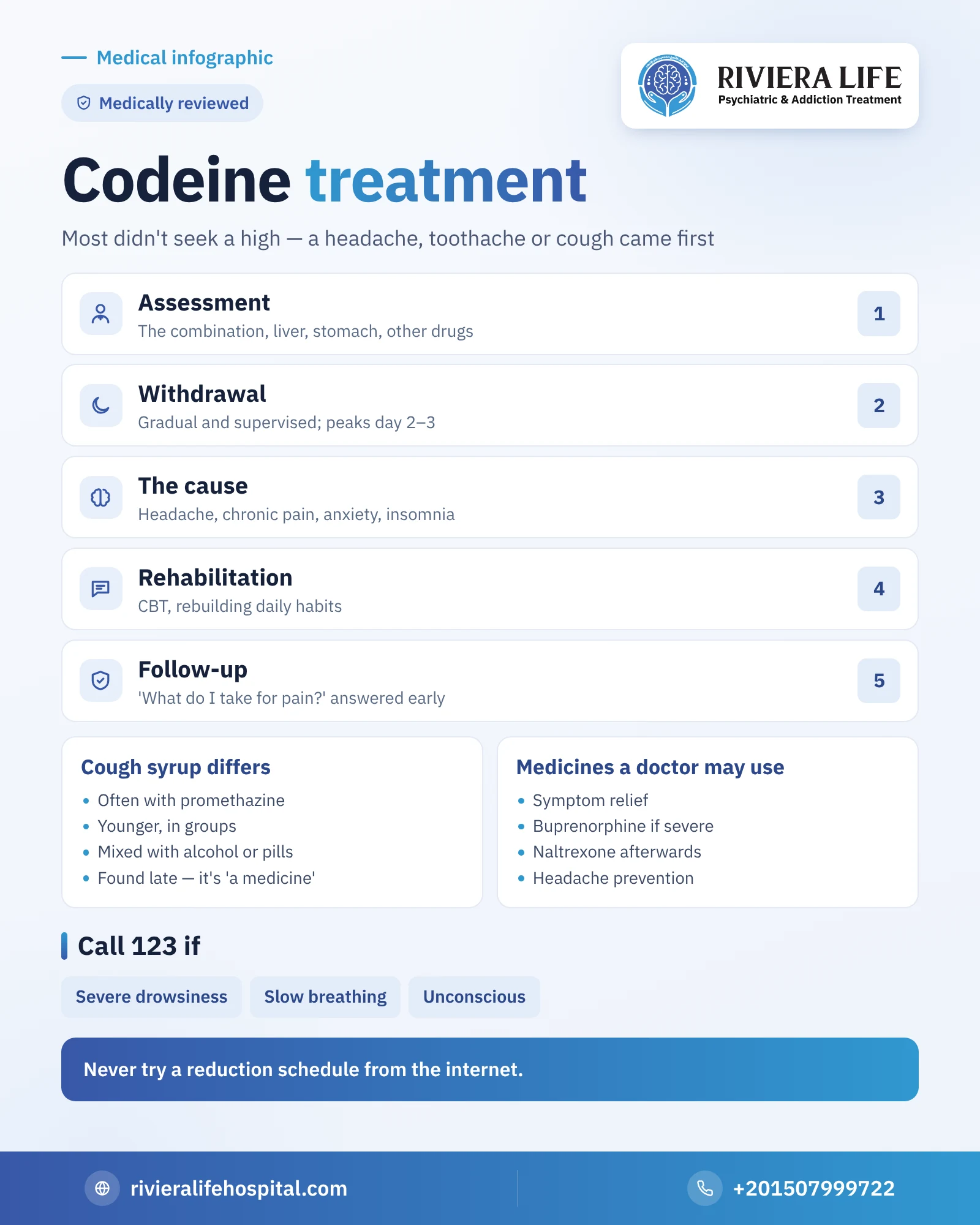
The treatment plan usually passes through five stages, and the duration of each varies with the amount, length of use and other substances:
- A medical and psychological assessment that determines the form of codeine used, its amount and any accompanying harm.
- Gradual or medically managed withdrawal that eases withdrawal symptoms.
- Treating the original cause: headache, chronic pain, anxiety or insomnia.
- Psychological and behavioral rehabilitation that rebuilds daily habits.
- Long follow-up and a clear plan to prevent relapse.
The first assessment: tests that mustn’t be skipped
The most important feature of assessing a codeine patient is asking about the combination, not codeine alone. Someone who takes tablets combining codeine and paracetamol in large numbers needs a liver function test, and someone who takes combinations containing an anti-inflammatory may need a stomach and kidney check, especially if they complain of severe heartburn or dark stools. The doctor asks about other medicines that may interfere with the withdrawal plan, including some antidepressants that affect how codeine is converted in the body.
On the psychological side, the doctor assesses anxiety, depression and sleep disturbance, as many discover after stopping that codeine was covering chronic anxiety. The patient is asked frankly and confidentially about tramadol, sleeping pills or hash, because multiple substances change the whole treatment plan.
Gradual withdrawal and expected withdrawal symptoms
Codeine withdrawal resembles that of other opioids but is usually milder than heroin or morphine withdrawal: runny nose, tears and yawning at first, then muscle aches, abdominal cramps, diarrhea, insomnia and anxiety, usually peaking on the second or third day, with the acute symptoms calming within about a week. But “milder” doesn’t mean easy; these are the days when most who try to stop alone fail.
That is why many doctors prefer reducing the amount gradually under supervision instead of stopping suddenly, with medicines to ease each symptom. Only the doctor decides how this is done and at what speed, and trying a reduction schedule from the internet is never advised. The full sequence of withdrawal symptoms is in the article on opioid withdrawal symptoms.
Medicines the doctor may use
Choosing the medicine is a medical decision depending on the severity of dependence and the presence of other substances; the main options are:
- Medicines for symptoms: to ease diarrhea, cramps and anxiety and improve sleep, which alone are enough in many mild cases.
- Buprenorphine: the doctor may turn to it in severe dependence or repeated relapse; it is explained in the article on buprenorphine.
- Naltrexone: may be used after withdrawal ends for those who need extra protection against return.
- Treating accompanying conditions: such as antidepressants or preventive headache treatment according to the diagnosis.
None of these medicines may be started or adjusted without the treating doctor.
Treating cough syrup addiction
Treating cough syrup addiction differs slightly from treating tablets for three reasons. First, many of these syrups contain, along with codeine, an antihistamine such as promethazine, so the patient is used to two substances, not one, and may suffer more severe insomnia after stopping. Second, users are often younger, drink it in groups, and sometimes mix it with soft drinks, alcohol or sleeping pills, a mixture that multiplies the risk of slow breathing. Third, the family discovers it late because it is “a medicine” found in every home.
That is why treatment here focuses on carefully checking other substances, dealing with peer pressure, and involving the parents in a clear plan. As for misused cough syrups that don’t contain codeine, such as some containing dextromethorphan, they have a different assessment the doctor determines.
Not all cough medicines contain codeine; many rely on dextromethorphan, and its misuse differs in effect and danger from codeine. Its details are in the article on Toscan syrup and dextromethorphan misuse.
Treating the cause: headache, pain and anxiety
Neglecting the original cause is the shortest road to relapse. Daily headache in someone who takes painkillers every day may itself be the result of overusing painkillers, and usually improves after weeks of stopping with preventive treatment chosen by a neurologist. Chronic back or joint pain needs an assessment of its source, non-opioid alternatives and physiotherapy. And someone who drank cough syrup to sleep or calm down needs treatment for anxiety or insomnia by safe means.
Psychological rehabilitation and the family’s role
Cognitive behavioral therapy helps the patient link craving to its situations: work pressure, late nights, or the first feeling of a headache. They learn practical alternatives for each situation instead of reaching for the strip or the bottle. The family’s role is to remove painkillers and extra cough syrups from the home, agree with the patient that any new painkiller is on prescription and with the treating doctor’s knowledge, and avoid searching and accusing, which pushes towards hiding. For many mild cases outpatient treatment is enough, while residential treatment is preferred in severe dependence, multiple substances or failed previous attempts.
Preventing relapse after stopping
Relapse in codeine cases may begin with something simple: a strong headache on a long working day, a toothache or a cold. That is why the discharge plan includes an answer in advance to the question “what do I take for pain?”, and telling any future doctor or dentist about the history of dependence. It is important to know that tolerance falls after stopping, so returning to the old amount, especially with sleeping pills or alcohol, may cause poisoning. For the general treatment plan for the whole opioid family, see opioid addiction treatment.
The right hospital for codeine addiction: how to choose
The right hospital for codeine addiction is the one that deals with what distinguishes this patient: a medicine that started with a prescription, combinations that may harm the liver, a headache or pain that needs real treatment, and young people misusing cough syrup. Ask before you decide:
- Does the hospital check the liver and stomach in those who overused combination tablets?
- Does it offer gradual withdrawal under medical supervision instead of sudden stopping?
- Does it have a plan to treat headache or chronic pain without returning to opioids?
- Does it deal with cough syrup misuse and mixing with sleeping pills or alcohol?
- Does it offer outpatient treatment for mild cases and admission for severe ones?
- Does it involve the family and provide follow-up after the program ends?
And beware of any party that promises a guaranteed cure or finishing treatment in a few days.
How Riviera Life meets these standards in codeine addiction treatment
This is what the patient and their family find at Riviera Life in practice:
- Official license: a hospital licensed by the Ministry of Health.
- Extended experience: fourteen years in addiction treatment and thousands of recovered cases.
- Specialist consultants: doctors in psychiatry and addiction treatment who set a plan that takes the original reason for use into account.
- Round-the-clock supervision: continuous medical follow-up during the first days of withdrawal.
- Flexibility in the form of treatment: an outpatient program for mild cases and admission for severe dependence or multiple substances.
- Complete confidentiality: full protection of the patient’s data, which matters to students and employees.
- A family program and aftercare: sessions for relatives and follow-up after discharge to prevent relapse.
The first consultation is free, and you can get in touch around the clock on +201507999722; the hospital is in Sheikh Zayed, Giza.
More from the opioids guide
- Opioids: the complete guide
- Codeine: its uses and risks
- Opioid addiction treatment
- Tramadol vs codeine
- Codeine withdrawal symptoms: the timeline, cough syrup specifics and when to worry
Questions many people ask
The acute withdrawal symptoms usually calm within about a week, but complete treatment including rehabilitation and follow-up lasts months. The duration varies with the amount, length of use and other substances.
Yes in many mild and moderate cases, with regular visits and close follow-up. Severe dependence, mixing with sleeping pills or failed previous attempts make admission safer.
Codeine itself isn't the biggest problem for the liver, but many of its tablets contain paracetamol, and overusing them may damage the liver. That is why the doctor requests liver function tests at the start of treatment.
Talk to him calmly without accusation, and book an assessment with a doctor specializing in addiction treatment. If severe drowsiness or slow breathing appears, call the ambulance on 123 immediately.
Look for liver and stomach checks, gradual supervised withdrawal, a plan for the original pain or headache, care for cough syrup misuse, a family program and follow-up. Riviera Life in Sheikh Zayed meets these criteria.