Codeine is an opioid painkiller extracted from the poppy plant, and it is included in painkiller tablets for mild and moderate pain and in some cough medicines. It seems a simple medicine because it is one of the weakest opioids, but it has a property that makes it different from them: most of its effect doesn’t come from it directly, but from the morphine it is converted into inside the liver, and this process differs from person to person according to their genes. That is why one person may feel no pain relief, while another is poisoned by the same prescribed dose. This article explains what codeine is, where it is found, why it is forbidden for children, how its use turns into dependence, and when the situation becomes an emergency.
What is codeine?
Codeine is one of the natural alkaloids found in opium, but it is present in it in a small proportion, so most medicinal codeine is made from morphine or other substances extracted from the poppy. It is classified among the weak opioids, and works on the opioid receptors in the brain and spinal cord, easing the sensation of pain, and it also calms the cough center in the brainstem and slows bowel movement.
Being “weak” means its pain-relieving strength is less than morphine, not that it is safe or far from addiction. It causes tolerance, dependence and withdrawal like the rest of the family, and in most countries, including Egypt, it is dispensed on prescription and under special controls.
Medicines containing codeine
Codeine is rarely dispensed alone; it usually comes in combinations:
- Painkiller tablets: codeine with paracetamol or an anti-inflammatory, for toothache, severe headache and pain after minor surgery.
- Cough syrups: to calm an exhausting dry cough, and they may contain with it an antihistamine that increases drowsiness.
- Less common uses: some cases of diarrhea, by the doctor’s decision.
In combinations containing paracetamol there is an extra risk many overlook: someone who increases the tablets seeking the effect of codeine takes large amounts of paracetamol with it, and this may severely damage the liver. To learn where codeine stands among the other opioid painkillers, see our article on types of opioid painkillers.
How is codeine converted into morphine in the body?
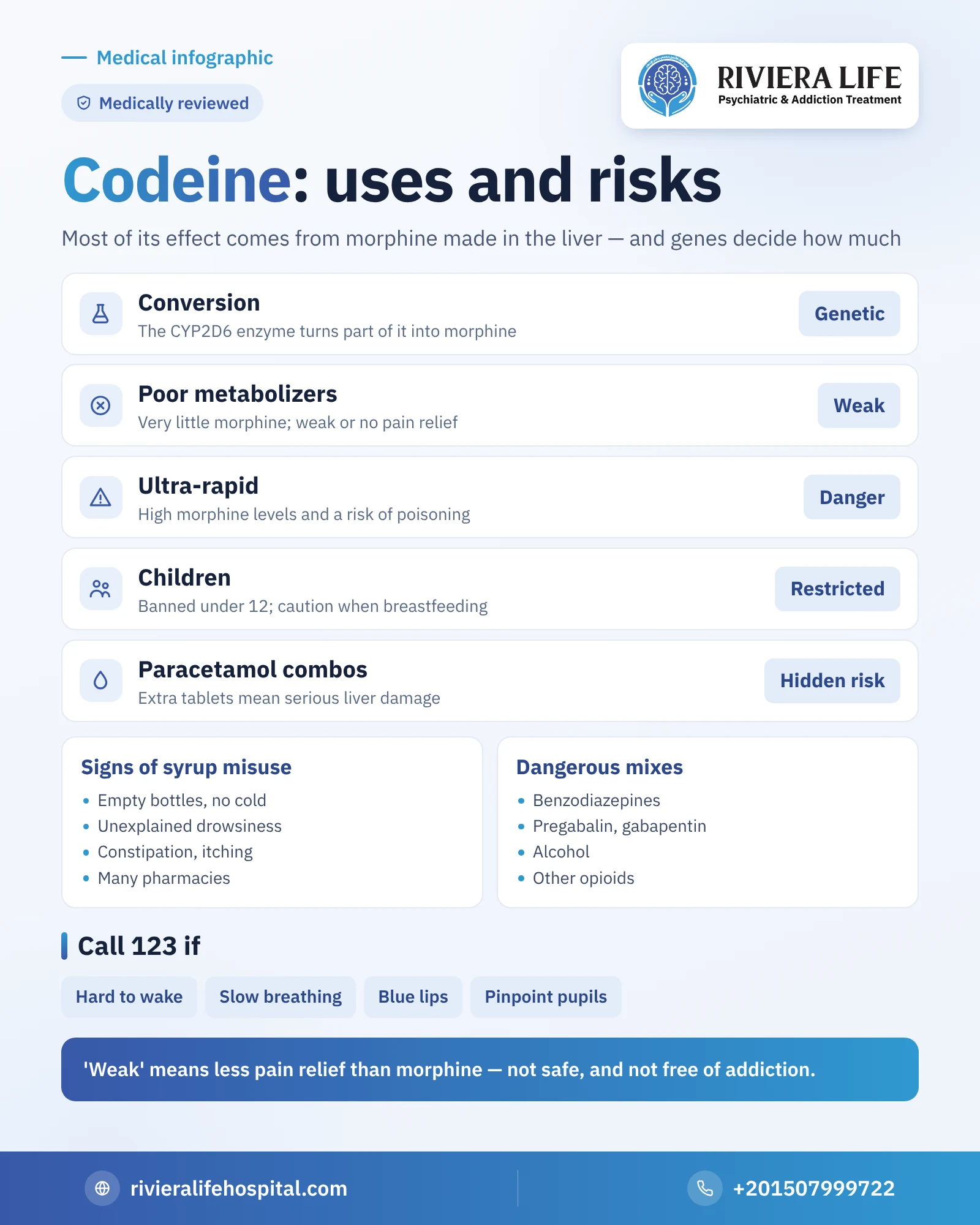
Codeine itself binds weakly to opioid receptors. After it is swallowed, a liver enzyme known as CYP2D6 converts part of it into morphine, and this morphine is responsible for most of the pain relief. Genes determine how active this enzyme is, so people fall roughly into three groups:
| Enzyme activity | What happens | The result |
|---|---|---|
| Weak | Very little is converted into morphine | Weak or no pain relief |
| Normal | An expected amount is converted | An effect proportionate to the prescribed dose |
| Ultra-rapid | A large amount is converted quickly | A high morphine level and a risk of poisoning |
The problem is that most people don’t know which group they belong to. The proportion of ultra-rapid metabolizers varies between populations, and it is reported to be higher in some populations of North Africa and the Middle East compared with others. Some medicines, including a number of antidepressants, also inhibit this enzyme and so weaken codeine’s effect, which may push a person to increase the amount on his own.
Why is codeine forbidden for children?
Cases of severe slowing of breathing and deaths have been recorded in children who took codeine at normal doses, and many of them were ultra-rapid metabolizers, especially after removal of the tonsils and adenoids. That is why the US Food and Drug Administration decided to prohibit its use in children under twelve, and to restrict it in teenagers with obesity, sleep apnea or lung disease. Health authorities also warn against its use during breastfeeding, because if the mother is a rapid metabolizer, morphine may pass to her infant through the milk, causing severe drowsiness and difficulty breathing.
The practical message for the family: don’t give a child a cough syrup or painkiller containing codeine without a doctor, and don’t use a medicine prescribed for an adult to treat a child.
Some cough syrups contain no codeine at all, yet are misused at high doses because of another substance in them, as our article on dextromethorphan cough syrup explains.
Misuse of codeine cough syrups
In many countries, codeine-containing cough syrups have become among the best-known medicines young people misuse, because they are treated as an ordinary medicine and are easy to hide. Some drink them in amounts far exceeding therapeutic use, seeking relaxation and dizziness, sometimes with antihistamines, sedatives or alcohol, a combination that multiplies the risk of slowed breathing.
Among the signs the family may notice: empty bottles of cough syrup without there being a cold or cough, unexplained drowsiness at strange times, slurred speech, persistent constipation, itchy skin, a decline in study or work, and repeatedly requesting the medicine from different pharmacies.
Does codeine cause addiction?
Yes, especially with daily use over a long period or in larger amounts than prescribed. It usually starts innocently: a recurring headache treated with codeine tablets every day, or chronic pain relieved by them for months. Over time their effect lessens so the amount increases, then distress and tension appear when the dose is late.
There is a particular trap for headache sufferers: near-daily use of painkillers, including codeine, may cause what is known as medication-overuse headache, so the medicine itself becomes a reason the headache continues, and the person enters an endless cycle. To understand the factors that make some people more prone to dependence, see our article on causes of opioid addiction.
Codeine withdrawal and treating dependence on it
On stopping after regular use, mild to moderate opioid withdrawal symptoms usually appear: anxiety and insomnia, a runny nose and yawning, muscle aches, diarrhea and abdominal cramps, and a strong craving for the medicine. Their severity varies with the amount and duration. Because codeine is a prescribed medicine, any reduction or stopping should be done in agreement with the doctor who prescribed it, and usually gradually.
If it has become real dependence, treatment follows the approach for opioids in general: assessment, safe withdrawal, sometimes a helping medicine, then psychotherapy and follow-up, with an alternative plan for the pain or headache that started the use. Details are in our article on opioid addiction treatment.
Codeine overdose
An overdose happens when a large amount is taken, in ultra-rapid metabolizers at normal doses, or when it is mixed with sedatives, pregabalin or alcohol. In combinations containing paracetamol, there is the added risk of liver poisoning, whose symptoms may not appear until a day or more later.
Call an ambulance on 123 immediately if you see
After taking codeine or a cough syrup containing it, especially in a child or with sedatives.
- Severe drowsiness and difficulty waking
- Slow, weak or irregular breathing
- Blue lips or nails
- Very small pupils
- Complete limpness of the body or no response
If the person has taken a large amount of tablets containing paracetamol, go to the emergency department even if he seems fine, because early treatment protects the liver.
Codeine with other medicines
The most dangerous things combined with codeine are everything that slows the nervous system: benzodiazepines and sleeping pills, pregabalin and gabapentin, alcohol, some antihistamines and other opioids. Combining it with tramadol specifically isn’t a decision for the patient to make; the comparison between the two medicines and the use of each is explained in our article on the difference between tramadol and codeine. Any new medicine, even an antidepressant or an antibiotic, deserves asking the doctor or pharmacist about its interaction with codeine.
How do you use prescribed codeine safely?
- Stick to the duration and dose the doctor set, and don’t increase it if you feel the effect is weak; tell him instead.
- Don’t stop it suddenly after long use, and agree with the doctor on how to stop.
- Avoid driving and operating machines if you feel drowsy.
- Keep it away from children and teenagers, and dispose of what remains after treatment ends.
- Tell the doctor if you are pregnant or breastfeeding, or if you have a chest or liver disease.
How can Riviera Life help you?
If a cough medicine or painkiller has turned into something you can’t do without, this is a medical problem with a solution. Riviera Life’s team of psychiatry and addiction treatment consultants offers a confidential assessment and a safe stopping plan that takes into account the original reason for use, whether headache or chronic pain, with a free first consultation.
More from our opioids guide
- Opioids: the complete guide
- The difference between tramadol and codeine
- Types of opioid painkillers
- Opioid withdrawal symptoms
- Codeine and cough syrup addiction treatment: from safe withdrawal to treating the cause
- Codeine withdrawal symptoms: the timeline, what’s specific to cough syrup and when to worry
- Hydrocodone: its uses, combinations, the risks of paracetamol and dependence
Questions many people ask
Codeine is a legitimate opioid medicine dispensed on prescription, but it works on the same receptors as opioid drugs, and can cause dependence and addiction if used for a long time or in larger amounts than prescribed.
No. Health authorities prohibit the use of codeine in children under twelve because of cases of slowed breathing and deaths, and restrict it in teenagers at risk of breathing problems. Always consult the doctor before giving a child any cough medicine.
Because its effect depends on its conversion to morphine by a liver enzyme, and some people have this enzyme with genetically weak activity, or take medicines that inhibit it. In this case the doctor should be told instead of increasing the dose.
It usually shows from about one to three days after the last dose, and the opiate strip detects it because it turns into morphine. That is why the testing body should be told about any medicine containing codeine.
After short use there is usually no problem, but after regular use for weeks or months withdrawal symptoms may appear. It is best to stop gradually in agreement with the doctor who prescribed it.