Tramadol and codeine are both painkillers from the opioid family, and both are usually prescribed for moderate pain. But the difference between tramadol and codeine is real: they are not the same medicine, and one should not be swapped for the other without a doctor. Codeine is a natural substance from the poppy that only works after the liver converts it into morphine, while tramadol is a synthetic substance that combines a weak opioid effect with raised serotonin and noradrenaline. This difference explains why one may help a person while the other doesn’t, and why tramadol carries a risk of seizures while codeine carries a particular risk for some people depending on their genes. This article gives a clear comparison of the two medicines, without any doses.
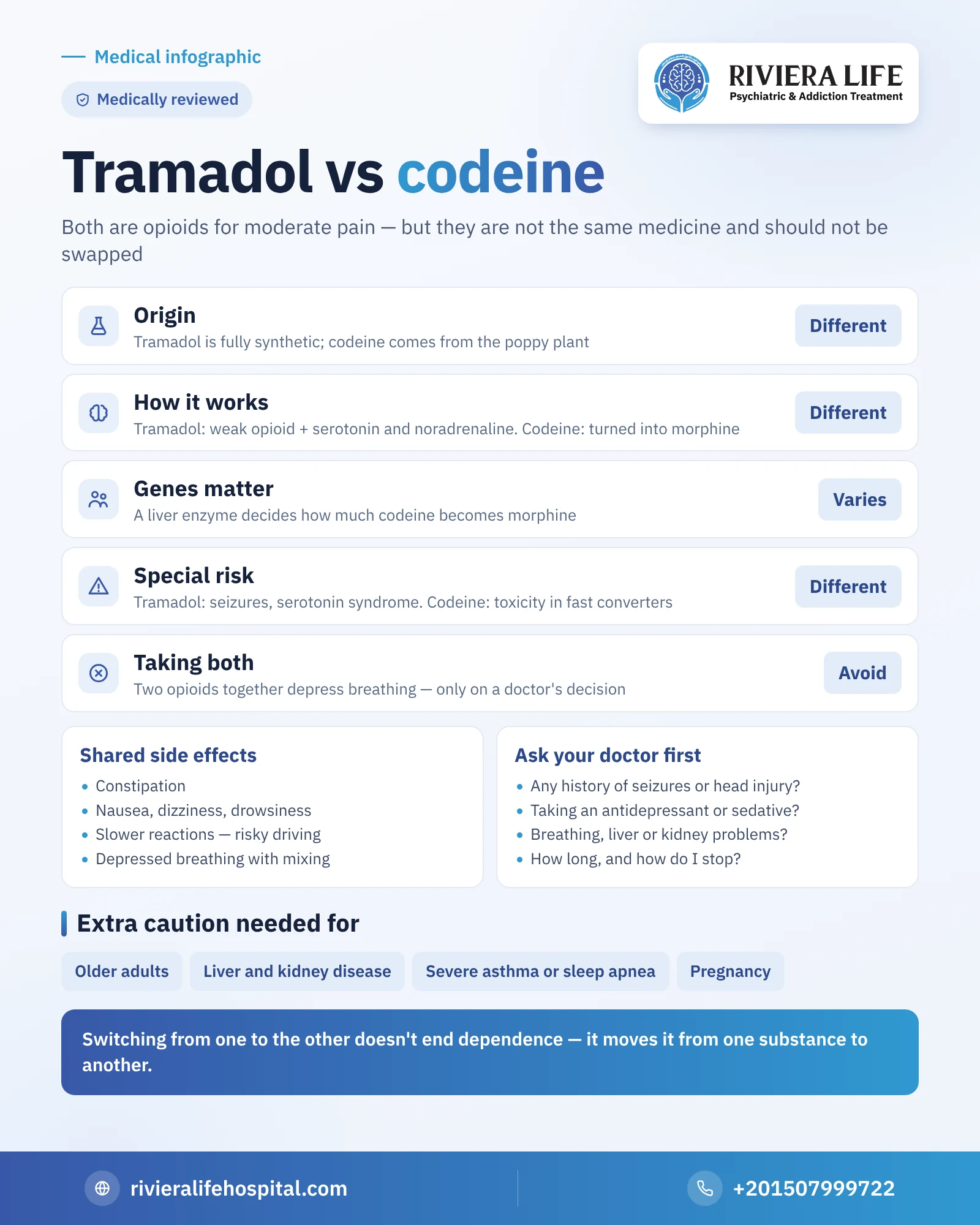
Tramadol vs codeine in brief
| Point of comparison | Tramadol | Codeine |
|---|---|---|
| Origin | Made entirely in the laboratory | Natural, from the poppy plant |
| How it works | Weak opioid + raised serotonin and noradrenaline | Converted into morphine in the liver |
| Uses | Moderate to relatively severe pain | Mild to moderate pain, and some cough medicines |
| Special risk | Seizures and serotonin syndrome | Poisoning in people who convert it into morphine too quickly |
| Addiction | Possible, and the most widespread in Egypt | Possible, especially with misuse of cough medicines |
| Taking them together | Not combined with codeine without a doctor | Not combined with tramadol without a doctor |
How does each one work in the body?
Codeine on its own has only a weak effect on opioid receptors. Its therapeutic value comes from the fact that an enzyme in the liver converts part of it into morphine, and it is the morphine that relieves the pain. In other words, codeine is like a “key” that only works once the liver has cut a ready-made copy from it.
Tramadol also depends partly on the same enzyme, since the product it is converted into in the liver acts more strongly on the receptors than the original substance. But it has a second route that has nothing to do with opioids: it blocks the reuptake of serotonin and noradrenaline in the brain, as some antidepressants do. That is why it is sometimes described as “half an opioid” — and this second route is the source of its particular dangers.
Why does their effect differ from person to person?
The activity of the liver enzyme that converts codeine into morphine varies genetically between people. Some convert it very slowly, so they feel no pain relief however much they take. Others — a minority — convert it too quickly, so they produce more morphine than expected and may suffer severe drowsiness and depressed breathing with ordinary amounts.
This is what makes the sentence “codeine didn’t work for me, so I’ll take more” dangerous, and the sentence “my friend took it and nothing happened to him” meaningless. Tramadol is affected by the same enzyme to a lesser degree, so its effect may also vary, but the difference is clearer with codeine. For this reason many countries no longer recommend codeine for children under twelve or for breastfeeding mothers, after cases of poisoning were recorded in children.
Differences in medical use
Tramadol is used to relieve moderate pain and above, such as pain after minor surgery or joint and nerve pain in certain cases, and it comes in immediate- and extended-release forms. Codeine, on the other hand, is mostly found in combinations with paracetamol or other drugs to relieve mild to moderate pain, and it may be included in some dry-cough medicines because it suppresses the cough center in the brain; it is also sometimes used to treat diarrhea.
That is why it is important to read all the ingredients of a medicine, not just the brand name. Someone may take a cough medicine containing codeine while taking tramadol for pain, without noticing that they have combined two opioids in one day. Our article on types of opioid analgesics covers the other members of this family and what sets each one apart.
Which is stronger, and which is better?
There is no single answer. Comparing them milligram for milligram is misleading, because the effect of both depends on how they are converted in the liver, on the type of pain and on the other medications the patient takes. Tramadol may suit someone who gets no benefit from codeine because of their genes, while codeine may suit someone with a history of seizures or who takes an antidepressant.
So the “better” one is the one the doctor chooses after learning the medical history and current medications — not the one that seems stronger. And if your current painkiller is no longer enough, that is a reason to go back to the doctor, not to increase the amount or add another painkiller. Our article on the strongest alternatives to tramadol suggests options by type of pain.
Differences in side effects
Side effects they share
- Constipation, which is very common with regular use of both.
- Nausea, dizziness and drowsiness.
- Slower reactions, which makes driving dangerous.
- Depressed breathing with large amounts or when mixed with sedatives or alcohol.
Side effects that are clearer with tramadol
- Seizures, which can affect even people who have never had one.
- Serotonin syndrome when combined with certain antidepressants or migraine medicines; the details are in our article on serotonin syndrome.
- Sweating, tension and insomnia in some people instead of drowsiness.
Who needs extra caution with each one?
Older people are more sensitive to both medicines, as drowsiness and dizziness can end in a fall and a fracture. In patients with kidney or liver disease the substance or its products may build up, so the doctor needs to review the choice itself, not just the amount. People with severe asthma or sleep apnea are more affected by depressed breathing. A pregnant woman should take neither except on a doctor’s decision, because regular use close to delivery can cause withdrawal symptoms in the newborn.
Can tramadol and codeine be taken together?
They should only be combined on a clear medical decision, and that is rare. Combining them means two opioids depressing breathing together and doubling constipation and drowsiness, with little extra benefit for pain. If they are combined by accident — a cough medicine with a tramadol tablet, for example — watch for drowsiness and breathing, and contact a doctor or pharmacist immediately. If there is drowsiness the person can’t be woken from, very slow breathing or a seizure, call an ambulance on 123.
Differences in dependence and addiction
Both can cause physical dependence with regular use over weeks, so withdrawal symptoms appear on stopping suddenly. This is different from addiction, which means losing control and continuing despite harm. In Egypt, tramadol tops the list of misused medicines, while codeine has been linked more to the misuse of cough medicines among some young people, and the dispensing authorities have tightened controls on these products.
Someone who tries to get off tramadol by switching to codeine, or the reverse, does not get rid of the dependence; they move it from one substance to another. You will find the signs that use has turned into addiction in our article on tramadol addiction symptoms.
Questions to ask your doctor before choosing one
- Do I have any history of seizures or a head injury?
- Am I taking an antidepressant, a migraine medicine or a sedative?
- Have I tried codeine before with no effect at all?
- Do I have a breathing, liver or kidney problem?
- How long am I expected to take it, and how will I stop at the end?
When do you need a specialist assessment?
If you find yourself needing a larger amount of either, buying the painkiller without a prescription, or feeling anxious, sweaty and achy whenever you are late taking it, these are signs of dependence that deserve assessment before things get more complicated. At Riviera Life, addiction treatment consultants assess the situation in complete confidence in a free first consultation, and set a safe stopping plan that takes the original pain into account, as our article on tramadol addiction treatment explains.
Read also
- Tramadol: the complete guide
- Tramadol vs morphine
- Opioids: the complete guide
- The harmful effects of tramadol on the body and brain
- Codeine: its uses, conversion to morphine, and the risks of addiction and overdose
- Tramadol vs gabapentin: mechanism, withdrawal and the risks of combining them
- Opium vs tramadol: the natural drug and the medicine — which is more dangerous?
- Codeine withdrawal symptoms: the timeline, what is specific to cough syrup, and when to worry
Questions many people ask
No. Both belong to the opioid family, but codeine is a natural substance that the liver converts into morphine, while tramadol is a synthetic substance that also affects serotonin and noradrenaline.
Because converting it into morphine depends on a liver enzyme whose activity varies genetically. People with low activity may get no benefit from it, and taking more is not the answer in that case.
No. Switching to codeine moves the dependence from one opioid to another. Stopping safely needs a medical plan that includes structured tapering and treatment of symptoms.
Not without asking a doctor, because the combination doubles drowsiness and depressed breathing. Read the ingredients of any cough medicine before taking it with an opioid painkiller.
The risk of seizures is clearer with tramadol, and it rises with large amounts, with certain psychiatric medications, or with a history of epilepsy or head injury.