Mental illnesses in older people are common, but they often go undiagnosed because the family thinks they are “part of aging”. The grandmother who no longer eats well and cries for no reason, the grandfather who has started suspecting his children, the father who sleeps by day and stays up at night: all of these may be signs of a treatable condition, not an inevitable result of age.
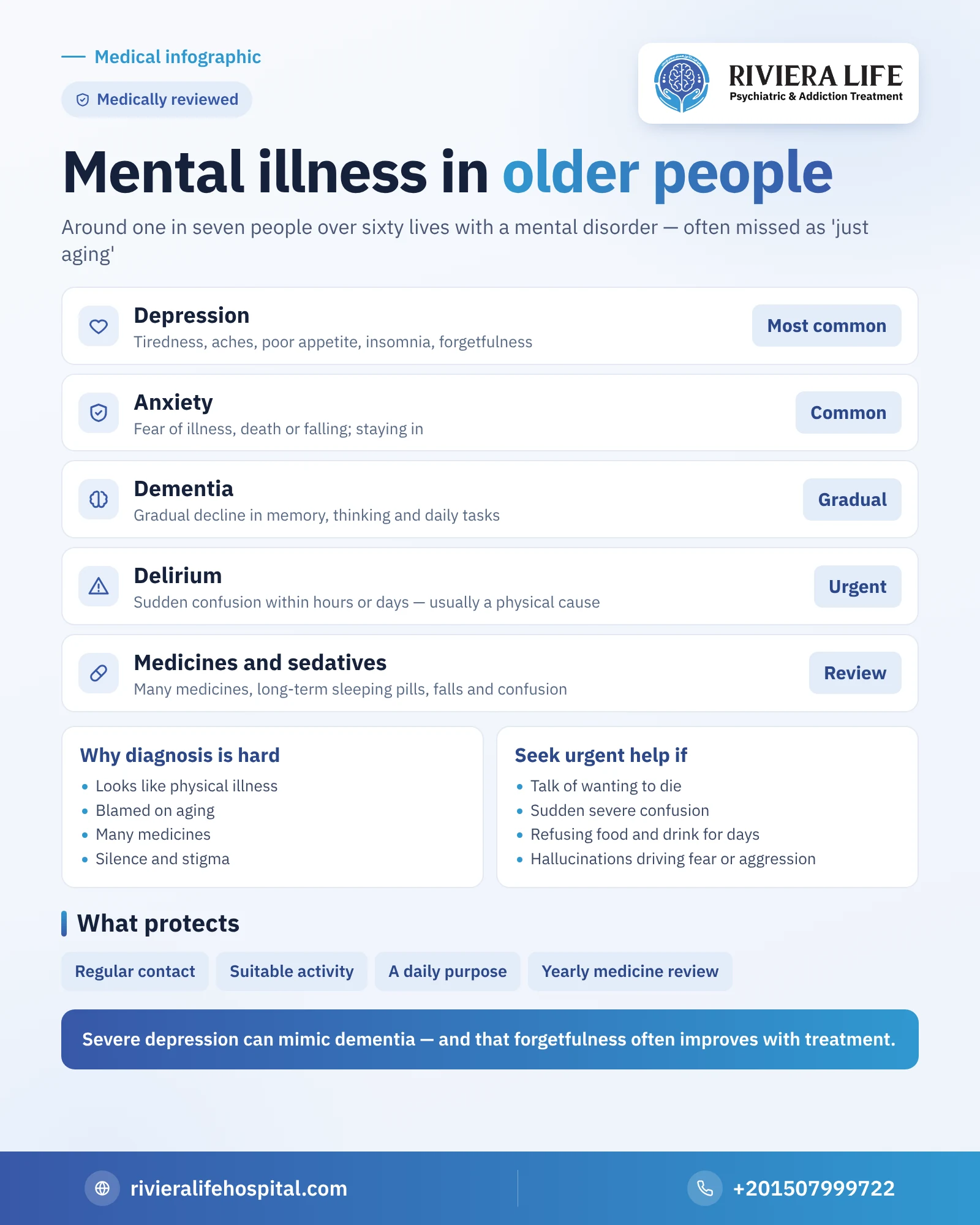
The World Health Organization estimates that roughly one in seven people over sixty lives with a mental disorder. In this article we cover the most common conditions at this stage, how their symptoms differ from those in younger people, what makes diagnosis harder, and how an older person can be treated safely.
Why do mental disorders increase in later life?
Age alone doesn’t cause illness, but this stage brings many pressures at once: retirement and the loss of role and routine, the death of spouses and friends, declining health and many medicines, weaker hearing and sight, and isolation when the children are busy. Brain chemistry also changes and blood circulation in the brain is affected, and illnesses such as diabetes, heart disease and thyroid disease may appear and contribute to the mental disorder.
It may also be that the older generation didn’t grow up in a culture that talks about mental health, so some see psychological complaints as weakness or shame, and hide them or express them only as physical pains.
The most common mental disorders in older people
Depression
The most common, and it may not look as we imagine. Some older people don’t say “I’m sad”, but complain of tiredness, body aches, loss of appetite, insomnia and increasing forgetfulness. It may appear as irritability and loss of interest in what they used to love. We explain its general signs in depression symptoms.
Anxiety
It shows as constant fear of illness, death or falling, or as tension, insomnia and palpitations. An older person may be afraid to go out alone, so their isolation grows. For details see anxiety symptoms.
Dementia and memory disorders
Not all forgetfulness is dementia. Dementia is an illness affecting memory, thinking and the ability to carry out daily tasks, and it develops gradually. It is the subject of its own article: caring for someone with dementia.
Delirium
An acute, sudden disturbance in attention and awareness, appearing within hours or days: clear confusion, fluctuation between alertness and drowsiness, and possibly hallucinations. It usually has a physical cause such as infection, dehydration or a medicine’s effects, and needs urgent medical assessment. It is often confused with dementia.
Late-onset psychosis and delusions
Suspicious ideas or hallucinations may appear for the first time in later life, for several reasons including dementia, physical illness or medicine effects. See hallucination symptoms and their causes.
Sleep disorders
Sleep structure changes with age, but severe, persistent insomnia isn’t normal, and may be a sign of depression, anxiety or pain, as explained in our article on sleep disorders.
Why are they hard to diagnose?
- Similarity to physical illness: exhaustion, insomnia and weight loss may be signs of depression or a physical illness, and separating the two needs examination.
- The belief that it is aging: so the complaint is ignored and treatment delayed.
- Multiple medicines: some blood pressure, heart and pain medicines can affect mood and thinking.
- Concealment: fear of stigma or of becoming a burden.
- Different symptoms: physical complaints stand out more than openly expressed sadness.
Depression or dementia? Why they get confused
Severe depression in older people can cause distraction, slowed thinking and forgetfulness that resemble dementia, so much so that doctors sometimes use the term “pseudodementia” to describe it. The important difference is that this forgetfulness usually improves with treating the depression. Conversely, depression may be one of the first signs of dementia in some people. So don’t rely on intuition: a medical assessment is what distinguishes them and sets the path.
What protects mental health in later life?
- Regular contact with family, neighbors and friends.
- Physical activity suited to their health.
- A simple daily purpose that gives a sense of being useful, such as caring for grandchildren, prayer and mosque activities, or a hobby.
- Regular medical follow-up and control of chronic illnesses.
- The doctor reviewing their list of medicines at least once a year.
- Regular sleep and enough nutrition.
Signs worth paying attention to
Ask for an assessment if you notice any of these changes in your older relative for more than two weeks: withdrawal from people and activities, neglecting hygiene and food, unexplained weight loss, new crying or irritability, severe insomnia, forgetfulness that disrupts daily life, strange suspicions of those around them, or sudden confusion. Sudden confusion in particular calls for a quick medical consultation, because it may indicate a physical cause.
Seek urgent help immediately if you see
Some changes in an older person can't wait. Call an ambulance on 123 or go to the nearest emergency department; for psychological support you can call the mental health hotline on 16328.
- Talk of death, wanting to end their life, or complete surrender
- Sudden severe confusion or not recognizing places and people within hours
- Complete refusal of food and drink for several days
- Hallucinations or suspicions driving them to fear, aggression or leaving the house
Older people and substance use: a risk many overlook
Some older people may rely on sleeping pills and sedatives for many years, with or without a prescription, and some may use alcohol to ease loneliness or pain. As metabolism slows, their bodies become more sensitive to these substances: the risk of falls, confusion and memory problems rises. If your relative has been using a sedative for a while, don’t stop it suddenly; stopping suddenly can be dangerous and must only be done under the supervision of the treating doctor. You’ll find in our article on sleeping pill addiction details of dependence and its risks for older people.
How is an older person treated?
- A comprehensive assessment first: a physical examination, tests and a review of all medicines, to rule out physical causes and see what can be adjusted.
- Psychotherapy: suits many older people, including cognitive behavioral therapy, family support and structuring the day.
- Medicines: the psychiatrist uses them cautiously because the body at this stage is more sensitive and medicines interact with each other. Side effects are monitored, and neither the patient nor the family changes or stops the medicine without a doctor. To learn about these medicines in general, read antidepressants.
- Social treatment: regular activities, meetings, and a gradual return to a role in which they feel valued.
- Hospital admission: sometimes needed when safety is at risk or symptoms are severe.
How can you help your father or mother?
Start by listening, not advising. A quiet daily sit-down means more to an older person than we imagine. Accompany them to the doctor if needed, and record the changes you notice and their dates to show the doctor. Make the home safe with good lighting, and encourage movement, sunlight and visiting friends. And don’t talk about them in their presence as if they weren’t there; their dignity is part of their treatment. On the effect of loneliness specifically, read loneliness and social isolation.
And don’t forget yourself: caring for an older person is draining. Ask your siblings for help, and don’t hesitate to talk to a specialist if you feel exhausted.
How can Riviera Life help you?
Riviera Life in Sheikh Zayed, Giza, offers a free first consultation with a consultant psychiatrist to assess an older person’s condition and involve the family in the plan, in complete confidentiality and under round-the-clock medical supervision when admission is needed. Call +201507999722.
Read also
- Caring for someone with dementia
- Depression treatment
- Sleep disorders
- Mental illnesses: symptoms, types and treatment
Questions many people ask
No. Depression is an illness that can be treated at any age; the mistake is treating it as normal sadness, which delays diagnosis.
It may appear as tiredness, physical aches, insomnia, loss of appetite, forgetfulness and irritability more than openly expressed sadness.
Dementia is a gradual decline in memory and thinking, while delirium is an acute, sudden confusion that appears within hours or days and usually has a physical cause needing urgent treatment.
They are used cautiously and with monitoring because the body is more sensitive and medicines interact; the medicine isn't adjusted or stopped except on the doctor's decision.
When withdrawal, sadness, insomnia or disruptive forgetfulness persist for two weeks or more, and immediately with sudden confusion or talk of death.