Difficulty expressing emotions is an experience many people know: you feel something happening inside you without knowing whether it is sadness, anger, fear or exhaustion. Psychiatrists call it “alexithymia”, meaning an absence of words for emotions, and it isn’t a standalone illness in the diagnostic manuals but a trait that appears to different degrees,
and it may accompany depression, autism, post-traumatic stress disorder or addiction. The person with it isn’t empty of emotions; his emotions are there and may be strong, but he can’t distinguish or describe them, and this tires him and those around him. The article explains how to recognize it, why it happens, and what helps.
What does difficulty expressing emotions mean?
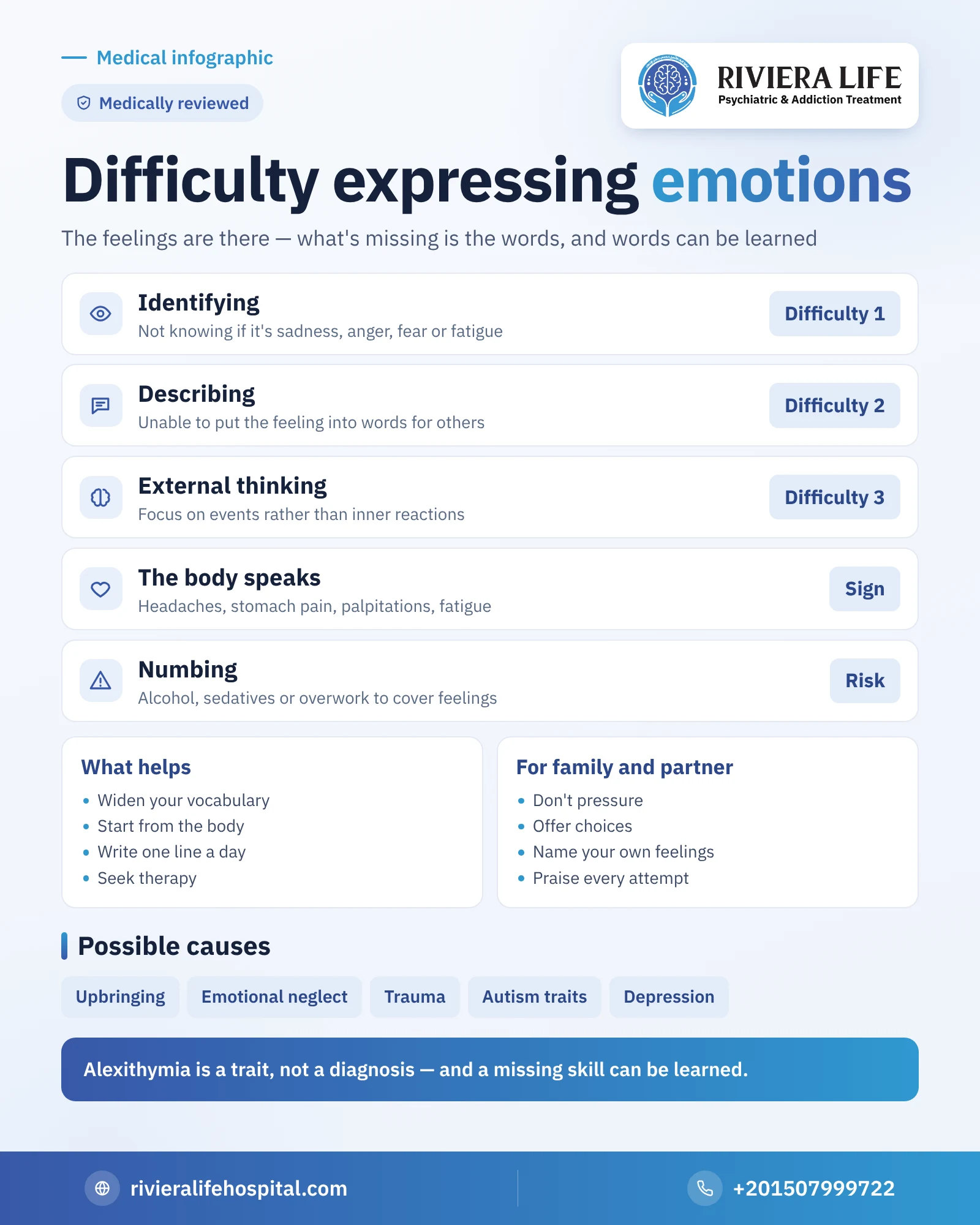
It usually consists of three overlapping difficulties: difficulty identifying what you feel, difficulty describing it in words to others, and a tendency to think about external events rather than inner reactions. It differs from deliberate concealment; someone who conceals knows what he feels and hides it, while here the feeling itself is unclear.
Some studies estimate that a not-small proportion of people, close to one in ten, carry a high degree of this trait, and the proportion rises among those with some psychiatric disorders. The figures vary with the measures and the societies, so they are taken as a rough estimate.
What does it look like in reality?
- When asked “What’s bothering you?” he answers “I don’t know” or “I’m tired” and says no more.
- He describes bodily sensations instead of emotions: “my chest is tight” or “my stomach hurts”, without linking them to a psychological event.
- He suddenly explodes in anger after a long period of silence, because emotions have built up without names.
- He talks about facts precisely and avoids talking about their impact on him.
- He sees talking about emotions as a waste of time or a weakness.
- He finds it hard to understand his partner’s or children’s feelings, so he seems cold when he isn’t.
- Few dreams and little imagination, or describing them dryly, in some people.
Why does this happen?
- Upbringing: a home where feelings aren’t named, where crying and anger are punished, or where the child is expected to behave like an adult. Phrases like “men don’t cry” turn into an inner rule.
- Emotional neglect: children who found no one to notice their sadness or joy don’t learn to link the sensation with its name.
- Trauma: the brain may shut down feeling as a means of protection. You will find detail on this in our article on psychological trauma.
- Neurological differences: the trait appears frequently among people on the autism spectrum, but it doesn’t necessarily mean autism, and the diagnosis is made by a specialist (see our autism guide).
- Depression and anxiety: depression can switch feeling off, so it appears as numbness.
- Genetic and biological factors: research points to a contribution in some cases, without there being a single confirmed cause.
The body speaks instead of words
When emotions don’t find their way into speech, they sometimes appear in the body: recurring headaches, pains in the stomach or back, palpitations and fatigue without a clear physical cause. The person may move between doctors without result. This doesn’t mean the pain is “imaginary”; it is real, but part of its cause may be psychological pressure that hasn’t been expressed. Our article on psychosomatic disorders covers this side in detail, and physical causes must always be ruled out first by a doctor.
The link to addiction
Someone who doesn’t know what he feels and doesn’t know how to soothe it may turn to what quiets the feeling quickly: alcohol, sedatives, drugs, or excess gaming, work and shopping. The substance here doesn’t treat the emotions but covers them, so the inability to understand them deepens. And if depression comes together with addiction, this needs integrated treatment, as our article on depression and addiction explains.
Its effect on relationships and marriage
A partner who asks “Do you love me?” and receives only practical answers ends up feeling lonely inside the home. And children who don’t hear a father express his love or sadness grow up with the same picture. This doesn’t mean the person doesn’t care, but he doesn’t have the tool. What helps in this case is turning love into clear actions and short words he practices, with couples therapy if needed. Articles such as loneliness and social isolation explain how the pain grows when real communication is absent.
How do you tell it apart from similar conditions?
| Condition | The key difference |
|---|---|
| Deliberate concealment | He knows what he feels and hides it by choice |
| Introversion | A preference for quiet with the ability to name emotions |
| Depression | Sadness, loss of pleasure and changes in sleep and appetite, and it may include emotional numbness |
| Callousness or psychopathy | An absence of empathy for others, while here the emotions remain and tire their owner |
| Alexithymia | Emotions are present but without names or clarity |
What helps in expressing emotions?
- Widen your vocabulary: instead of “fine” and “bad”, look for more precise words: worry, disappointment, jealousy, relief, regret, pride. Some people use printed lists of emotions.
- Start from the body: ask yourself where do I feel tension now? In the chest, the throat or the stomach? Then ask what this sensation is like.
- Write once a day: what happened? How was my body? What is the closest feeling? Even if the answer is one line.
- Link the event to the feeling: after a disagreement or important news, stop for a minute and say inside yourself “I feel… because…”.
- Try non-verbal expression: drawing, music or free writing, as they are ways that open the door before speech takes shape.
- Seek psychotherapy: among the methods therapists use are cognitive behavioral therapy, dialectical behavior therapy, which trains recognizing and regulating emotions (dialectical behavior therapy), and group therapy. Improvement comes gradually.
If depression, anxiety or the effects of trauma appear, the doctor may suggest treating them, which may include medicines according to his assessment, and he alone starts or adjusts them.
Can it improve?
Yes. Because the trait isn’t a fixed fate, but a missing skill that can be learned as a person learns a new language. You find people who start with two or three words and then their vocabulary widens over months of practice and therapy, and their relationships improve with it and their sense of a tired body eases. Those who progress fastest are usually those who set aside a short, fixed time each day, and those who find a patient therapist or partner. And some people first need treatment for depression or the effects of trauma before their emotions become clear.
How do family and partner deal with it?
- Don’t say “Tell me what’s inside you” in a pressuring tone, as forcing closes the door further.
- Offer suggestions: “Are you upset or tired?” is easier than an open question.
- Name your own feelings in front of him, as he learns from the example.
- Praise every attempt at expression, however small.
- Don’t interpret his silence as lack of interest, and don’t over-defend yourself.
When should you seek help?
Seek it if the matter has affected your relationships or work, if it is accompanied by recurring physical symptoms, if you have started drinking or using substances to avoid what you feel, or if thoughts that you don’t deserve to live have appeared. In case of immediate danger call an ambulance on 123 or the mental health hotline on 16328.
How can Riviera Life help you?
At Riviera Life in Sheikh Zayed, Giza, you meet a consultant psychiatrist who listens to you without rushing and determines whether depression, anxiety, trauma or addiction lies behind the difficulty in expression, then draws up a plan that suits you. Confidentiality is complete, and the first consultation is free: +201507999722.
More from our mental health guide
Questions many people ask
A trait that makes it hard to identify and describe emotions, not a standalone diagnosis. It appears to different degrees and may accompany depression, autism or trauma.
No, his emotions are there and may be strong, but he can't distinguish them or express them.
An upbringing that treats crying as weakness plays a big role, but it may also be linked to emotional neglect, trauma or neurological traits.
Yes, by practicing naming emotions, linking them to the body and psychotherapy, and the improvement is gradual.
Some complaints such as headaches and stomach pains may be linked to psychological pressure that hasn't been expressed, but physical causes must first be ruled out by a doctor.