Loss of interest, which doctors call “anhedonia”, is when the things that used to make you happy stop doing so: a hobby, good food, going out with friends, even good news. It doesn’t necessarily mean you are sad, as you may feel a cold emptiness with no crying in it. It is a symptom, not a standalone illness, and it appears in depression and in other conditions. Here we explain what anhedonia is, how it differs from depression, its relationship with dopamine, and what gradually brings pleasure back.
What is anhedonia?
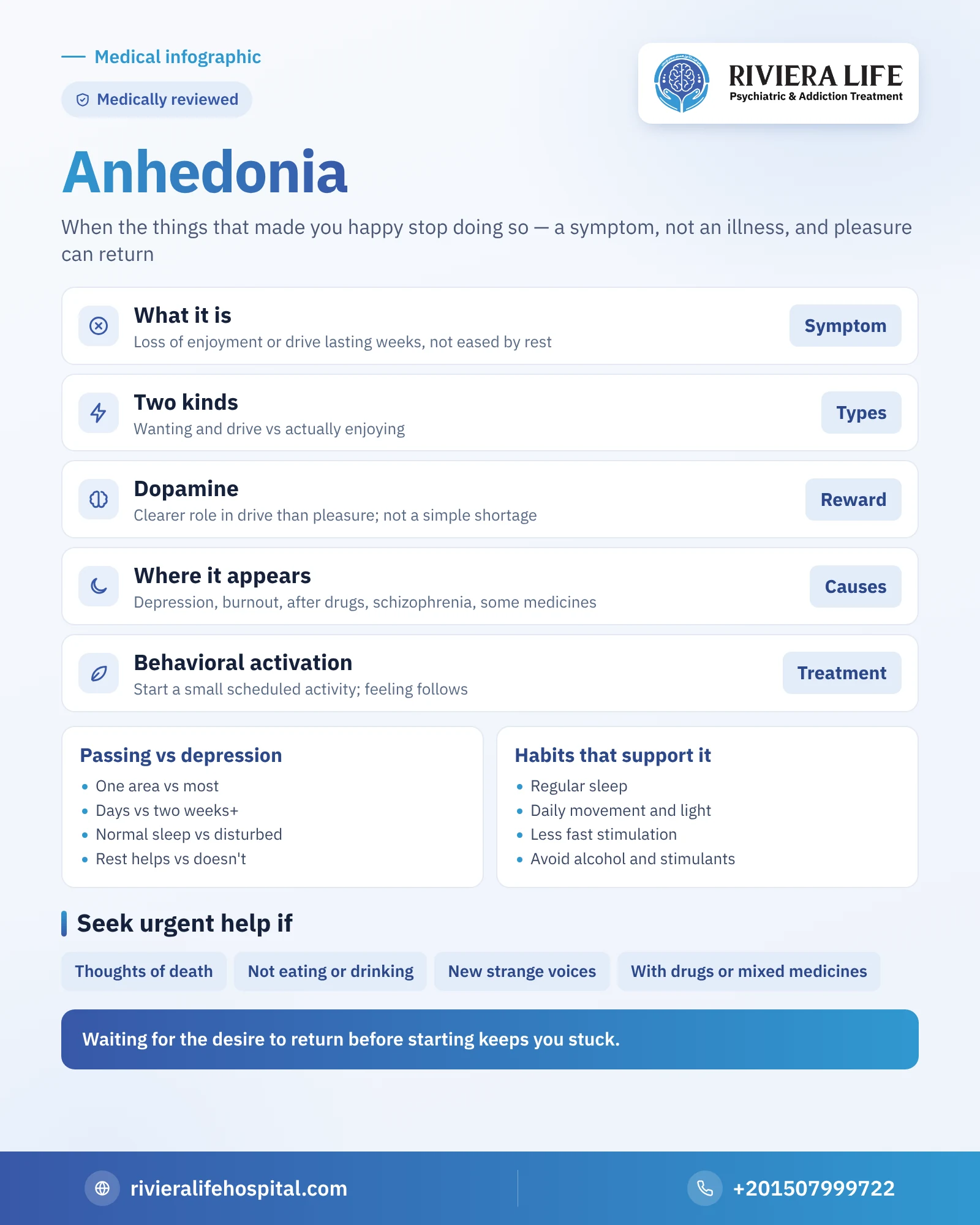
It is a clear decrease in the ability to enjoy or in the drive to do what used to be enjoyable. One person says: “I still go to the gym but it has no taste”, and another says: “I know I love this meal but I don’t feel anything”. Some express it as “numbness” or “life in black and white”. It differs from ordinary tiredness in that it doesn’t go away after rest, it covers more than one activity, and it lasts for weeks.
Two kinds of pleasure are affected
Researchers roughly distinguish two kinds. The first is wanting and drive: getting excited before the event and starting to act. The second is actual enjoyment: feeling pleasure when things happen. Some people lose drive more than enjoyment, so they enjoy themselves once they start but can’t start. Others are the opposite. Knowing which kind is stronger in you helps the doctor and therapist choose a plan that suits you.
Dopamine: what is its relationship with anhedonia?
Dopamine is linked to the reward circuit in the brain, the circuit that drives us to seek rewarding things and pursue them. Research indicates that its role is clearer in drive and motivation than in pleasure itself, and that the opioid system, serotonin and other systems have a role in enjoyment. So the matter can’t be reduced to the phrase “dopamine deficiency”. What is known is that drugs, stimulants and excessive digital stimulation may exhaust this circuit and make ordinary things seem dull. For details see our articles on dopamine deficiency symptoms and dopamine and addiction.
When does anhedonia appear?
- Depression: one of the two core symptoms for diagnosis, alongside low mood.
- Exhaustion and burnout: when long stress drains the energy of feeling; you will find details in our article on burnout.
- After stopping substances: some who have stopped drugs or alcohol feel numbness in the first weeks and months, which usually improves with time.
- The negative symptoms of schizophrenia: a decline in drive and emotional expression, which differs from depression in its causes.
- Neurological and physical illnesses: such as Parkinson’s disease and hypothyroidism.
- Some medicines: some people may feel emotional blunting with certain medicines; the doctor is told and the medicine isn’t stopped on one’s own.
- Psychological trauma: when a person shuts down his feelings for protection.
The difference between anhedonia and depression
This is the most frequently asked question. Anhedonia is a symptom, and depression is a complete disorder. Depression is diagnosed when there is low mood or loss of pleasure, with several other symptoms such as disturbed sleep, appetite, concentration and energy and a feeling of guilt, for two weeks or more. So you may lose interest without depression in situations such as boredom with a job or routine, after a long period of achievement, or during temporary stress. And if the other symptoms are present with it, it is more likely part of depression. You will find the full list of symptoms in depression symptoms.
| Aspect | Passing loss of interest | Anhedonia in depression |
|---|---|---|
| Scope | One or two areas, such as work or a hobby | Almost all activities |
| Duration | Days or weeks, and changing | Two weeks or more without change |
| The body | Sleep and appetite usually normal | Disturbed sleep, appetite and energy |
| Self-view | Intact | Guilt or a feeling of worthlessness |
| Improvement with rest | Desire usually returns | Doesn’t improve with a holiday or sleep |
What gradually brings pleasure back?
Behavioral activation
This is a studied therapeutic method: don’t wait for the desire to return before you start, but start a small scheduled activity, and pleasure will return after it. Choose a simple activity you used to love, lasting ten minutes, at a fixed time. Feeling follows action, not the other way round, which is why it seems counterintuitive. Increase the duration gradually, and write down your level of enjoyment from zero to ten after each activity, and you will discover an improvement you weren’t noticing.
Psychotherapy and medication
Cognitive behavioral therapy helps break the cycle of withdrawal. The doctor may prescribe antidepressants when depression is the cause, taking into account that some medicines may improve mood and pleasure to different degrees. No medicine is started or stopped except under the doctor’s supervision. Details are in depression treatment.
Habits that support the circuit
- Regular sleep, as lack of sleep switches off the sense of reward.
- Daily movement, even short, and morning sunlight.
- Reducing excessive fast stimulation such as constant scrolling, for a week as a trial.
- Staying away from alcohol, stimulants and substances that reset the reward circuit negatively.
- Time with people who don’t ask you to perform, even if you don’t feel like it.
Anhedonia after stopping drugs
One of the hardest things a person in recovery faces is that life seems dull after the brain got used to strong rewards. Some describe it as “nothing is worth it”. This feeling is common and temporary in most cases, and improves over weeks and months as the circuit regains its balance, but it is also one of the causes of relapse if it isn’t understood and treated. So if you are at this stage, what matters is not to bear it alone, and to tell your treatment team, and you can read our article on when does the body return to normal after quitting drugs?.
Seek urgent help immediately if you see
Call an ambulance on 123 or go to the nearest emergency department, and you can ask for guidance from the mental health hotline 16328.
- Thoughts of death, self-harm or that life has no value
- Complete refusal to eat, drink or keep personal hygiene
- Strange thoughts or voices that weren’t there before
- Sudden loss of interest with substance use or mixed medicines
Am I lazy or have I lost interest?
Many blame themselves: “I’m lazy, I lack discipline”. Laziness is usually a temporary choice, while pathological loss of interest makes a person want to enjoy and be unable to. If you try and fail, feel guilty after every attempt, and wait for “the desire to come back” but it doesn’t, you are more likely facing a symptom that needs understanding, not blame. Blame adds to the burden and delays the first step, and the first step is all that is needed.
How do those around you follow the situation?
A husband or family may interpret anhedonia as coldness or lack of appreciation. If someone dear to you has changed and no longer delights in what used to delight him, try asking gently instead of holding him to account: “I’ve noticed you don’t enjoy such-and-such anymore, would you like to talk?”. And let him choose a small activity to share with you without pressure to show joy. As long as it continues, a medical assessment is a suitable step.
When should you ask for medical help?
If loss of pleasure has lasted two weeks or more and covered most of your activities, affected your work and relationships, or come with disturbed sleep and appetite and a feeling of hopelessness, book an appointment with a psychiatrist. And if it appeared after starting a new medicine, tell the doctor who prescribed it and don’t stop it yourself. Our article on when do you need a psychiatrist? explains how to prepare for the first visit.
How can Riviera Life help you?
At Riviera Life in Sheikh Zayed, psychiatry consultants distinguish between depression, burnout and what follows stopping substances, and set a suitable plan in complete confidentiality, with a family program and follow-up after improvement. The first consultation is free on +201507999722.
More from our depression guide
Questions many people ask
It is a clear decline in the ability to enjoy or in the drive toward activities that used to be enjoyable, lasting weeks and not going away with rest. It is a symptom, not a standalone illness.
Anhedonia is a symptom that may appear in depression and other conditions, while depression is a disorder that includes other symptoms such as sleep, appetite and guilt, lasting two weeks or more.
Dopamine is linked to drive and reward, but the matter is more complex than a simple shortage, and other systems such as opioids and serotonin take part in pleasure.
In most cases it improves gradually over weeks and months as the reward circuit regains its balance, and support from the treatment team helps get through this stage.
Behavioral activation with small scheduled activities, with regular sleep, movement and morning light, and psychotherapy or medication when depression is present, under the doctor's supervision.