
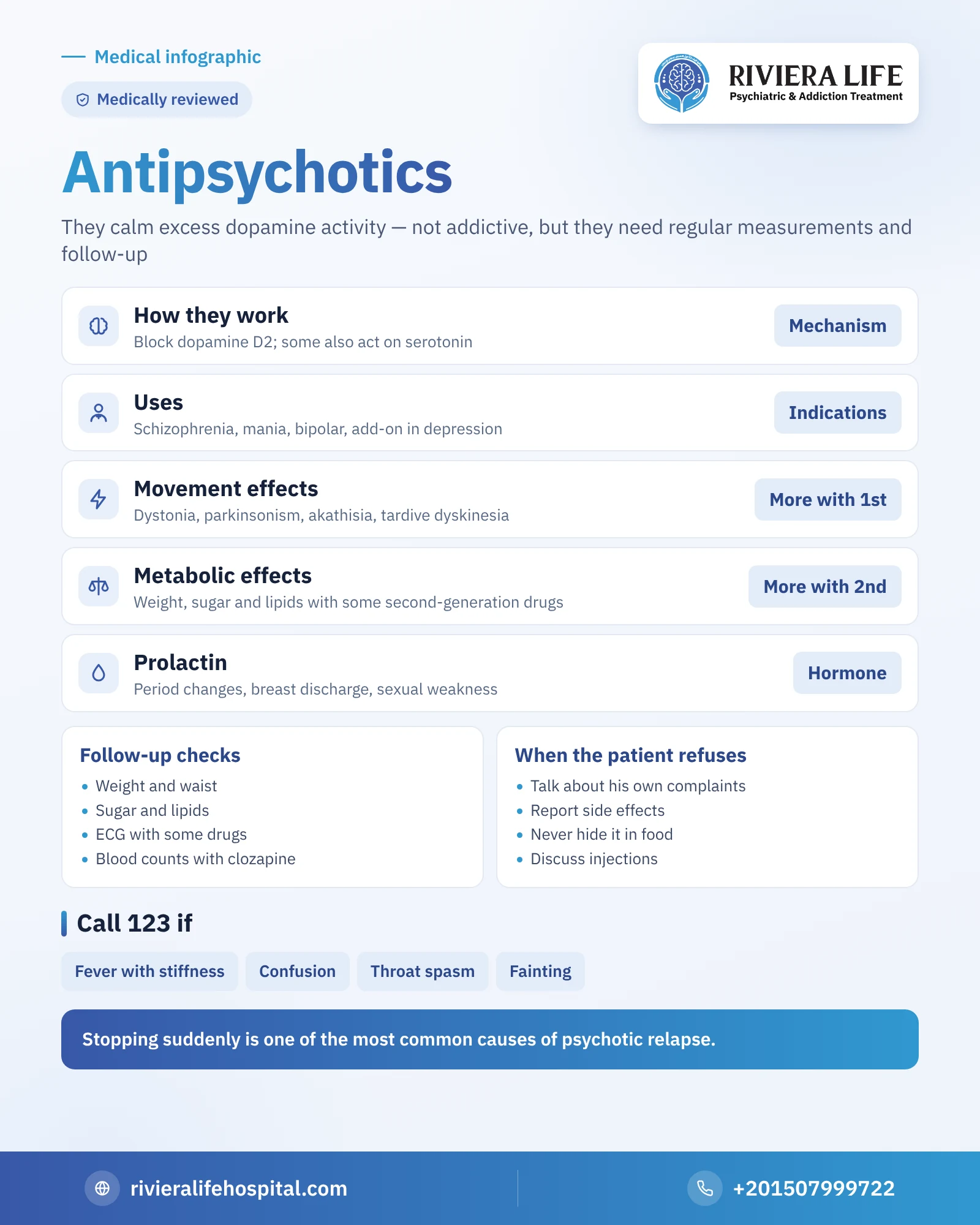
Antipsychotics are medicines that work mainly by calming excess dopamine activity in some brain circuits, easing hallucinations, delusions and disordered thinking, and they are also used in manic episodes and bipolar disorder, and sometimes with antidepressants. They are divided into an older first generation and a newer second generation, and each generation has a different pattern of side effects: movement effects are clearer with the first generation, and effects on weight and blood sugar are clearer with some second-generation medicines. These medicines don’t cause addiction, but they need regular follow-up with tests and measurements. As usual, we won’t give doses; starting, adjusting and stopping happen with the psychiatrist only.
What are antipsychotics?
The first antipsychotic appeared in the 1950s, and changed the face of psychiatry; patients who used to spend years in asylums became able to return home. The name describes their first use, treating psychosis, but the range of their use has widened a lot. To understand psychosis itself, and what happens when a person loses contact with reality, read our psychosis guide.
Most of these medicines work by blocking dopamine type 2 receptors, and some also affect serotonin receptors. Blocking dopamine in the pathway responsible for thoughts and perception calms psychotic symptoms, while blocking it in other pathways, such as the movement pathway and the pituitary pathway, explains most of their side effects.
First and second generation: what is the difference?
| Comparison | First generation (typical) | Second generation (atypical) |
|---|---|---|
| Examples | Haloperidol, chlorpromazine | Olanzapine, risperidone, quetiapine, aripiprazole, clozapine |
| How they work | Strong dopamine blockade | Dopamine blockade with an effect on serotonin |
| Movement effects | More common | Generally less, varying between medicines |
| Weight, blood sugar and lipids | Usually less | Clearer with some medicines such as olanzapine and clozapine |
The differences within one generation are large, so knowing a medicine’s generation isn’t enough to predict its effects. For example, risperidone is second generation but clearly raises prolactin, olanzapine is effective but linked to weight gain, and quetiapine has a clear sedating effect. Clozapine is the medicine reserved for schizophrenia that hasn’t responded to at least two medicines, and needs regular blood tests to monitor white blood cells.
What are antipsychotics used for?
Schizophrenia and psychotic disorders
They are the cornerstone of treatment, whether in the first episode or in preventing relapse. Our article on schizophrenia treatment explains how they combine with psychological and social rehabilitation.
Manic episodes and bipolar disorder
They are used to calm an acute manic episode, and some are used for prevention or to treat bipolar depression, alone or with a mood stabilizer.
Supporting uses
The doctor may add an antipsychotic to an antidepressant in depression that hasn’t responded, in psychotic depression, or in cases of severe agitation. Some are used for severe irritability with autism spectrum disorder in children under specialist supervision.
A use we don’t advise
Using antipsychotics as a “sleeping pill” without a clear psychiatric reason is widespread, and it exposes the person to metabolic and movement effects with no justification.
Movement side effects
They are called extrapyramidal symptoms, and appear in different forms:
- Acute dystonia: a sudden, painful spasm in the muscles of the neck, jaw or eyes, usually in the first days, and it responds quickly to treatment.
- Parkinson-like symptoms: tremor, stiffness, slow movement and a rigid facial expression.
- Motor restlessness: an inner feeling of being unable to sit still, which some mistake for anxiety or relapse.
- Tardive dyskinesia: involuntary movements of the mouth, tongue and face appearing after long use, which may persist, so the doctor checks for them regularly.
To treat some of these symptoms the doctor may prescribe an anticholinergic medicine such as Parkinol. This medicine helps with spasm and tremor, but doesn’t treat tardive dyskinesia and may worsen it, and it is misused in Egypt for its effect on mood and perception. That is why it is only taken with a prescription and for the period the doctor sets.
Metabolic effects: weight, blood sugar and lipids
Some second-generation medicines increase appetite and change how the body handles sugar and fat, so weight rises and blood sugar and cholesterol may rise. This doesn’t happen to everyone or to the same degree, but it is a major reason patients stop the medicine without permission. The solution isn’t stopping, but early follow-up, physical activity, nutrition, and sometimes changing the medicine to one with a lighter effect.
Prolactin and other effects
Blocking dopamine in the pituitary gland raises prolactin, which may cause menstrual disturbance, breast discharge, sexual weakness, or breast enlargement in men. Other effects include drowsiness, dizziness on standing, constipation, and heart rhythm changes with some medicines. And there is a special warning: antipsychotics aren’t advised for older people with dementia except when necessary and with great caution, because they are linked to increased health risks in them.
Neuroleptic malignant syndrome and when to go to the emergency department
Neuroleptic malignant syndrome is rare but an emergency: high fever with severe muscle stiffness, clouded consciousness and fluctuating blood pressure and pulse. It may happen with any antipsychotic, usually in the first weeks or after the dose is raised.
Call an ambulance on 123 immediately if you see
In someone taking an antipsychotic, especially after starting the medicine or changing its dose:
- High fever with severe muscle stiffness
- Confusion, deep drowsiness or difficulty waking
- Heavy sweating with a fast pulse or fluctuating blood pressure
- A spasm in the throat or tongue that obstructs swallowing or breathing
- Fainting or severe palpitations
Medical follow-up during treatment
Follow-up of antipsychotics isn’t a luxury, but part of the treatment:
- Measuring weight and waist circumference at the start and at intervals.
- Testing blood sugar and lipids before starting and after a period the doctor sets.
- Measuring blood pressure and pulse.
- An ECG with some medicines or for those with risk factors.
- A prolactin test if its symptoms appear.
- Periodic examination for involuntary movements.
- Regular blood counts with clozapine.
Long-acting injections
Some antipsychotics are available as an intramuscular injection given in the clinic every few weeks or longer depending on the medicine. The idea is simple: a patient who forgets or refuses tablets, or relapses repeatedly because of stopping, gets a steady level of medicine without remembering a tablet every day. And the family and doctor know precisely whether treatment is continuing. The injection isn’t a punishment or a sign that the case is hopeless, but a practical choice the doctor discusses with the patient and family, usually after making sure the patient tolerates the medicine itself in tablet form.
Can antipsychotics be stopped?
Stopping suddenly is one of the most common causes of psychotic relapse, and may also cause discontinuation symptoms such as insomnia, nausea and restlessness. The decision to stop or reduce depends on the diagnosis, the number of episodes and the duration of stability, and is done gradually with monitoring for early signs of relapse. To learn the difference between physical dependence and addiction with these and other medicines, see our article on whether psychiatric medicines are addictive.
The family’s role when the patient refuses the medicine
Refusing the medicine is common in psychosis, and sometimes it isn’t stubbornness but part of the illness itself, as the patient doesn’t see himself as ill at all. Direct argument rarely works. It is better for the family to talk about symptoms that bother the patient himself, such as insomnia, tension or problems at work, not about the diagnosis, and to pass on to the doctor any complaint of side effects instead of dismissing it, as bothersome effects are a main reason for stopping. The family shouldn’t put the medicine in food or drink without the patient’s knowledge, but discuss alternatives with the doctor, including long-acting injections or hospital admission when there is danger.
How can Riviera Life help you?
At Riviera Life, psychiatry consultants follow patients with psychosis and bipolar disorder with a plan that includes choosing the most suitable medicine, monitoring weight, tests and movement effects, and long-acting injections when suitable, with a family program that helps it spot signs of relapse early. The first consultation is free and confidentiality is complete.
More from our psychiatric medicines guide
- Psychosis: the complete guide
- Psychiatric medicines: types and uses
- Schizophrenia treatment
- Olanzapine: uses and side effects
- Clozapine: uses, blood tests and side effects
- Amisulpride (Solian): uses, prolactin and effects
- Aripiprazole (Abilify): uses, restlessness and impulsivity
- Chlorpromazine (Neurazine): uses and side effects
- Haloperidol (Haldol): uses, movement effects and warnings
- Sulpiride (Dogmatil): uses, prolactin and warnings
- Neuroleptic malignant syndrome: symptoms, danger and when to call an ambulance
- Side effects of psychiatric medicines: weight, periods and drowsiness
- Cariprazine (Reagila): uses, side effects and motor restlessness
Questions many people ask
Some have a clear sedating effect as a side effect, but their main function is treating psychotic symptoms and stabilizing mood, and they aren't sedatives in the usual sense.
Yes, sometimes, such as for depression that hasn't responded, manic episodes or severe agitation. The name doesn't mean the patient has schizophrenia.
It isn't inevitable, and varies with the medicine and the person. Early monitoring of weight, blood sugar and lifestyle, and changing the medicine when needed, reduce the problem a lot.
They aren't stronger in themselves, but they ensure the medicine arrives regularly, which reduces relapse in those who find it hard to keep to daily tablets.
It is possible in many cases with advance planning. Discuss it with your doctor before pregnancy, and don't stop the medicine suddenly on discovering it, because relapse is dangerous for mother and fetus.