To this day, no herb or herbal mixture has been scientifically proven to treat drug addiction or bring a patient out of it. That is the short, honest answer to the question of herbal treatment for drug addiction.
Some plants may ease a minor symptom such as insomnia or tension, but they don’t treat the changes addiction makes in the brain, and some can be genuinely dangerous if used instead of a doctor, especially during withdrawal from alcohol and sedatives. In this article we review the best-known herbs in circulation and what science says about each, the truth about “body cleanse” products, what can safely be done at home, and when relying on herbs becomes a gamble with someone’s life.
Is there a herbal treatment for drug addiction?
Addiction isn’t a substance stuck in the body that needs someone to “drive it out”; it is a change in the brain’s reward and control circuits, accompanied by physical and psychological dependence and tangled psychological and social causes. That is why a cup of herbal drink or capsules from a herbalist can’t repair what needs months of psychological and behavioral treatment, and sometimes an approved medicine.
Research on specific herbs has mostly been small and short, with conflicting results or results limited to a single symptom. No reliable medical body has approved any herb as a treatment for addiction.
Why are herbal remedies so popular?
We completely understand why families turn to them. There is the fear of stigma and of the neighbors finding out, the wish for a “natural” treatment that seems safe, worry about cost, and adverts on social media promising a cure in days. Sometimes the patient themselves suggests herbs, because they seem like a route that doesn’t require admitting the problem to a doctor.
The problem is that “natural” doesn’t mean “safe”, and the time lost on experiments may be exactly the time in which the addiction deepens.
What does science say about the best-known herbs?
| Herb | What is said about it | What the evidence says | Main risks |
|---|---|---|---|
| Passionflower | Calms withdrawal symptoms | Very small trials suggested it eases anxiety only | Drowsiness, and it multiplies the effect of sedatives |
| Valerian and chamomile | Treat insomnia and tension | May help with light sleep, with no effect on addiction | Dangerous with alcohol and sedatives because they add to the depressant effect |
| St John’s wort | Lifts mood after stopping | Insufficient evidence in the context of addiction | Reduces the effectiveness of many medicines, and can cause serotonin syndrome with antidepressants |
| Kudzu | Reduces the urge to drink | A few studies on alcohol only, with limited results | Unknown in the long term |
| Milk thistle | Cleans toxins from the liver | No evidence that it treats addiction | Gives a false sense of safety |
| Licorice | Strengthens the body after withdrawal | Nothing to do with treating addiction | Raises blood pressure and lowers potassium when overused |
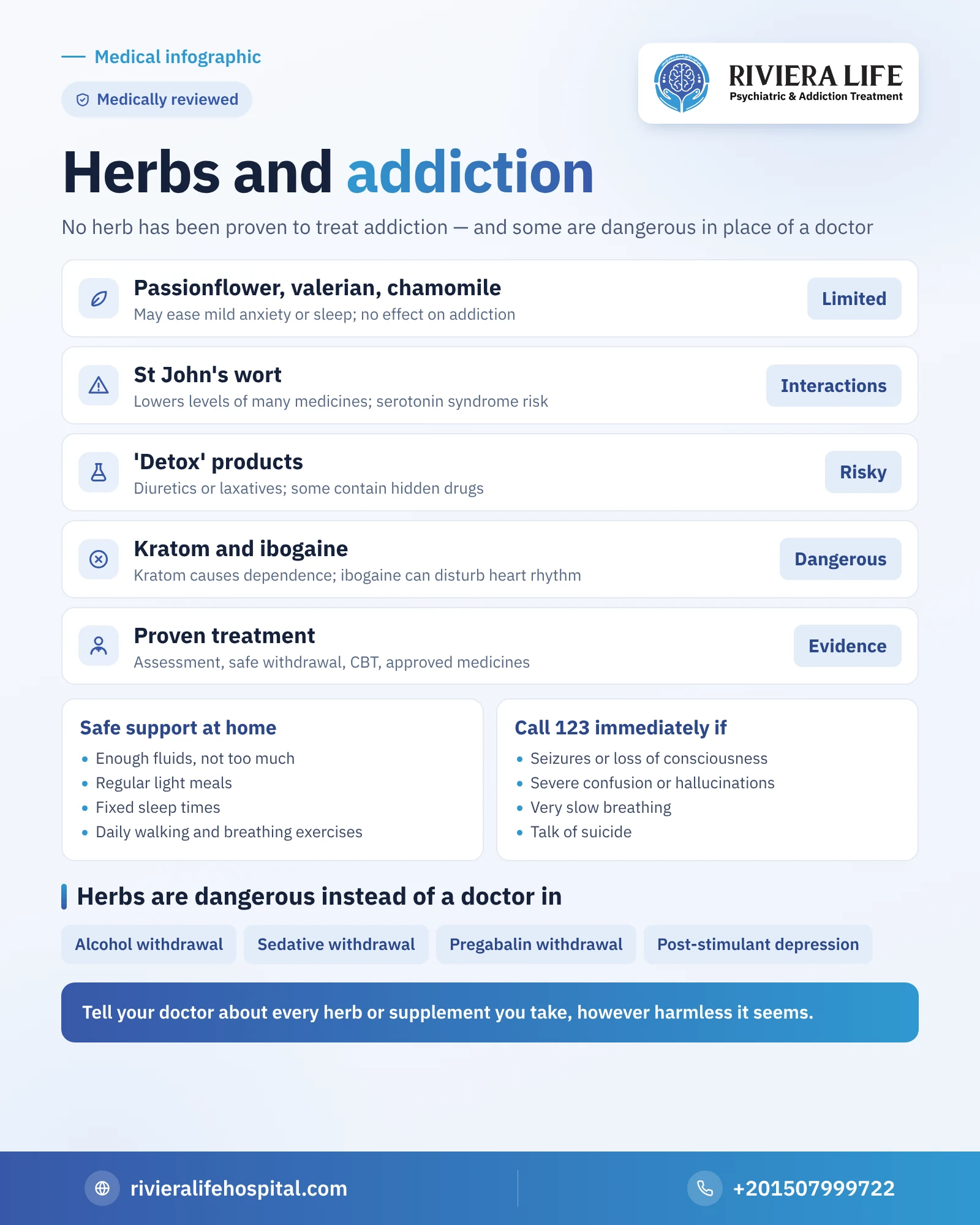
“Drug cleanse” products: what’s the truth?
Capsules and drinks are widely marketed as cleaning drugs out of the body within days. The truth is that the liver and kidneys are what get rid of the substance, and no product speeds this up to any meaningful degree. Most of these products contain diuretics or laxatives, so they cause dehydration and salt imbalance that can be dangerous for the heart, especially for someone going through withdrawal that already involves vomiting and diarrhea.
Worse still, some products marketed as herbal supplements have turned out to contain medicines not listed on the pack, so the patient takes a substance they don’t know about, and the doctor doesn’t know it is there. Often the real reason for buying them is to pass a test — the truth about which we explain in our guide to drug testing.
Kratom and ibogaine: “natural alternatives” that create a new danger
Kratom is a plant some of whose components act on the same opioid receptors, which is why it is promoted as an alternative to heroin and tramadol. But it can cause dependence and withdrawal symptoms of its own, and serious poisonings have been recorded, especially when it is mixed with other substances. In other words, the patient may come out of one addiction only to enter another.
Ibogaine, extracted from the roots of an African plant, is sometimes offered abroad as a “single-session” treatment. What is known medically is that it can cause serious heart rhythm disturbances and has been linked to documented deaths, and it isn’t approved as a treatment for addiction.
When does relying on herbs become a danger to life?
The biggest danger is sometimes not the herb itself, but what is left untreated when it is relied on:
- Withdrawal from alcohol, sedatives and pregabalin: it can cause seizures and delirium, and no herb prevents that. Stopping here needs a doctor, as we explain in our article on drug withdrawal symptoms.
- Opioid withdrawal: severe vomiting and diarrhea can cause dehydration, and going back to using after days of abstinence can cause an overdose because tolerance has fallen.
- The crash after stimulants: severe depression and suicidal thoughts need a psychiatric assessment, not a calming drink.
- A mental disorder, pregnancy, or heart, liver or kidney disease.
Call an ambulance immediately (123 in Egypt) if you see
Don't wait for any herbal mixture to work when these signs appear.
- Seizures or loss of consciousness
- Severe confusion or hallucinations while stopping
- Very slow breathing, bluish lips or difficulty waking
- Chest pain or severe, irregular palpitations
- Repeated vomiting with signs of dehydration
- Talk of suicide or an attempt at self-harm
Herbs interacting with addiction treatment medicines
Many patients take herbs secretly alongside their treatment, thinking they “do no harm”. But St John’s wort, for example, can lower the blood levels of some medicines, including medicines used to treat opioid addiction, so withdrawal symptoms suddenly return. And valerian can multiply the effect of prescribed sedatives. That is why we always ask the patient and their family to tell the doctor about every herb or supplement they take, however simple it seems.
What can safely be done at home?
There are supportive measures that genuinely help, provided they back up treatment rather than replace it:
- Drinking enough water and fluids, without overdoing it.
- Regular light meals rich in vegetables and protein.
- Fixed sleep times, and putting the phone away before bed.
- A daily walk or moderate physical activity, which improves mood and sleep.
- Breathing and relaxation exercises during waves of anxiety and craving.
- A warm drink such as chamomile for comfort, after checking with the doctor that it doesn’t conflict with any medicines.
What treatment has been proven to work?
Evidence-based treatment begins with a medical and psychological assessment, then safe management of withdrawal, then psychological and behavioral treatment such as cognitive behavioral therapy, with approved medicines for some types of addiction, and aftercare that prevents relapse. The details are in our guide to drug addiction and how it is treated.
We set out the complete steps of drug addiction treatment — from the first assessment and detox to rehabilitation and follow-up — in our addiction treatment guide.
What should the family do if the patient insists on herbs?
Arguing directly usually pushes them to cling to their view. It works better to agree on a middle step: “Try what you like, but only after a doctor has seen you and knows what you’ll be taking.” This sentence preserves their dignity and puts them in front of a specialist. And if the substance is alcohol or sedatives, don’t accept any home attempt to stop before an assessment. For more ways of persuading, read how to help someone with an addiction and persuade them to get treatment.
How can Riviera Life help you?
If fear of scandal or of hospital is what has made you think of herbs, start with a free, confidential consultation with Riviera Life’s consultants in psychiatry and addiction treatment, where you will learn the right plan for your situation without any commitment. You can reach us around the clock on +201507999722.
Read also
- Addiction treatment at home: the medical truth and the safe limits
- Can someone addicted to drugs quit on their own?
- Naloxone and rescue from overdose
- Drug withdrawal symptoms and when they become dangerous
Questions many people ask
No herb has been proven to treat addiction. Some herbs may ease mild insomnia or tension, but they are no substitute for medical and psychological treatment, and they may interact with medicines.
No. The liver and kidneys clear the substance at their natural rate, and cleansing products are usually diuretics or laxatives that can cause dehydration and salt imbalance, and some contain undeclared substances.
It isn't an approved treatment: it acts on opioid receptors and can cause dependence, withdrawal and poisoning, so the patient swaps one problem for another.
Don't do it before asking the doctor. St John's wort, for example, can lower the levels of some medicines, and valerian multiplies the effect of sedatives.
When they are used instead of a doctor during withdrawal from alcohol, sedatives or pregabalin because of the risk of seizures, with severe depression after stimulants, or with pregnancy or heart or liver disease.