A drug test is a laboratory examination that looks for the drug or its breakdown products in a sample of urine, blood, saliva or hair. It is requested in emergencies, before appointment to some jobs, during follow-up of addiction treatment, and sometimes by a family’s decision. The result isn’t a final verdict: a rapid test can be wrong, confirmation needs a specialist laboratory, and the substance appearing doesn’t necessarily mean addiction. This guide explains the types of test, how to read the strip and its codes, the causes of false results, and what to do if a positive result appears.
What is a drug test and how does it work?
After use, the body absorbs the substance, then the liver usually breaks it down into smaller compounds called metabolites, which leave gradually with the urine or remain as a trace in the hair. The test looks for this substance or its products, and only declares the result positive if its concentration exceeds a certain level called the “cutoff”. That is why a person may actually have used, but the concentration in their sample is below the cutoff, so the result comes out negative.
Why is a drug test requested?
- In emergencies: to explain a coma, seizures or sudden behavioral disturbance and choose the right treatment.
- In medical and psychiatric assessment: when symptoms appear that may be caused by a substance, such as psychosis or panic attacks.
- During addiction treatment: to follow commitment, detect relapse early and know what substances are being mixed.
- For work and licenses: in some jobs and bodies and for obtaining some permits, according to the rules in force.
- At home: when the family suspects one of its members of using.
Sample types: urine, blood, saliva and hair
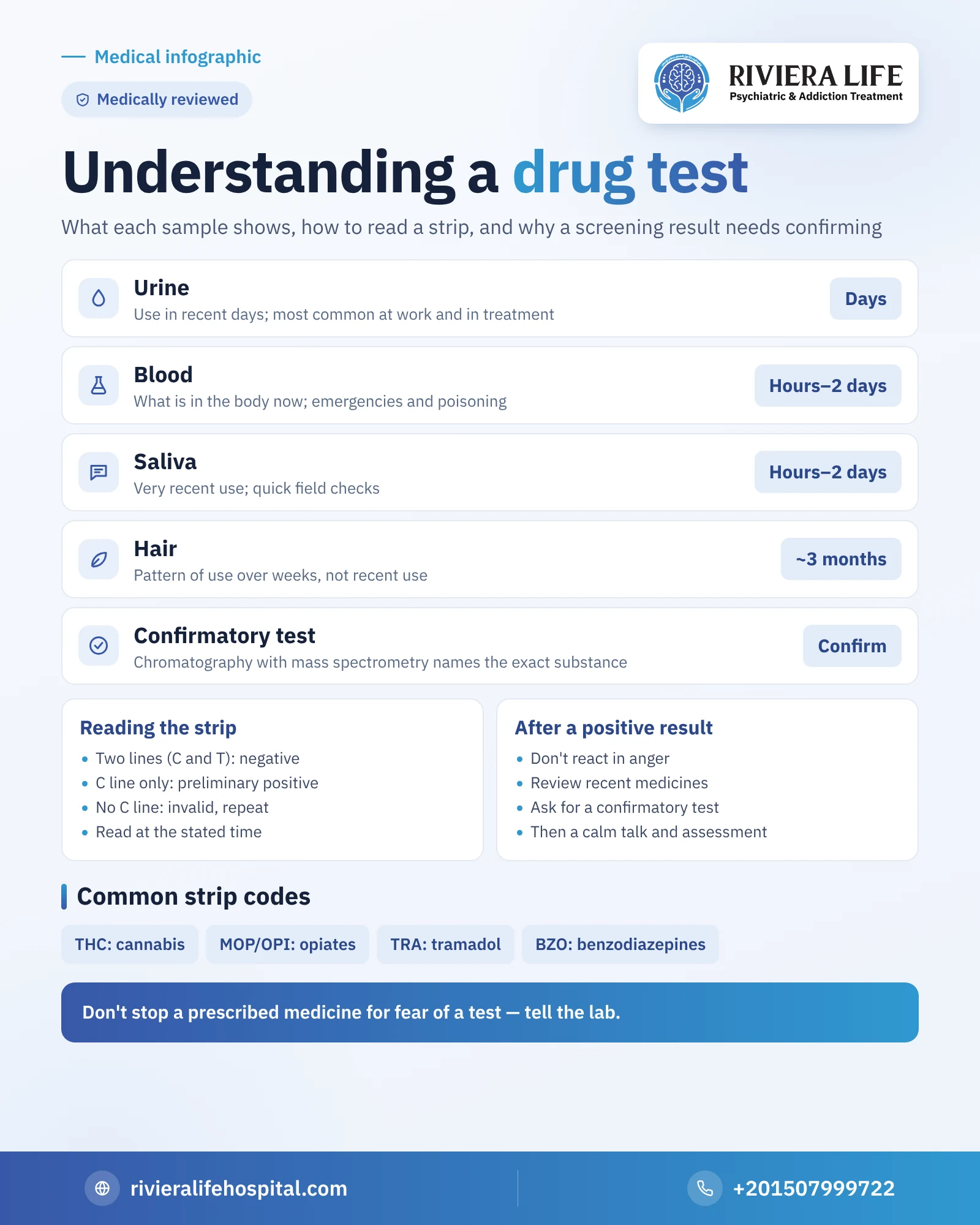
Each sample has what it detects and what it can’t, and the durations here are approximate and general, varying greatly with the substance and amount:
| Sample | What it reflects | General detection range | Where it is mostly used |
|---|---|---|---|
| Urine | Use in recent days | A day to a few days for most substances, and longer with chronic use of some | Most common at work and in treatment |
| Blood | The substance present in the body now | Hours to about a day or two | Emergencies and assessing poisoning |
| Saliva | Very recent use | Hours to about two days | Quick field checks |
| Hair | The pattern of use over weeks | Up to about three months | Knowing the history, not recent use |
Screening test and confirmatory test: what’s the difference?
A screening test, whether a rapid strip or a laboratory device, relies on an immune reaction that recognizes the shape of the molecule. It is fast and relatively cheap, but it may react with substances similar in structure to the drug and give a false positive. A confirmatory test is carried out with precise separation and measurement devices such as chromatography coupled with mass spectrometry, so it identifies the specific substance and its concentration.
The professional rule is that any positive screening result with important consequences, such as a job or legal decision, must be confirmed with a confirmatory test before it is relied on.
How do you read a rapid drug test strip?
The strip usually contains two zones: the control line (C) and the test line (T). The way to read it is the opposite of what many expect:
- Two lines, at C and at T: the result is negative, meaning the substance isn’t present at a concentration above the cutoff.
- One line at C only: the result is preliminarily positive.
- No line at C: the test is invalid and must be repeated with a new strip.
And if the T line appears very faint, most manufacturers count it as a negative result as long as it is present, but following the strip’s own instructions and reading the result at the stated time are essential, because a late reading may mislead.
Drug test codes: what do the letters mean?
| Code | Substance or family |
|---|---|
| THC | Cannabis: hashish, bango and marijuana |
| MOP or OPI | Morphine and natural opiates such as heroin and codeine |
| TRA or TML | Tramadol |
| BZO | Benzodiazepines |
| AMP | Amphetamine |
| MET or mAMP | Methamphetamine (ice) |
| COC | Cocaine |
| MDMA | Ecstasy |
| KET | Ketamine |
| MTD and BUP | Methadone and buprenorphine |
| K2 | Some synthetic cannabinoids |
| OXY | Oxycodone |
| FYL or FEN | Fentanyl |
| BAR | Barbiturates |
| PCP | Phencyclidine, a dissociative drug |
| 6-MAM | A metabolite linked specifically to heroin |
It is important to know that the standard opiate test may not detect all synthetic opioids, that pregabalin doesn’t show in most standard strips, and that synthetic drugs such as strox and voodoo constantly change their formula and so escape many tests, as we explain in our article how long strox stays and the truth about it showing in tests.
5-panel, 7-panel and 10-panel tests: which should you choose?
The number refers to how many substances the strip or panel detects at the same time. The 5-panel covers the most common substances, while the 7-panel and 10-panel add others. The choice rests on one question: what is the suspected substance? A 10-panel that doesn’t include tramadol is no use if tramadol is the main suspect, and a 5-panel isn’t enough when sedatives are suspected if it doesn’t include them. Read the list of codes on the package before buying, or ask the laboratory.
How many days do drugs show in a test?
There is no single answer; the duration varies with the substance, the type of sample, the amount, how often it is used and liver and kidney function. That is why we have dedicated a separate article to each substance with detailed detection times:
- How long hashish stays in the body and in tests
- How long tramadol stays in urine and blood
- How long pregabalin stays in the body
- How many days does heroin show in a test?
- How long ice stays in urine, blood and hair
- How long captagon stays in the body
- How long benzodiazepines stay in the body
- How long alcohol stays in blood and urine
Where is a drug test done, and when does the result appear?
The test is done in licensed private medical laboratories, and in the laboratories of government and university hospitals. Tests for appointment and promotion in the state’s administrative apparatus have bodies and procedures set by law, explained in our article the law and addicts in Egypt. Rapid home strips are sold in pharmacies, and their limits are explained at the end of this article.
How long does the result take?
A rapid strip gives its reading within minutes. A screening test in the laboratory usually appears the same day. A confirmatory test with chromatography devices needs longer, which may extend to days, depending on the laboratory and the number of substances requested.
Does a drug test require fasting?
It doesn’t require fasting from food. But don’t drink very large amounts of water right before the sample; laboratories reject a heavily diluted sample and ask for the test to be repeated. And tell the laboratory about every medicine you take, even if it is an ordinary painkiller or cold medicine.
What determines the price of the test?
There is no single price, because the cost changes with several factors: the number of substances examined (5-, 7- or 10-panel), the type of sample (urine is usually cheaper than blood and hair), the need for a confirmatory test, and whether you need an official stamped report for an employer or for travel. Ask the laboratory about these items before paying so you know what you are getting.
Do cigarettes, alcohol or the exact type of drug show in the test?
Standard tests don’t look for nicotine, so cigarettes don’t show in them unless a special cotinine test is requested. Alcohol usually isn’t part of the standard strip, and needs a separate breath, blood or urine test. And a rapid strip identifies the substance’s family, not its name: the opiate line, for example, doesn’t by itself distinguish between heroin and codeine, and it is the confirmatory test that identifies the exact substance.
False results: when is the test wrong?
The false positive
A screening test may react with legitimate medicines or foods. Well-known examples are that cough medicines containing codeine and poppy seeds may show a positive opiate result, that some cold and nasal congestion medicines and ADHD medicines may interfere with the amphetamine test, and that a number of psychiatric and other medicines may cause cross-reactions. The solution is to tell the laboratory about all medicines before the test and ask for confirmation when in doubt.
The false negative
And the result may come out negative despite use if the sample was taken too early or too late, the substance wasn’t included on the strip, its concentration was below the cutoff, or the sample was diluted.
Medicines that show in a drug test
A rapid strip doesn’t distinguish between a substance someone took to get high and a medicine a doctor prescribed for them; it only detects the molecule. So many legitimate medicines show in the test, and knowing their classes saves the family misunderstanding.
Medicines that show because they are the substance tested for
- Sedatives from the benzodiazepine family, such as diazepam and alprazolam, though some strips may not pick up certain types.
- Opioid painkillers, such as codeine, tramadol and morphine.
- ADHD medicines that contain amphetamine.
- Methadone and buprenorphine when used in treating addiction itself.
Medicines that may give a false positive
- Some cold medicines and decongestants with the amphetamine test.
- Some antidepressants, such as sertraline with the benzodiazepine panel and bupropion with the amphetamine panel.
- Antibiotics from the quinolone family with the opiate panel.
The right procedure is simple: take a list of your medicines and their prescriptions with you, tell the laboratory or doctor before the test rather than after the result appears, and ask for a confirmatory test for any positive result. And don’t stop a prescribed medicine for fear of the test, as stopping sedatives or psychiatric medicines suddenly may do more harm than good. For more on the relationship between prescribed medicines and dependence, read prescription drug addiction.
Can a drug test be cheated?
The honest medical answer: there is no safe or guaranteed way. Laboratories check the validity of the sample itself, a diluted or adulterated sample is repeated or treated as an unacceptable result by many bodies, and some of the circulating recipes are dangerous to the body. The only thing that clears the substance from the body is time. Why vinegar, salt and IV-drip tricks are exposed, and what the laboratory checks in detail, you will find in our article on cheating a drug test. And if the test date is close, start with the guide I have a drug test: what should I do?.
What do you do if a positive result appears?
- Don’t act in anger, as the preliminary result may be wrong.
- Review the medicines and supplements the person has taken in recent days.
- Ask for a confirmatory test at a reliable laboratory.
- If use is confirmed, treat it as an opportunity for a calm conversation and a specialist assessment, not a moment of punishment.
Does a test detect addiction?
No. The test answers one question: is there a substance in the body now or in the recent period? Addiction is a diagnosis a doctor makes based on the pattern of use, loss of control and harms, as we explain in our guide to drug addiction. Someone who tried once may have a positive test without addiction, and an addict who has stopped for some days may have a negative test.
Is it right to do the test at home?
Home strips are available and useful as an initial check, provided you buy the type suited to the suspected substance and read the result carefully. But forcing a son to take the test or tricking him into it may destroy the trust the family will need later. It is better for the test to be part of an open conversation or a medical assessment. You will find other ways of noticing use in the guide how to know if there is a drug addict in your home.
And if the test is required for appointment, promotion or a driving license, its practical steps and your rights when the result is positive are in our article drug testing for employees and licenses in Egypt.
How can Riviera Life help you?
If the test result has opened a door the family wasn’t ready for, the next step is a confidential assessment by consultants in psychiatry and addiction treatment, which determines whether this is passing use or an addiction that needs a plan. The first consultation is free on +201507999722.
Read also
- How long opioids stay in the body
- How do I know if my son is addicted to drugs?
- Herbal treatment for drug addiction: the truth and the risks
- How do I help an addicted person into treatment?
Questions many people ask
On most rapid strips, two lines, at C and at T, mean the result is negative. A line at C alone means a preliminary positive result, and no line at C means the test is invalid.
Urine, blood and saliva tests mostly detect recent use, while a hair test detects the pattern of use over weeks that may reach about three months.
This can happen in a screening test, for example with cough medicines containing codeine and some cold medicines. So tell the laboratory about all your medicines and ask for a confirmatory test when in doubt.
It doesn't show in most standard strips and needs a special laboratory test. Likewise, many synthetic drugs are not detected by conventional strips.
No. The test only proves the substance is present; addiction is a medical diagnosis based on the pattern of use, loss of control and harms, and needs a specialist assessment.
It isn't on the announced list of tests in the initiative for screening people about to marry, which covers diabetes, blood pressure, obesity, hepatitis viruses, HIV, blood group and hemoglobin. Either party can request it and have it done at a licensed laboratory.
It doesn't require fasting from food, but it is better not to drink excessive water before the sample because a diluted sample is rejected, and tell the laboratory about any medicines you take.