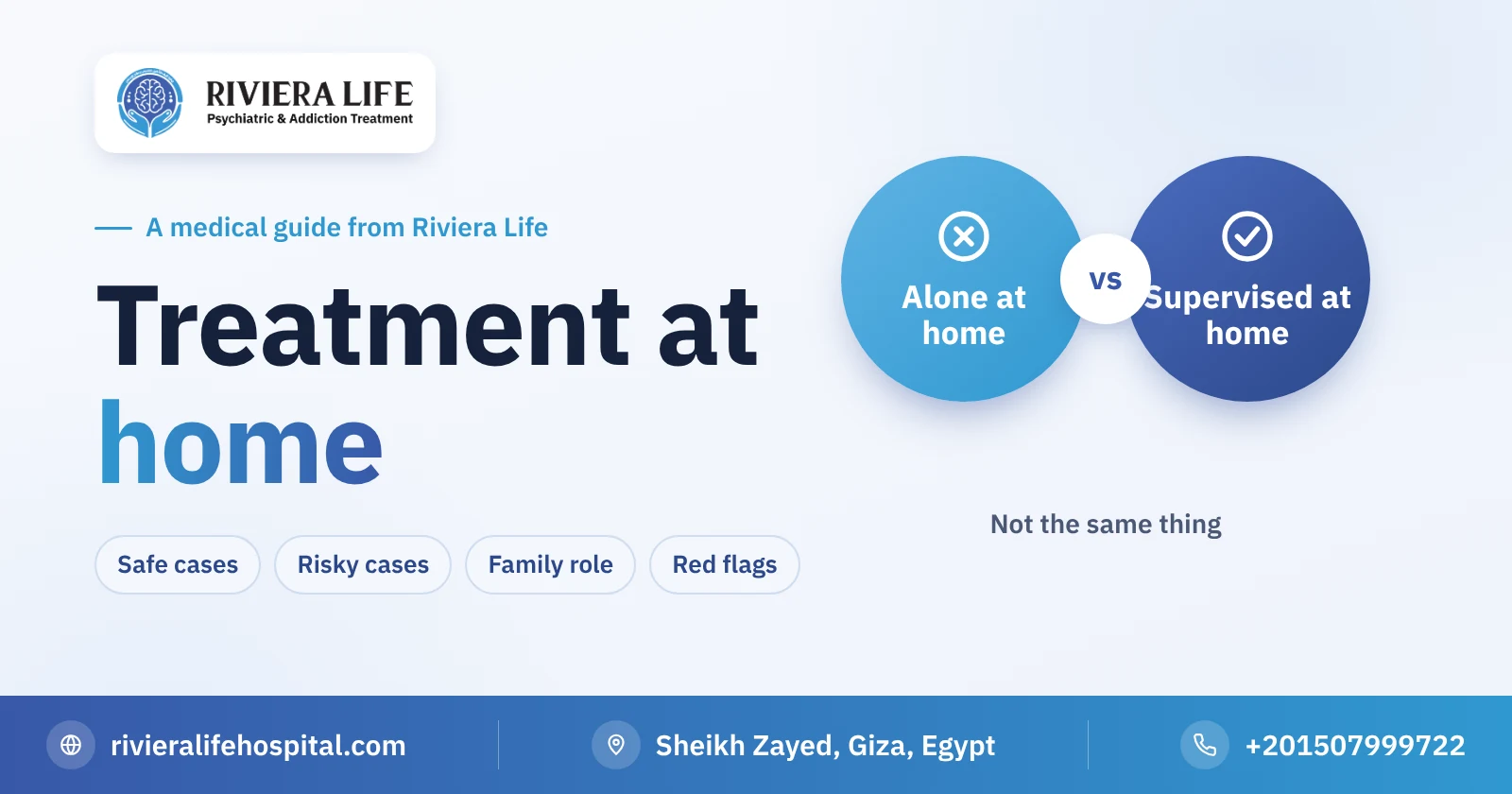
Can addiction be treated at home? The medical answer: part of the treatment journey can happen at home, on condition that the case is suitable and there is a doctor who assesses and follows up and a clear plan. But for the patient to stop suddenly in his room while the family closes the door and waits isn’t treatment, and may be dangerous to his life with some substances. This article explains when home is a safe place for treatment and when it isn’t, why many home attempts fail, what the family can do safely, and the signs that require stopping and moving to hospital immediately.
What does “addiction treatment at home” mean medically?
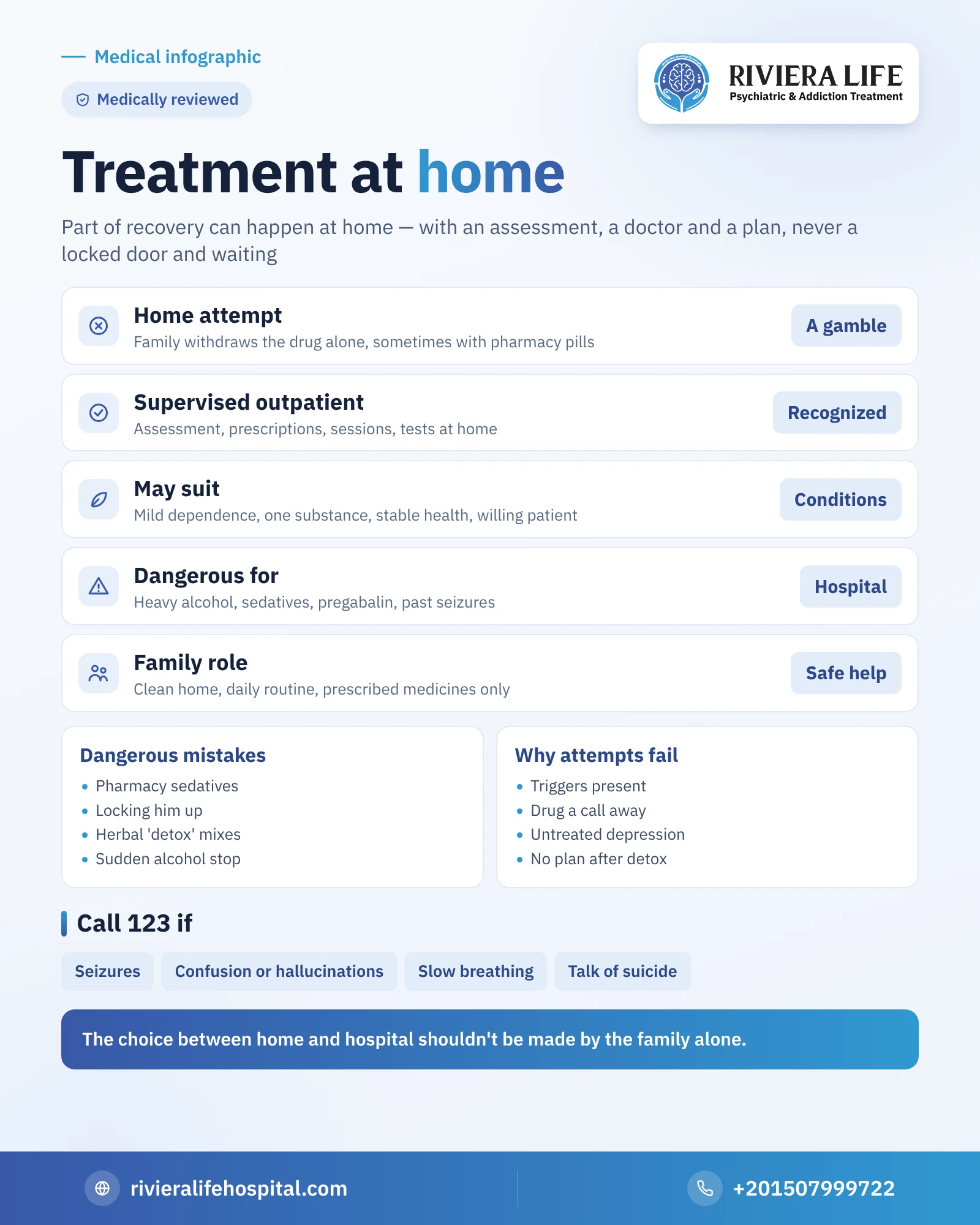
People confuse two completely different things. The first is the family trying to withdraw the drug from the patient inside the home by its own effort, sometimes with medicines from the pharmacy or herbal mixtures. The second is organized outpatient treatment, in which the patient lives at home while a medical team handles assessment, prescribing medicines, psychological sessions, periodic follow-up and tests. The first is a gamble, and the second is a recognized treatment option for particular cases.
When we talk in this article about safe home treatment, we always mean the second type. The difference between what works at home and what needs a hospital becomes clearer in our guide to drug addiction treatment.
What happens in the body on stopping at home?
Hours or days after the last dose, withdrawal symptoms begin, and they differ completely according to the substance: aches, diarrhea and insomnia with opioids; tremor, anxiety and possibly seizures with alcohol, sedatives and pregabalin; and a sharp crash and depression with stimulants. The full details are in our article on drug withdrawal symptoms. What concerns us here is that the home doesn’t have the tools to deal with complications if they happen, and that the craving in these days is at its strongest while the substance is a phone call away.
When might treatment at home work?
The doctor may decide that follow-up from home is suitable if most of these conditions come together:
- Mild to moderate dependence, without a history of severe withdrawal symptoms.
- The substance isn’t one with dangerous withdrawal, or stopping will be through gradual reduction set by the doctor.
- No mixing of several substances.
- No severe psychiatric disorder, suicidal thoughts or psychosis.
- Stable physical health, with no pregnancy or advanced heart or liver disease.
- The patient himself wants treatment and isn’t forced into it.
- A supportive home free of the substance, with a responsible adult who can follow up.
- The ability to reach the doctor and emergency services quickly.
Cases in which home treatment is dangerous
- Dependence on alcohol, sedatives or pregabalin in large amounts, because of the risk of seizures and delirium.
- A previous history of seizures or delirium during withdrawal.
- Mixing opioids with sedatives, or a history of overdose.
- Severe depression, suicidal thoughts or psychotic symptoms, especially after stimulants or strox.
- Pregnancy, or older age with chronic illnesses.
- Previous home attempts that ended in relapse.
- A home where someone uses, where there is violence, or a family so exhausted it can no longer follow up.
Why do many attempts at treatment at home fail?
Imagine a young man who decided to stop tramadol over a weekend. The first day passes with difficulty, and on the second night he can’t sleep, his body aches, and his phone has the numbers of those he used to buy from. His family is asleep, and the substance is a quarter of an hour away. This scene repeats often, and it sums up the reasons for failure: the triggers are present, the substance is available, the craving is at its peak, and there is no one to intervene at the critical moment.
The opposite scene happens too: a family afraid for its son watches him night and day, keeps him from his phone and from going out, and lives days of severe tension. He may actually stop under this siege, but as soon as the surveillance eases after two weeks he goes back, because nothing has changed inside him. Prevention alone postpones use and doesn’t treat its cause.
There are other less obvious reasons: untreated depression or anxiety that pushes the patient to return, a family that collapses from exhaustion after a few days, and the absence of a plan for after withdrawal, so everyone considers the task finished once the physical symptoms disappear.
What can the family do safely?
- Start with a medical assessment before any step, even if the doctor later decides treatment will be from home.
- Clear the home of the substance and the tools linked to it, and secure the household’s sedative and painkiller medicines.
- Organize the patient’s day: fixed sleep and meal times, light activity, and less staying up late.
- Stick to the medicines exactly as the doctor prescribed, without more or less.
- Keep a calm dialogue without daily lectures or threats.
- Write down any worrying symptoms and share them with the doctor at the time.
- Protect the family itself with rest and support, because an exhausted carer can’t continue.
Medicines for addiction treatment at home: what does the doctor decide?
Someone searching for medicines for addiction treatment at home usually wants pills that end withdrawal without going into hospital. But there is no single medicine that suits all substances, and a medicine that helps one patient may harm another. The doctor is the one who determines after assessment whether the patient needs medicine at all, which medicine, and when to start.
These are examples for information only, not a prescription:
- Opioids: substitute medicines such as buprenorphine may be prescribed under strict dispensing arrangements, or naltrexone to prevent relapse after completely stopping the substance.
- Alcohol: there are medicines that reduce craving and protect against relapse after withdrawal ends, while withdrawal sedatives are only given with a precise medical plan. You will find the comparison in medicines for treating alcohol addiction.
- Accompanying symptoms: insomnia, anxiety and depression are treated with medicines the doctor chooses, sets the duration of and reviews.
Whatever the medicine, dispensing, adjusting and stopping it is the doctor’s business alone. Don’t buy a sedative or sleeping pill from the pharmacy to calm the patient, don’t transfer someone else’s prescription to him, and don’t give him a medicine to stop withdrawal symptoms before assessment; the treatment itself may turn into a new problem. Some substitute opioid medicines are also subject to strict dispensing laws, so relying on what people pass around isn’t right.
Dangerous mistakes many make
- Giving the patient sedatives or sleeping pills from the pharmacy to calm him; this may lead to slowed breathing or a new addiction.
- Locking up or restraining the patient; this doesn’t treat addiction, exposes him to harm, and destroys trust.
- Relying on herbal mixtures or “cleansing” products, whose truth we have explained in our article on herbal treatment of drug addiction.
- Stopping alcohol or sedatives suddenly without a doctor.
- Giving the patient money or the phone without controls in the first days.
Home or hospital? A quick comparison
| Criterion | Home attempt without a doctor | Outpatient treatment from home with medical supervision | Treatment in hospital |
|---|---|---|---|
| Assessment and diagnosis | Absent | Present before starting | Comprehensive and ongoing |
| Dealing with complications | Late and dangerous | Calling the doctor and transfer when needed | Immediate, around the clock |
| Distance from the substance and triggers | Weak | Medium, depending on the family | High |
| Psychotherapy | Usually absent | Regular sessions | Daily and intensive |
| Suitable for | Not advised | Mild, stable cases | Moderate, severe and complex cases |
When do you stop home treatment immediately?
Call an ambulance on 123 immediately if you see
These signs mean the home is no longer a safe place for treatment right now.
- Seizures or loss of consciousness
- Confusion, hallucinations or not knowing the place and time
- Slow or weak breathing, or difficulty waking
- Chest pain or severe palpitations
- Persistent vomiting with signs of dehydration
- Talk of suicide or attempts to harm oneself or others
There are also less acute signs that mean the plan needs changing: a return to use even once, refusing follow-up, a clear deterioration in mood and sleep, or the family’s complete exhaustion.
If the doctor decides treatment will be from home
In this case the home becomes part of a treatment plan with stages, appointments and defined roles for the family, which we explain in detail on our page on the home addiction treatment program. An organized program usually includes visits or follow-up sessions at fixed times, medicines the doctor prescribes and whose effect he reviews, periodic tests when needed, individual psychotherapy, family sessions, and a written plan for what happens if a danger sign appears. A middle solution may suit some cases, such as the half-residency program, or follow-up through online addiction treatment after withdrawal ends.
How can Riviera Life help you?
The decision between home and hospital shouldn’t be made by the family alone. At Riviera Life you start with a free, confidential consultation in which an addiction consultant assesses the case, then tells you frankly whether it allows follow-up from home or needs a stay with round-the-clock supervision. Contact us on +201507999722.
Read also
- Can a drug addict quit on his own?
- The full residential addiction treatment program
- How do I help an addict and persuade him to get treatment?
- Drug addiction: definition, signs and treatment
Questions many people ask
Some mild, stable cases can be followed from home, but on condition of a medical assessment, a plan and regular follow-up. A home attempt without a doctor isn't treatment and may be dangerous.
Alcohol, sedatives and pregabalin in large amounts, because their withdrawal may cause seizures and delirium. Stopping them needs medical supervision and gradual reduction.
No. Sleeping pills and sedatives from the pharmacy may slow breathing, especially with opioids, and may cause a new addiction. Any medicine must be prescribed by the doctor.
No. Locking up doesn't treat the causes or manage withdrawal, exposes the patient to harm, destroys his trust in the family, and often ends in relapse as soon as he gets out.
A home program is an organized medical plan run by a specialist team for suitable cases, while stopping at home without a doctor is an individual attempt that lacks the tools for assessment and dealing with complications.