Drug addiction is a chronic disorder that affects the brain’s reward and control circuits, so the person finds themselves driven to use even though they see the harm with their own eyes: a job lost, a home tense, health declining. It isn’t a weakness of morals or lack of faith, but a medical condition with signs, causes and treatment. In this general guide we explain the meaning of addiction, how it differs from mere use, how it develops, its general signs, and the usual path of treatment. The details of each substance separately you will find on its own page, and we point to them where relevant.
What is drug addiction by medical definition?
Doctors describe addiction as a pattern of compulsive use that continues despite negative consequences, often accompanied by loss of the ability to stop or reduce the amount. Its modern medical name is “substance use disorder”, and its severity is measured by the number of signs that apply to the person: mild, moderate or severe.
This article is dedicated to drug addiction specifically. Addiction in its broader sense, including addiction to behaviors such as gambling and video games, we explain in the addiction guide.
The key word here is “compulsive”. The young man who decides every night that it will be the last, then finds himself the next night looking for the substance, isn’t necessarily lying to himself; the decision to stop exists, but the system that carries out the decision has been damaged.
Use, dependence and addiction: what is the difference between them?
These terms are often mixed up in family conversations, although distinguishing between them changes the way the condition is dealt with:
| Term | Meaning | Example |
|---|---|---|
| Use or misuse | Using a substance in a harmful or illicit way, without the person necessarily losing control | Trying hash at a party with friends |
| Tolerance | Needing a larger amount to get the same effect | The tramadol tablet that used to be enough is no longer enough |
| Physical dependence | The body adapting to the substance so withdrawal symptoms appear on stopping | A patient taking an opioid painkiller on prescription for a long period |
| Addiction | Loss of control and continuing despite harm, with life preoccupied by the substance | Borrowing, lying and leaving work for the sake of use |
Physical dependence may exist without addiction, as in some chronic pain patients, and clear addiction may exist with mild physical withdrawal symptoms, as in many cases of stimulants.
How does addiction change the brain?
Drugs release amounts of dopamine in the reward circuit far beyond what natural pleasures such as eating, success and relationships release. With repetition the brain adapts, so ordinary pleasures become dull, and the brain learns to link places, people and feelings to the substance. This explains the urgent craving that suddenly flares when passing a certain street or after a family argument. We explain this mechanism at length in the article on dopamine and addiction.
At the same time the frontal lobe’s ability to restrain, plan and weigh consequences weakens, and the stress systems become more sensitive. The result is a person who feels distressed without the substance, and finds real difficulty in resisting the craving.
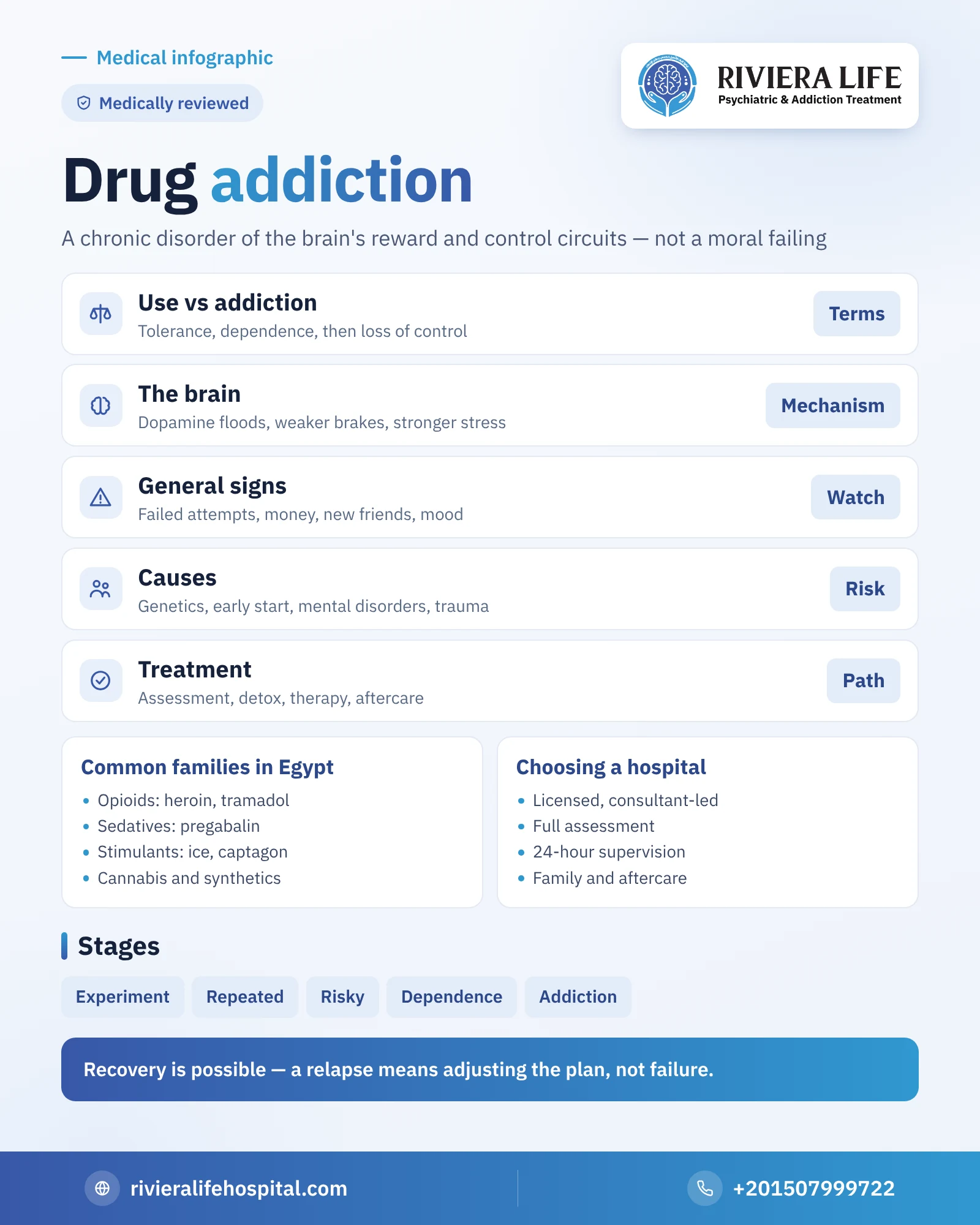
How does addiction develop? From experiment to loss of control
No one wakes up an addict suddenly. The usual path passes through overlapping stations, and its speed differs from substance to substance and person to person:
- Experiment: curiosity, peer pressure or a desire to escape distress.
- Repeated use: on specific occasions, then on days of pressure.
- Risky use: driving under the influence, mixing substances, or spending beyond one’s means.
- Dependence: tolerance, withdrawal symptoms and constant preoccupation with getting the substance.
- Full addiction: life revolves around the substance, and everything else recedes.
Intervention is possible at any station, and the earlier it is, the easier.
What are the general signs of drug addiction?
The precise signs differ according to the substance, but there is a common denominator the family may notice or the person may notice in themselves:
- Repeated attempts to stop or reduce that end in failure.
- Increasing amounts or frequency of use over time.
- Neglecting study, work or household duties.
- Withdrawing from old friends and the appearance of a mysterious new circle.
- A constant need for money and things disappearing from the house.
- Clear mood swings and irritability when deprived of the substance.
- Continuing despite clear health, legal or family problems.
If you are a father or mother and want a practical list of what to watch for at home, refer to the guide how do I know if my son is addicted to drugs?, and for visible changes in appearance and look, the article on the characteristics of a drug user.
Why does one person become addicted and another not?
There is no single cause. Usually more than one factor comes together: a genetic predisposition, an early start in adolescence when the brain is still developing, an untreated mental disorder such as depression, anxiety or ADHD, traumatic experiences in childhood, and an environment in which getting the substance is easy. The presence of a risk factor doesn’t mean addiction is inevitable, just as its absence doesn’t mean the person is immune. To understand the way the patient justifies continuing, read how does a drug addict think?.
The most widespread types of drugs in Egypt
The common substances fall into families that resemble each other in their effect and risks, and each substance has an independent page explaining its symptoms and treatment in detail:
| Family | Common examples | Most prominent risk |
|---|---|---|
| Opioids | Heroin, tramadol, morphine | Suppressed breathing and overdose |
| Sedatives | Pregabalin, benzodiazepines, alcohol | Withdrawal that may cause seizures |
| Stimulants | Ice, captagon, cocaine | The heart, psychosis and depression after stopping |
| Cannabis | Hash, bango, marijuana | Memory, motivation and psychosis in those susceptible |
| Synthetic drugs | Strox, voodoo, shadow | Unknown composition and unexpected poisoning |
Mixing more than one substance is common in Egypt, such as tramadol with hash or pregabalin, which multiplies the risks and complicates treatment. There is an independent guide to the names used on the street: drug street names in Egypt.
How does addiction affect the life of the patient and their family?
The harm doesn’t stop at the body. There are diseases of the heart, liver and lungs and infections transmitted by injection, and there are depression, anxiety and psychosis, but there are also divorce, debts, job loss and legal problems. And the family pays a parallel price of anxiety and exhaustion. The details of each substance’s harms are on its page, and what matters here is that the harm is cumulative, and that a large part of it improves after stopping and treatment.
How is drug addiction treated?
Effective treatment isn’t a single step, but a path that adapts to the person and the substance:
You will find the stages of drug addiction treatment in detail, the duration of each stage and when residence is necessary, in the addiction treatment guide.
- A comprehensive medical and psychological assessment that determines the substances, the severity of dependence and accompanying illnesses.
- Detox under medical supervision when needed, with details of what happens in it in the article on drug withdrawal symptoms.
- Helping medicines for some types of addiction, such as opioids and alcohol.
- Behavioral psychotherapy that rebuilds skills, such as cognitive behavioral therapy.
- Treating accompanying mental disorders at the same time.
- Aftercare and follow-up for months to prevent relapse.
The place of treatment is determined according to the case: full residence, half residence, or outpatient follow-up. The residential addiction treatment program presents the most comprehensive picture of this path.
Does a drug addict recover?
Yes, many recover and return to their jobs and homes. But it is more accurate to talk about “recovery” rather than “a cure in a dose”, because addiction is a chronic condition resembling in its nature blood pressure and diabetes: it needs long management, and a relapse may happen. And a relapse, if it happens, doesn’t mean treatment failed, but that the plan needs adjusting. What clearly raises the chances of success is staying in treatment long enough, family involvement, and follow-up after discharge.
How do you choose a place for drug addiction treatment?
The right hospital for drug addiction treatment is one that treats the whole patient: the substance they use, what they mix with it, their psychological state, and their family. Before you decide, ask: and you will find a complete checklist of questions and warning signs in the article on how to choose an addiction treatment hospital.
- Is the hospital licensed, and is treatment in it led by consultants in psychiatry and addiction treatment?
- Does it begin with a comprehensive assessment that uncovers mixed substances and accompanying mental disorders?
- Does it provide round-the-clock medical supervision during withdrawal, especially with sedatives and alcohol?
- Does it offer structured psychotherapy, not merely residence for detox?
- Does the family have a dedicated program that helps it support and set limits?
- Is there clear aftercare after discharge?
And don’t trust anyone who guarantees you recovery at a specific rate or claims to end addiction within a few days.
How Riviera Life meets these standards in drug addiction treatment
These are the details of what Riviera Life offers in this respect:
- Official license: a hospital licensed by the Ministry of Health.
- A long history in recovery: fourteen years in psychiatry and addiction, during which thousands have recovered.
- Consultant doctors: treatment is led by consultants in psychiatry and addiction, with experience with all classes of drugs and cases of using more than one substance at the same time.
- Medical oversight that doesn’t stop: a medical team follows the patient night and day during withdrawal and in the stages that follow.
- An individual plan: starting with an assessment of the substance and the psychological, physical and family situation.
- A family program: sessions that help the family understand the illness and take part in treatment.
- Aftercare: organized follow-up after discharge to reduce the risk of relapse.
- Complete confidentiality: full protection of the privacy of the patient and their family.
The treatment journey begins with a free first consultation; call us at any hour on +201507999722, or visit us at our base in Sheikh Zayed, Giza.
And when the time for treatment comes, choose an addiction treatment hospital in Egypt by clear criteria: licensing, the medical team, continuous supervision and follow-up.
Read also
- Drug withdrawal symptoms: what happens after stopping?
- Can a drug addict quit on their own?
- How do I help an addict and persuade them to get treatment?
- Drug prevention: a practical guide for the family
- The end of a drug addict: where untreated addiction leads and what changes it
- Prescription drug addiction: how it starts with a prescription, its signs and how it is treated safely
- The social stigma of addiction: its types, its effect on treatment and how to reduce it
- Psychological and physical addiction: the difference between them and how each is treated
- The addictive personality: fact or myth, and what are the risk traits?
Questions many people ask
Medical bodies consider it a chronic brain disorder that changes the reward and control circuits. Willpower matters in recovery, but it needs treatment to support it because the very system that carries out the decision has been affected.
Addiction in its medical sense usually needs repetition, but the first experience may be dangerous in itself because of poisoning or overdose, and some substances lead to dependence faster than others.
A user uses the substance without necessarily losing control, while an addict continues despite harm, fails to stop, and use becomes the center of their life. Repeated use may turn into addiction over time.
It differs by substance and severity; detox takes days, the treatment program weeks to months, and follow-up may extend a year or more. Staying in treatment long enough is among the most important reasons for success.
Choose a licensed hospital led by psychiatry and addiction consultants, with round-the-clock supervision, structured psychotherapy, a family program and aftercare. Riviera Life in Sheikh Zayed meets these criteria with fourteen years of experience and complete confidentiality.