The drug names used among young people in Saudi Arabia differ in large part from the Egyptian names: Captagon and its nicknames such as “Abu Hilalain”, shabu and its synonyms, and expressions such as “all-nighter pills”, alongside the names of medicines sought outside prescription. This article sets out the best known of these names in awareness-raising language, and explains the substance each name most likely refers to, with links to the medical guide for each substance. We note from the start that popular names change quickly, and that a name never determines the real composition of what is sold under it.
How are drug names read in Saudi Arabia and the Gulf?
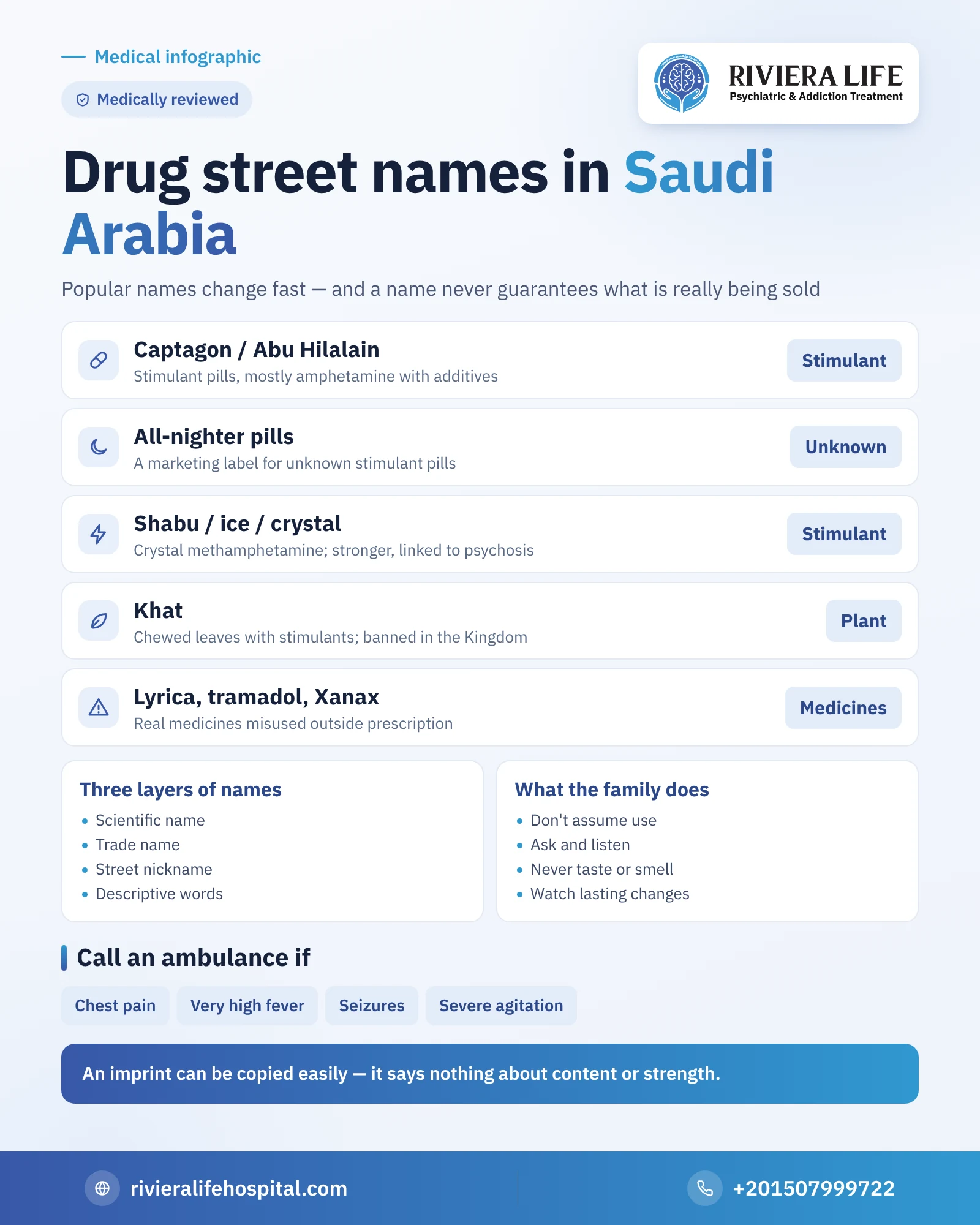
Each substance has three layers of names. The scientific name, such as methamphetamine, which the doctor and the laboratory use. Then the trade name if it is a medicine, such as Lyrica. Then the popular nickname young people use, which changes the most, as it may come from the shape of the pill, an imprint on it, or a borrowed foreign word.
In the Gulf specifically, descriptive words are often used instead of names, such as “pills”, “white” or “herb”, and these are descriptions of form that don’t indicate a particular substance. So any link between a nickname and a substance remains a likelihood, not a certainty. A simple example: the word “white” may be used by one person to mean stimulant pills, by another to mean a powder, and by a third in its completely ordinary sense.
The best-known names in Saudi Arabia and what they refer to
| Popular name | Most likely substance | More |
|---|---|---|
| Captagon / Abu Hilalain | Stimulant pills, most of those seized contain amphetamine with additives | Captagon guide |
| All-nighter pills / study pills | A marketing description for stimulant pills of unknown content | Amphetamine guide |
| Shabu | Crystal methamphetamine | Shabu guide |
| Ice / crystal / meth | The same substance under names borrowed from English | Methamphetamine guide |
| Hashish | Cannabis resin | Hashish guide |
| Marijuana / herb | Dried cannabis herb | Marijuana guide |
| Chemical / spice | Herbs sprayed with synthetic cannabinoids | Spice guide |
| Lyrica | The medicine pregabalin | Pregabalin guide |
| Tramadol | An opioid painkiller | Tramadol guide |
| Xanax / nerve pills | Benzodiazepine sedatives or other psychiatric medicines | Benzodiazepines guide |
| Heroin | A semi-synthetic opioid | Heroin guide |
| Cocaine | A stimulant extracted from coca leaves | Cocaine guide |
| Molly / happiness pills | Attributed to ecstasy | Ecstasy guide |
Captagon and its nicknames: why does it dominate talk in the Gulf?
Captagon was originally the trade name of an old medicine withdrawn from medical use decades ago, but the name remained and came to be applied to pills made illicitly. The nicknames associated with it usually come from the imprint on the pill, the best known being “Abu Hilalain” after a design resembling two facing crescents. Here specifically a common mistake occurs: the imprint can easily be copied, so it doesn’t indicate what is in the pill or its strength.
These pills are marketed among students under descriptions such as “all-nighter pills” and “study pills”, so some think they help concentration. The truth is that unknown stimulants raise blood pressure and pulse, disturb sleep and mood, and may lead to dependence; details of their signs are in our article on Captagon addiction symptoms.
Shabu: is it the same as Captagon?
No. Shabu is crystals of methamphetamine, also known as ice, crystal and sometimes “glass” because of its appearance, while Captagon is pills that usually contain amphetamine. Both substances belong to the stimulant family, but methamphetamine has a stronger effect on the brain and usually lasts longer, and is more clearly linked to psychosis. We have explained the scientific difference in our article on methamphetamine vs amphetamine.
Hashish and khat: where does each fit?
Hashish comes from the cannabis plant, and in Saudi Arabia is usually known by its own name without many nicknames. Khat is a plant whose leaves are chewed, and it contains stimulant substances; it is banned in the Kingdom even though chewing it is a social tradition in some neighboring countries. This difference between countries confuses some young people, who think that what is accepted elsewhere isn’t harmful, which is medically untrue.
Names of medicines that are misused
Some of the most widely used names aren’t street names at all, but the names of real prescription medicines, such as Lyrica, tramadol and anxiety medicines. Their danger is that a young man feels reassured by them because they are “from the pharmacy”, then exceeds the prescribed dose or combines them with others. Combining sedatives and opioid painkillers specifically may slow breathing. And if a medicine has actually been prescribed, it isn’t stopped suddenly without a doctor.
Names imported from the internet
English words reach young people through social media, such as “speed” for stimulants, “molly” for ecstasy, “spice” for synthetic cannabinoids and “acid” for hallucinogens. These names give the substance a modern image and hide its danger, and many of them are applied to products whose real composition no one knows.
Does a name being common mean the substance is widespread?
Not necessarily. Some names become well known because they are repeated in the news and awareness campaigns, not because their use is widespread among everyone. And any figure on prevalence needs an official source, a specific year and a clear method of measurement. So don’t build your worry on how well known a name is, but on what you actually notice in your son’s behavior.
What about the regulatory position in the Kingdom?
The regulations in the Kingdom of Saudi Arabia deal very strictly with possessing and promoting drugs, and psychiatric medicines and strong painkillers are subject to controls on dispensing. On the other hand, specialized government treatment pathways are available in the Kingdom for those who ask for help. We don’t go into the details of penalties here because they change and need a legal specialist, but the practical message for the family is clear: the earlier treatment starts, the smaller the health, social and legal losses together, and delaying out of fear of scandal usually makes the situation harder.
How do these names differ from Egyptian names?
In Egypt, names of synthetic herbal mixtures such as strox and voodoo are common, and “powder” usually means heroin, while in Saudi Arabia Captagon and shabu dominate the conversation. Someone moving between the two countries may hear the same name with a different meaning. You will find the full Egyptian list in our article on drug street names among young people in Egypt.
How does the family deal with a name that raises concern?
- Don’t assume use just because your son knows the name, as such knowledge is widespread online.
- Ask him what he heard and where, and listen more than you talk.
- Don’t taste or smell any unknown substance you find.
- Watch for persistent changes in sleep, weight, money and study.
- If the name comes together with these changes, ask for a specialist assessment, and you will find practical steps in our article on how to help an addict.
When is it urgent?
Stimulants such as Captagon and shabu may cause serious poisoning even in a healthy young man, especially with long sleepless nights, dehydration or combining with other substances.
Call an ambulance immediately if you see
After using a stimulant or unknown pills, call an ambulance (997 in Saudi Arabia, 123 in Egypt) in case of:
- Chest pain or severe irregular palpitations
- A very high temperature with heavy sweating or dehydration
- Seizures or loss of consciousness
- Severe agitation, hallucinations or sudden pathological suspicion
- A sudden severe headache or weakness on one side of the body
How can Riviera Life help you?
Many Gulf families start with a simple question: is what we are seeing substance use or just a phase? You can start with a free, confidential first consultation by phone with Riviera Life’s psychiatry and addiction consultants on +201507999722, and discuss the option of treatment in a hospital licensed by the Egyptian Ministry of Health in Sheikh Zayed, with round-the-clock medical supervision and a family program.
Read also
- Drug street names among young people in Egypt
- What are the terms addicts use?
- Captagon addiction treatment
- How do I know if my son is addicted to drugs?
- Addiction treatment in Egypt for Gulf patients: privacy, steps and follow-up after returning
- Addiction treatment in Saudi Arabia: where does the family start?
- Drug names in the Maghreb
Questions many people ask
The nickname is usually used for Captagon pills because of the imprint on them, but the imprint can be copied and doesn't indicate the pill's content.
No, shabu is crystals of methamphetamine, while Captagon is pills that usually contain amphetamine, and both belong to the stimulant family.
This is a marketing description for stimulant pills of unknown content, which may raise blood pressure and pulse, disturb sleep and mood, and lead to dependence.
Yes, khat is banned in the Kingdom; it is a plant containing stimulant substances, even though chewing it is a social tradition in some neighboring countries.
Not necessarily, as these names are widespread online and in awareness campaigns. What matters is noticing persistent changes in behavior, sleep, money and study.