Electroconvulsive therapy, whose medical name is electroconvulsive therapy or ECT, is a medical psychiatric treatment carried out today under full anesthesia and a muscle relaxant, in which a carefully measured electric current produces a short, monitored seizure in the brain. The image fixed by old films, of an awake patient writhing in pain, bears no resemblance to what happens in modern hospitals. Doctors turn to it in specific cases, most notably severe or psychotic depression, catatonia and cases that haven’t responded to medication. This article explains the truth about these sessions, when they are used, how they generally proceed, their side effects including memory, the myths that surround them, and the patient’s right to consent.
What is electroconvulsive therapy?
The medical team places electrodes on the scalp after the patient is asleep under anesthesia, then passes a calculated current for a few seconds that produces a seizure inside the brain, usually lasting less than a minute. Because the patient takes a medicine that relaxes their muscles, almost nothing shows on their body except slight movement, and the team monitors the heart, oxygen, blood pressure and brain activity throughout.
Scientists are still studying exactly how this treatment achieves its effect. Current hypotheses speak of changes in neurotransmitters and hormones, of stimulating the growth of new connections between nerve cells in mood-related areas, and of resetting disturbed brain networks. What is more certain than its mechanism is its effectiveness in the right cases.
Between the film image and today’s medical reality
| In old films and stories | In modern practice |
|---|---|
| The patient is awake and in pain | Brief general anesthesia, so the patient feels nothing |
| Violent convulsions and fractures | A muscle relaxant keeps movement very slight |
| Punishment or a means of control | A medical treatment with specific indications and written consent |
| Erases the personality | Doesn’t change the personality; its main effect is on mood and symptoms |
| A strong, random current | An electrical dose calculated for each patient and monitored by devices |
When do doctors turn to electroconvulsive therapy?
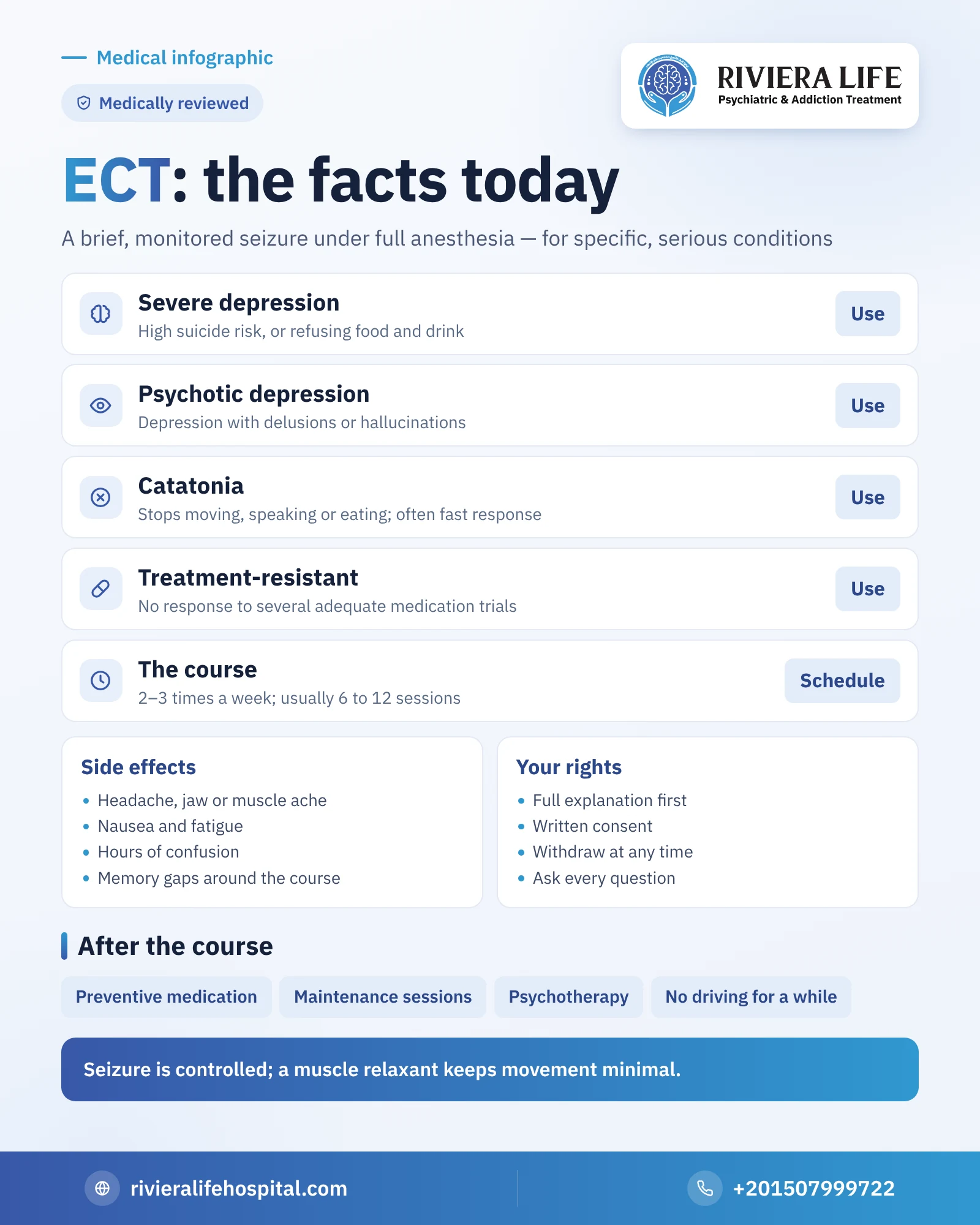
These sessions aren’t a first choice for most patients, but in certain cases they may be the fastest and safest option:
- Severe depression: especially when there is a high risk of suicide, or a refusal of food and drink that threatens life.
- Psychotic depression: when depression is accompanied by delusions or hallucinations, a condition that responds well to this treatment. See psychotic depression.
- Catatonia: when the patient stops moving, speaking or eating, and the response is often fast.
- Treatment-resistant cases: depression that hasn’t improved after trying more than one medicine at adequate doses and durations.
- Severe manic episodes in bipolar disorder when medication isn’t enough.
- Some resistant cases of schizophrenia, usually alongside medication.
It may sometimes be considered when medication is dangerous for the patient for a medical reason, or in someone who responded well to it in a previous episode. In all cases the decision is individual and is taken after careful assessment.
Assessment before starting the sessions
Before the first session, the patient goes through a comprehensive psychiatric and medical assessment: a review of their medical history and current medicines, a physical examination, blood tests, usually an ECG, and an assessment by the anesthetist. Some medicines may need an adjustment decided by the doctor, and some heart or neurological conditions require special precautions. The patient is asked to fast for some hours before each session, as with any procedure under anesthesia.
How does a session generally proceed?
- An intravenous line is placed and the monitoring devices are attached.
- The patient is given a short-acting anesthetic, then a muscle relaxant, and breathes oxygen.
- The doctor passes the current for seconds, and the seizure is followed on the EEG screen.
- The patient wakes within minutes in the recovery room, and may feel temporarily confused.
The session itself takes minutes, and the whole time including recovery is about an hour. Sessions are usually given two or three times a week, and the number of sessions in one course usually ranges between six and twelve depending on the response. The doctor chooses whether to place the electrodes on one side or both, as the one-sided method is linked to less effect on memory.
Side effects: what can happen?
Short-term effects
- Headache and pain in the muscles or jaw on the day of the session.
- Nausea and fatigue.
- Confusion and disorientation for hours after waking, more so in older people.
Memory
This is what worries patients and their families most, and it deserves an honest answer. Many have difficulty remembering events from the period around the sessions, and sometimes some of the weeks or months before them. This problem improves in most patients within weeks to a few months after the course ends. But some people report gaps in older personal memories that last longer or don’t fully return. These effects are usually less with modern techniques, and the doctor discusses them with the patient before starting and monitors them during the course.
Serious medical risks are rare, and are mostly linked to anesthesia and the state of the heart, which is why the prior assessment is done.
Who needs special caution?
There aren’t many absolute contraindications, but doctors weigh the benefit and risks carefully in those with unstable heart disease or a recent heart attack, raised pressure in the brain, a recent stroke, severe lung disease, or problems that increase the risks of anesthesia. In these cases a multidisciplinary team makes the decision.
Common myths about electroconvulsive therapy
- “It is used for someone who has completely lost their mind”: most who receive it are patients with severe depression who are well aware of their suffering.
- “It causes permanent brain damage”: modern studies haven’t shown structural brain damage from this treatment when given by the approved method.
- “The session is painful”: the patient is fully asleep and doesn’t feel the current.
- “Its effect is temporary, so it’s useless”: improvement can be fast and large, but it needs preventive treatment afterward to prevent relapse, like any treatment for an illness that can return.
- “It is always forced on the patient”: as a rule it is done with the patient’s written consent after a full explanation.
Informed consent and patient rights
Before any session, the doctor explains to the patient, and to the family if they wish, why the treatment is proposed, the expected benefits, the side effects including memory, the available alternatives, and what may happen if it isn’t done. Then the patient signs written consent, and has the right to withdraw consent at any time, even after the course has begun. When the patient is in a state that doesn’t allow them to understand and decide, such as severe catatonia, hospitals follow specific legal and medical procedures that protect their rights. Don’t hesitate to ask all your questions; a good team welcomes them.
What happens after the course ends?
The end of the sessions isn’t the end of treatment. Most patients need preventive medication, and sometimes spaced-out maintenance sessions, with psychotherapy and regular follow-up. During the sessions the patient is usually advised not to drive or make major financial or legal decisions until the confusion has passed. There are other brain stimulation treatments, such as transcranial magnetic stimulation, which have their own indications and are discussed by the doctor according to the case. For the broader picture, see depression treatment and bipolar disorder treatment.
Seek urgent help immediately if you see
Call an ambulance on 123, the mental health hotline on 16328, or go to the nearest emergency department.
- Talk of death or ending life with severe depression
- Refusing food and drink for days
- Stopping moving and speaking, with rigidity or prolonged staring
How can Riviera Life help you?
If a member of your family has severe depression or a condition that hasn’t improved despite treatment, Riviera Life’s consultant psychiatrists carry out a comprehensive assessment and explain the suitable treatment options clearly, with round-the-clock medical supervision when a stay is needed. The first consultation is free and confidential on +201507999722.
More from our psychiatric treatment guide
- Depression: the complete guide
- Psychotic depression
- Depression treatment
- Dialectical behavior therapy
- Transcranial magnetic stimulation: how it works, who it is for and its side effects
Questions many people ask
No, the patient is under brief general anesthesia with a muscle relaxant and doesn't feel the current. After waking they may have a headache or mild muscle ache.
Many have difficulty remembering the treatment period and a little before it, which usually improves within weeks to months, and some may be left with gaps in older memories.
They are usually given two or three times a week, and a course ranges from about six to twelve sessions depending on the response.
Yes. As a rule it is only done with written consent after explanation, and the patient has the right to withdraw consent at any time, with special legal procedures for those unable to decide.
Usually not; most patients need preventive medication or maintenance sessions afterward, along with psychotherapy, to prevent relapse.