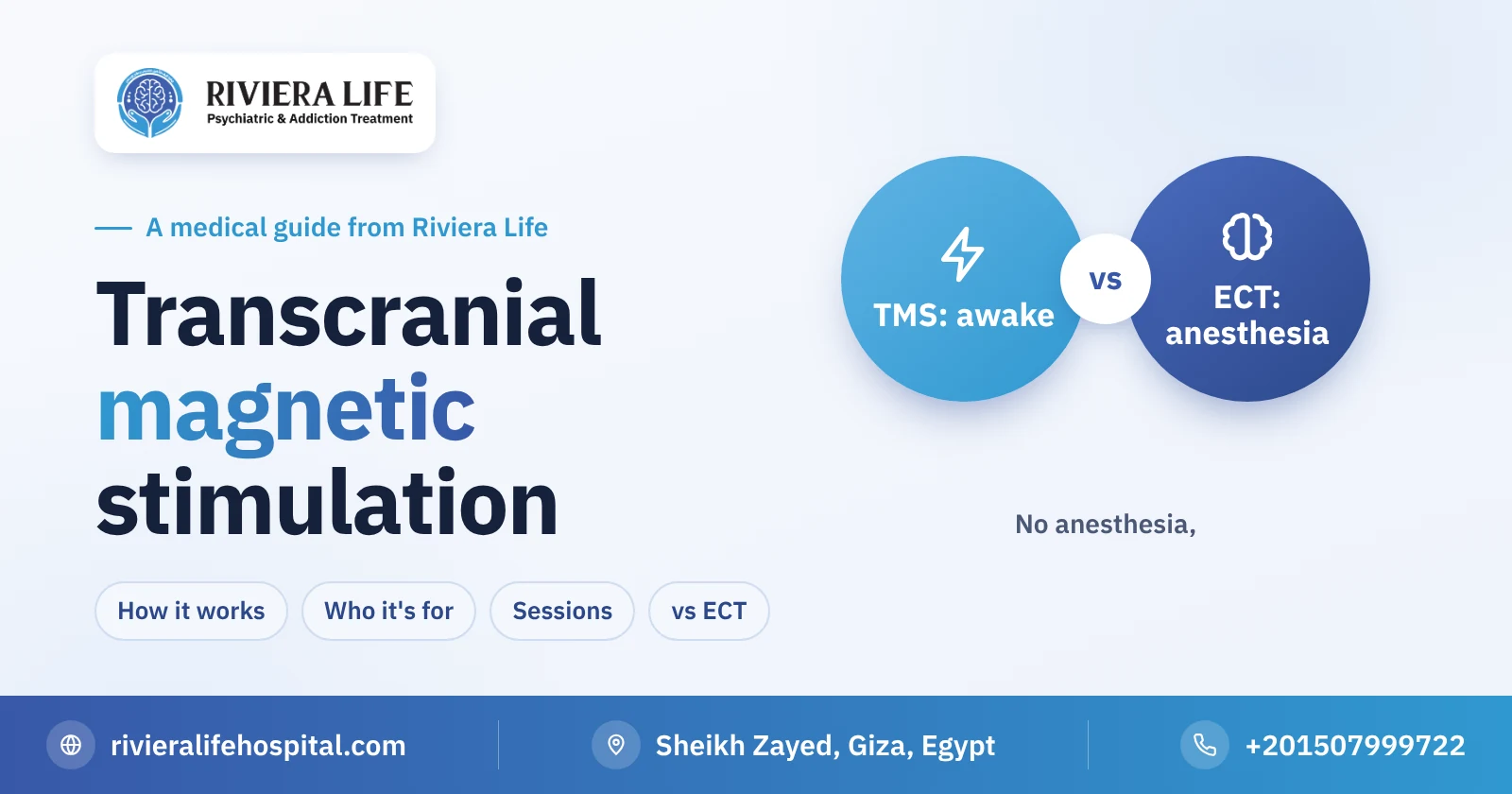
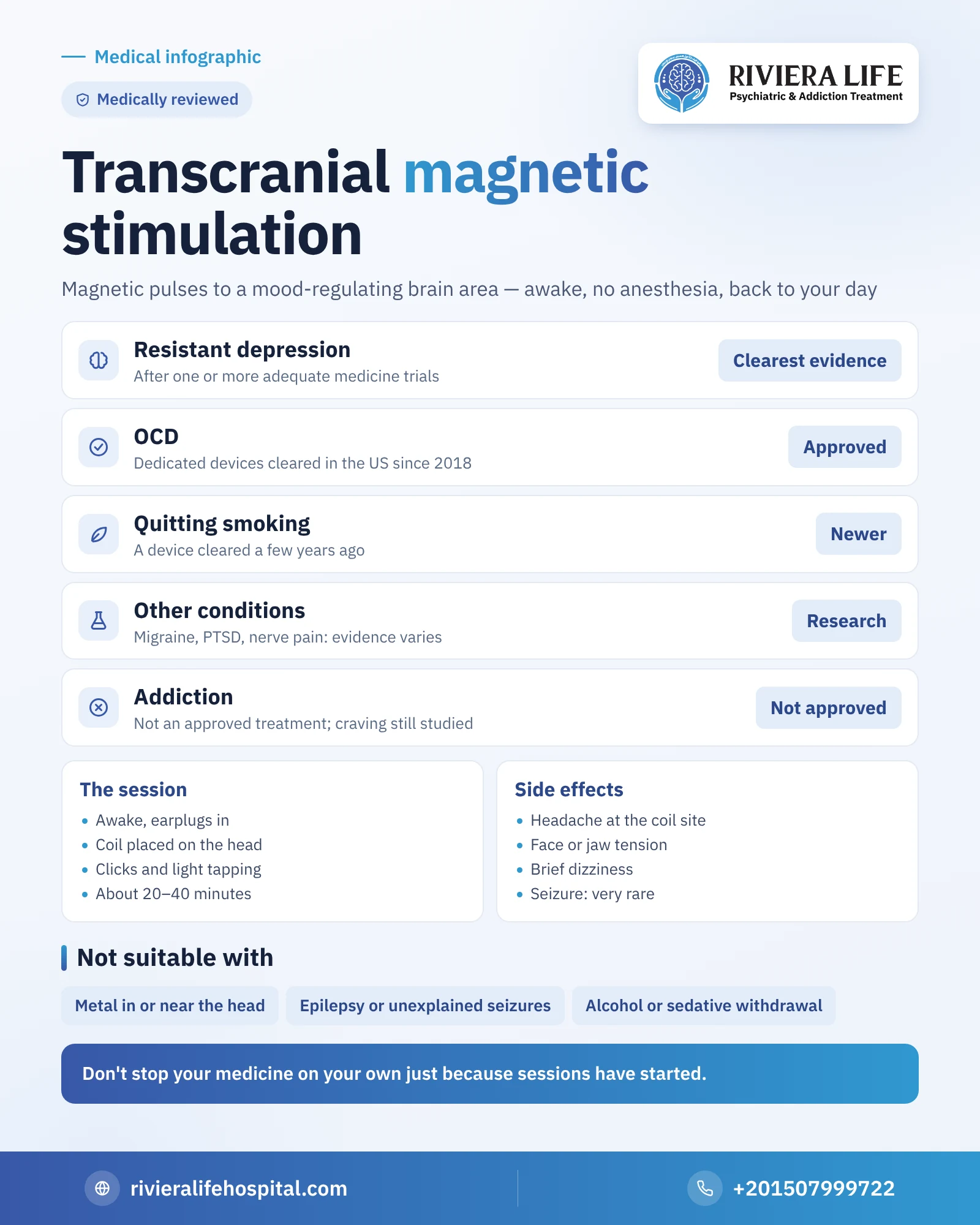
Transcranial magnetic stimulation is a treatment in which an electromagnetic coil is placed on the scalp and sends short magnetic pulses that activate a specific area of the brain linked to mood regulation. It doesn’t need anesthesia or admission to hospital; the patient sits awake and returns to their day after the session. It is used mainly for depression that hasn’t improved with medicines, and has other, less established uses. This article explains how it works, who it suits, what happens in the session, its side effects, and the difference between it and electroconvulsive therapy.
What is transcranial magnetic stimulation?
Its scientific name is transcranial magnetic stimulation (TMS), and the most common type is the repetitive form (rTMS). The idea relies on an old physical principle: a changing electric current in a coil generates a magnetic field, and this field passes through the skull painlessly and induces a very weak current in the nerve cells beneath it. It is a relatively modern treatment that entered psychiatry more than three decades ago, and the US Food and Drug Administration cleared devices for treating depression from around 2008, then for other conditions we mention later.
How does it work?
In depression the activity of an area at the front of the brain known as the dorsolateral prefrontal cortex decreases; it is linked to networks involved in mood, motivation and decision-making. The coil is aimed at this area specifically, and repeated pulses are given to raise its activity and improve its connection with the rest of the network. Not everything about the mechanism is known, but evidence points to changes in the connectivity of brain networks, which explains why the response needs weeks of consecutive sessions and not a single session.
Who is it used for?
- Resistant depression: those who haven’t improved after trying one or more medicines at adequate doses and durations, or couldn’t tolerate the medicines’ effects. This is the use with the clearest evidence.
- Obsessive-compulsive disorder: dedicated devices for this purpose appeared and were cleared in the United States from 2018, for those for whom medicines and behavioral therapy weren’t enough.
- Quitting smoking: the same agency cleared a device for this a few years ago, and it is still a recent use.
- Other conditions under research: migraine, some negative symptoms of schizophrenia, post-traumatic stress disorder and nerve pain. The evidence in these varies and needs more studies.
It isn’t usually a first treatment. The doctor usually starts with psychotherapy and medicine, as in our article on depression treatment, then considers stimulation when needed.
Assessment before starting
It is preceded by an assessment by a psychiatrist who reviews the diagnosis, previous treatments, current medicines and medical history, and asks about seizures, head injuries and any metal or implanted devices in the body. A depression scale is usually measured before and during the sessions to assess the response objectively. The appropriate placement point for the coil and the pulse strength suited to you are determined; this is known as the “motor threshold” and is measured by observing a small finger movement when stimulating over the motor cortex.
How does the session go?
- You sit awake in a comfortable chair, and wear earplugs because the device makes a loud clicking sound.
- The coil is fixed on the head over the target area.
- You hear successive clicks and feel a light tapping on the scalp, and the face muscles may twitch a little.
- The session usually lasts between about twenty and forty minutes, varying with the protocol.
- Afterwards you can usually drive and return to work.
Sessions are usually given daily, five days a week, for four to six weeks or more, and may be followed by spaced-out sessions. There are faster protocols that compress the sessions into a shorter period, still being studied and applied in specialist centers.
What can be expected from the results?
In studies, a notable proportion of patients whom medicines didn’t help improve, and some of them reach a large reduction in symptoms or recovery from them. Not everyone finds the same benefit; some don’t respond, and in some the improvement fades after months so they need maintenance sessions. That is why frankness about expectations is advised, and psychotherapy, medicine, good sleep and activity remain part of the plan, not something to neglect.
Side effects
They are mostly mild and temporary: headache or pain at the coil site, tension in the face or jaw muscles, and brief dizziness. These usually decrease after the first days. The most serious reported is a seizure, which is very rare when safety procedures are followed and the patient is screened in advance. There is a rare possibility of a predisposed patient switching from depression to hypomania, so anyone with a history of bipolar disorder is monitored. The treatment doesn’t usually cause memory loss or cognitive disturbance.
Who isn’t stimulation suitable for?
- Those with metal or implanted devices in or near the head, such as a cochlear implant or clips from some brain blood vessel operations.
- Those with epilepsy or a history of unexplained seizures, who need a special assessment and great caution.
- Those using medicines or substances that raise the risk of seizures, including withdrawal from alcohol or sedatives, so treatment is postponed.
- Those with an implanted medical device such as a pacemaker, depending on its type and location, as the specialist doctor decides.
The difference between magnetic stimulation and electroconvulsive therapy
The two names are similar in people’s minds, but the difference is large. Our article on electroconvulsive therapy explains that those sessions are done under general anesthesia and induce a controlled seizure in the brain.
| Point of comparison | Magnetic stimulation | Electroconvulsive therapy |
|---|---|---|
| Anesthesia | Not needed; the patient is awake | Brief general anesthesia |
| Deliberate seizure | No | Yes, a controlled and monitored seizure |
| Memory | Not usually affected | May cause temporary memory loss |
| Severe cases | Less suitable in psychotic depression and imminent risk | Stronger effect in severe cases |
| Session frequency | Daily for weeks | Two to three times a week |
Neither is a substitute for the other in every case; the doctor chooses according to the severity of the depression, how urgently help is needed and the patient’s physical condition.
Magnetic stimulation and addiction
Depression is widespread among people recovering from addiction and is one of the strongest triggers of relapse, as in our article on depression and addiction. Researchers have studied using stimulation to reduce craving in people addicted to cocaine, alcohol and nicotine, and some results were encouraging, but they haven’t reached the level of an approved treatment for all substances. It doesn’t replace medical withdrawal, psychotherapy or relapse-prevention medicines. It should be read as a supportive option under research, which the doctor discusses for your case, not something to be promoted.
Beware of exaggerated promises
- No home device is equivalent to the licensed medical devices operated by a trained team.
- Don’t trust anyone who promises a guaranteed cure for depression or addiction in a few sessions.
- Make sure the device is licensed and the place provides a responsible doctor and an assessment before starting.
- Don’t stop your medicine on your own just because the sessions have started.
Seek urgent help immediately if you see
Call an ambulance on 123, or the mental health hotline on 16328, or go to the nearest emergency department.
- Thoughts of ending life or planning self-harm
- A seizure or loss of consciousness after the session
- A sudden increase in activity and less sleep with unusual impulsiveness
Many confuse magnetic stimulation with neurofeedback, although the latter is training the brain on its own signals without any external stimulation; the difference between them is in neurofeedback.
How can Riviera Life help you?
If you suffer from depression that hasn’t improved, or addiction accompanied by depression, what matters is that it starts with an assessment that determines where the problem is and then the most appropriate treatment. The psychiatry and addiction consultants at Riviera Life provide this assessment in complete confidentiality, and set a plan that includes family support and follow-up after discharge. The first consultation is free on +201507999722.
More from our psychiatric treatment guide
Questions many people ask
It doesn't need anesthesia. The patient feels a light tapping and clicks on the scalp, the face muscles may twitch a little, and it may cause a temporary headache.
No. Magnetic stimulation has no anesthesia and no deliberate seizure, while electroconvulsive therapy is done under general anesthesia and induces a controlled seizure.
Usually daily sessions five days a week for several weeks, with the protocol varying and the doctor deciding.
No; it is used mainly for depression that has resisted medicines, after an assessment, and isn't suitable for those with metal in the head or a risk of seizures.
It isn't considered an approved treatment for addiction, and research is still studying its effect on craving alongside the main treatments.