Anxiety at bedtime is when you feel tension, palpitations or a flood of thoughts as soon as you put your head on the pillow, even though you were calm or tired minutes before. This happens because the day is full of busyness that blocks thinking, and when everything goes quiet at night, postponed thoughts come to the front. This doesn’t always mean you have chronic insomnia; it may be night-time anxiety that can be untangled with clear steps. In this article we explain why anxiety intensifies at night, how to tell it apart from insomnia, and what helps before sleep and in the middle of the night.
Why does anxiety get worse at night?
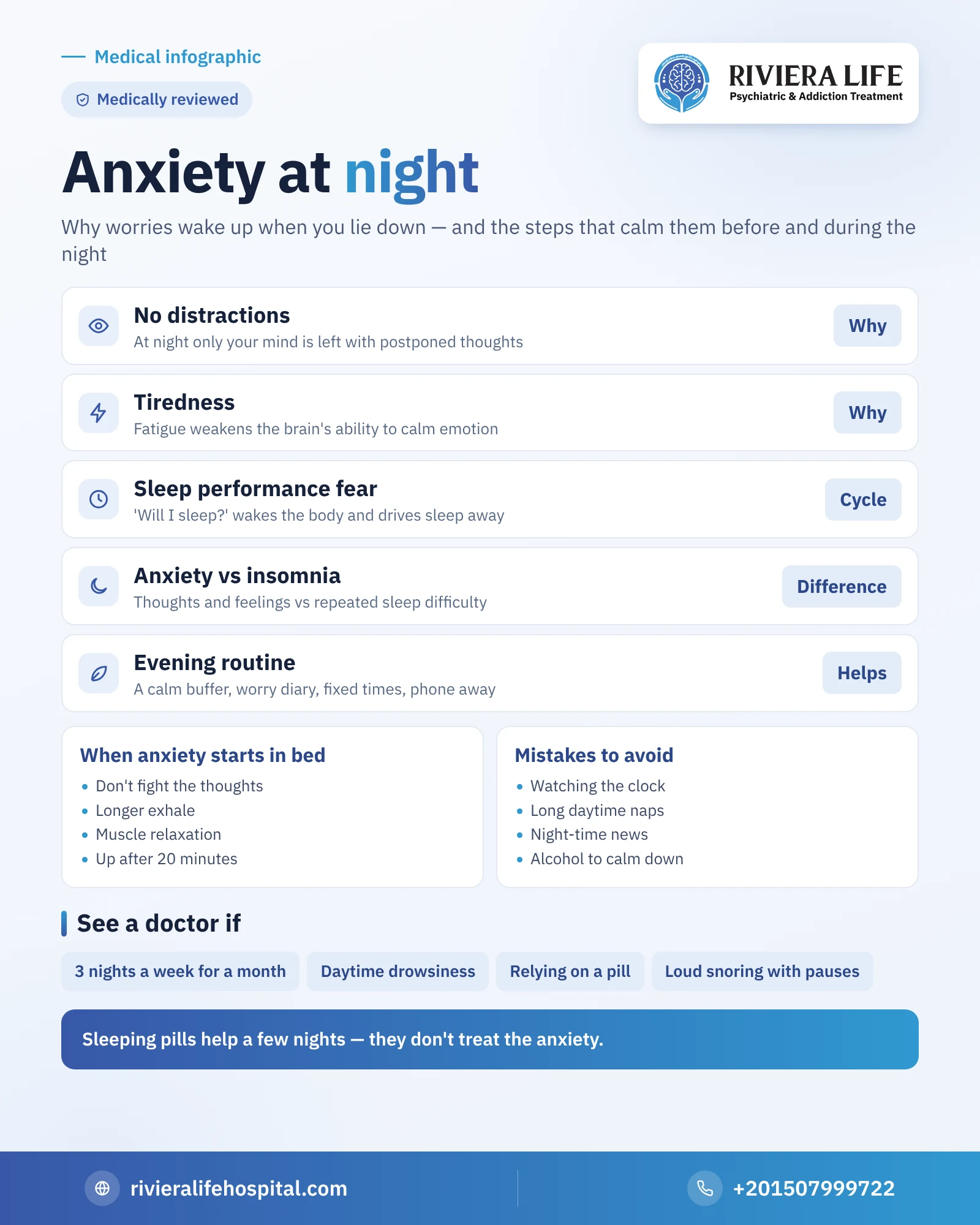
- Distractions disappear: in the day work, people and your phone keep you busy, and at night only your mind is left.
- Tiredness: exhaustion weakens the ability of the part responsible for logical thinking to calm emotion, so problems look bigger.
- Darkness and being alone: the absence of outside conversation leaves room for harsh inner dialogue.
- Sleep performance anxiety: over time you come to fear the night itself: “Will I sleep? I’ll be exhausted tomorrow.” This fear wakes the body and drives sleep away.
- The rhythm of stress hormones: in people living with chronic stress, their level may not drop as it should in the evening, and you can understand this more in high cortisol symptoms.
Anxiety at bedtime or insomnia?
The two overlap but aren’t the same thing. Night-time anxiety centers on thoughts and feelings such as fear, tension and anticipation, and it may happen even with enough sleep. Insomnia is difficulty starting or maintaining sleep, or waking early, three nights a week or more for a long period, with daytime functioning affected. It often starts with anxiety and then settles in as a habit. For details, see our insomnia guide and our article on sleep disorders.
| Question | Anxiety at bedtime | Chronic insomnia |
|---|---|---|
| What keeps you awake? | Thoughts, fears and feelings of tension | The difficulty of sleeping itself and constant wakefulness |
| Does it happen in the day? | Usually concentrated at night and milder in the day | Tired in the day, with weaker concentration and mood |
| Duration | May last days or be linked to an event | Weeks or months, recurrently |
| Best direction | Treating the anxiety and calming the evening | Behavioral insomnia treatment and assessing causes |
How do you know your sleep is affected by anxiety?
- To-do lists and worries spin in your head when you try to sleep.
- Your heart races or your chest tightens without exertion.
- You wake suddenly after a few hours with a feeling of dread or tension, then can’t get back to sleep.
- You look at the clock and count how much sleep you have left.
- You feel better on holiday or when you change place.
And if the awakenings come with sudden breathlessness and a feeling of dying, it may be a night-time panic attack, which is distressing but not dangerous in itself, though the heart should be checked if it is the first time or comes with chest pain.
An evening routine that calms the mind
The mind needs a gentle slope, not sudden brakes. These steps help many people:
- A buffer between the day and sleep: half an hour to an hour without work, news or arguments, with dim lighting.
- A worry diary: two hours before sleep, write what is on your mind and what you will do about it tomorrow, then close the notebook. Getting thoughts onto paper lightens the burden of holding them in your head.
- Fixed times: sleep and wake at similar times, even on holidays.
- A warm bath or light reading: any boring, relaxing activity works; avoid anything that stirs emotion.
- The phone out of bed: content, notifications and light all keep you on alert.
- Coffee and nicotine: cut caffeine after midday, and watch smoking near bedtime because nicotine is a stimulant.
- A light dinner: a heavy meal causes heartburn and tossing and turning.
If you lie down and the anxiety starts
- Don’t fight the thoughts: trying to stop them makes them grow. Tell them “I’ve noticed you, I’ll let you pass” and return to your breathing.
- Slow breathing: breathe in through the nose and out through the mouth with a longer exhale, for several minutes.
- Muscle relaxation: tense each muscle group for two seconds then relax it, starting from the feet and moving up.
- Leave the clock: turning the clock around or moving the phone away stops you counting time.
- If about twenty minutes pass without sleep: go to another room with dim light and read something calm, and return when you feel sleepy. The bed should be linked to sleep, not to anxiety.
- Imagine a calm, detailed scene: the sea, rain or a journey you know by heart, because vivid imagination occupies the mind away from anxious thoughts.
Mistakes that increase anxiety at night
- Monitoring your sleep: the more you try to force yourself to sleep, the more alert the body becomes.
- Making up with long daytime naps: this weakens the drive to sleep at night and locks in the cycle.
- Reviewing the day’s problems in bed: so the brain learns that the bed is a place for thinking.
- Scrolling news and messages before sleep: content that stresses or provokes.
- Alcohol to calm down: it may speed drowsiness, but it makes sleep broken and adds anxiety at dawn.
- Looking for a solution in the middle of the night: difficult decisions are postponed to the morning, because the night magnifies everything.
And if your child or teenager starts refusing to sleep alone or fears the dark, it may be part of separation anxiety or study pressure, and it needs conversation and assessment, not punishment.
If it is a child or teenager who is anxious at night
Night-time anxiety in young people shows as repeated requests for water or for parents, or refusing a dark room. It is best for sleep to have a fixed, calm ritual, for the child to be reassured with a short sentence and then left to learn to calm himself, and to listen to what occupied him during his day before sleep, not in the middle of the night.
Why isn’t a sleeping pill enough?
When night-time anxiety persists, some turn to sleeping pills or sedatives. They help with sleep for a limited number of nights, but they don’t treat the cause of the anxiety, their effect lessens with time, and more severe insomnia may appear when they are stopped. Some medicines need monitoring for the possibility of dependence, as we explain in our article on sleeping pill addiction. Any sleep medicine, from melatonin to others, is used under a doctor’s supervision, and you can read melatonin and sleep to learn about its limited role.
Specialist treatment
Cognitive behavioral therapy for insomnia is the first line when the problem persists, combining regulation of sleep and bed times with modifying frightening thoughts about sleep. And when general anxiety or depression lies behind the insomnia, the doctor treats the original disorder, and may use suitable medicines when needed and under follow-up. For details of psychological treatment, see anxiety treatment. As for someone who was using a substance to calm down at night and whose sleep worsened on stopping, it is best that stopping happens under medical supervision.
When should you see a doctor?
- Difficulty sleeping has continued three nights a week for more than a month.
- Your work or driving is affected by drowsiness.
- Awakenings with severe palpitations or choking keep recurring.
- The anxiety comes with sadness, loss of interest or thoughts of hopelessness.
- You rely on a pill, a syrup or a substance to sleep.
- Sleep comes with loud snoring and pauses in breathing, as the cause may be physical.
Seek urgent help immediately if you see
Call an ambulance on 123 or go to the nearest emergency department, and you can contact the mental health hotline 16328 in case of:
- Chest pain spreading to the arm or jaw, or severe shortness of breath
- Thoughts of self-harm or ending your life
- Confusion, hallucinations, tremor or seizures after stopping alcohol or sedatives
How can Riviera Life help you?
At Riviera Life in Sheikh Zayed, psychiatry consultants assess the causes of anxiety and insomnia together, and set a plan of behavioral and, when needed, medication treatment, with supervision for those who need to stop sleeping pills or sedatives safely, in complete confidentiality. The first consultation is free on +201507999722.
More from our anxiety guide
- Anxiety: the complete guide
- Anxiety symptoms: the psychological and physical signs
- Overthinking: rumination, anxiety and techniques to stop it
- Panic attacks: how to recognize them and what to do during them
- Parasomnia: sleepwalking, night terrors and home safety
- Recurring nightmares: their causes, link to trauma and what stops them
- Insomnia test: instant result
Questions many people ask
Because the absence of distractions at night leaves the mind to its postponed thoughts, and tiredness weakens the ability to calm them. Over time you may come to fear the night itself, so the body stays on alert.
They aren't the same thing; night-time anxiety revolves around thoughts and feelings, while insomnia is repeated difficulty sleeping with a daytime effect. Insomnia often starts with anxiety and then turns into a habit.
Slow your breathing and focus on a longer exhale, and don't watch the clock. If about twenty minutes pass without sleep, read something calm in dim light and then go back to bed, and if palpitations recur with chest pain, get a medical check.
They may help with sleep temporarily, but they don't treat anxiety and may cause dependence and rebound insomnia. Any sleep medicine should be taken under a doctor's supervision.
Look for a hospital that assesses anxiety and insomnia together, offers behavioral treatment, and supervises stopping sleeping pills safely. Riviera Life in Sheikh Zayed meets these criteria, with a free first consultation and complete confidentiality.