Overthinking is when the mind circles the same idea again and again without reaching a solution: it replays an old situation and asks “Why?”, or jumps to tomorrow and asks “What if?”. It isn’t a psychiatric diagnosis in itself, but a common pattern that feeds anxiety and depression and steals sleep. It has two different forms, each needing different handling: rumination, which is preoccupied with the past, and worry, which is preoccupied with the future. In this article we distinguish between them, explain why it is hard to stop, offer proven practical techniques, and clarify when this pattern turns into a disorder that needs specialist treatment.
What is overthinking?
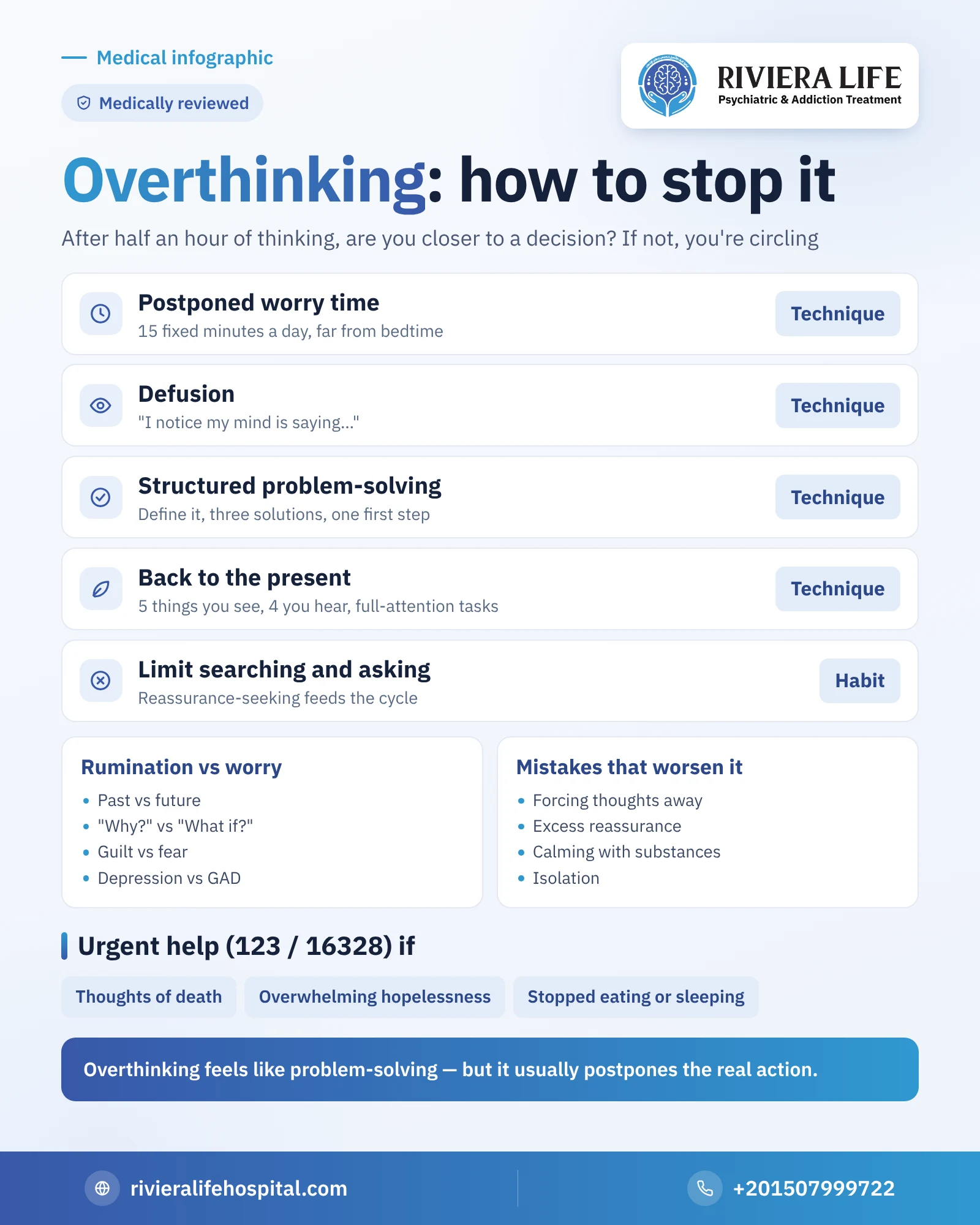
Every person thinks about his problems, and this is healthy. The difference is that useful thinking moves: it defines the problem, weighs the solutions, then decides on a step. Overthinking stays in the same place. Researchers call it “repetitive negative thinking”, and see it as a common factor in many disorders, not specific to one of them. Its practical sign is simple: after half an hour of thinking, have you become closer to a decision or an understanding? If the answer is no, and you are more tense than when you started, you are ruminating or worrying, not thinking.
Rumination and worry: two different faces
| Point of comparison | Rumination | Worry |
|---|---|---|
| Direction in time | Usually the past | The future |
| The dominant question | Why did this happen? Why am I like this? | What if the worst happens? |
| The accompanying feeling | Sadness, guilt and disappointment | Fear, tension and anticipation |
| The closest disorder | Depression | Generalized anxiety |
| Example | Replaying a conversation with the manager twenty times | Imagining being fired and its consequences |
Many move between the two in a single session: starting by blaming oneself for yesterday’s mistake, then moving on to imagining its consequences next month.
Why can’t we stop?
The overthinker usually holds two kinds of beliefs about his thinking. The first is positive: “If I think about all the possibilities, I won’t be surprised”, “Thinking about my mistake stops me repeating it”. These beliefs make stopping seem reckless. The second is negative: “I can’t control my thoughts”, “I’ll go mad from thinking so much”. This adds worry on top of worry. Added to that is the illusion of problem-solving; circling the problem gives a false feeling that you are doing something, while you are postponing the real action. And trying to drive the thought away by force brings it back stronger, as happens when you try not to think about something specific.
Overthinking, anxiety and depression
The relationship runs in both directions. Generalized anxiety is at its core based on chronic worry about many topics, and overthinking prolongs it. Rumination is among the strongest factors linked to depression; someone who tends to ruminate on his sadness has longer episodes and a greater risk of their return. That is why psychiatrists treat it as a separate treatment target, not just a symptom. It also appears in social anxiety as reviewing every word said in a meeting after it ends, and in obsessive-compulsive disorder as compulsive mental reviewing that differs in nature, as we will explain.
Overthinking and sleep
The bed is overthinking’s favorite stage; distractions disappear, and the mind finally finds time “to review the day”. Tension rises so sleep is delayed, and staying up weakens the brain’s ability to regulate emotions the next day, so rumination increases the following night. With repetition the brain learns to link the bed with wakefulness, which is one of the mechanisms of chronic insomnia. Practical solutions include: setting a worry time hours before sleep, not during it, writing down pending tasks on paper before turning off the light, and getting out of bed if insomnia lasts more than about a quarter of an hour, returning when sleepy.
Practical techniques to stop overthinking
Postponed worry time
Set a quarter of an hour daily at a fixed time, away from bedtime. When a worrying thought comes to you during the day, write it in two words and tell yourself: “It has its appointment”. At the appointment review the list; you will find that many have lost their force, and what remains can be dealt with by a step. This technique doesn’t prevent worry, but teaches you that you hold the decision of when to worry.
Defusion from thoughts
Instead of arguing with the thought, change your relationship with it. Add before it the phrase “I notice that my mind is saying…”, or give the recurring story a name such as “the failure story again”. It seems simple, but it turns the thought from a fact that controls you into a mental event you observe. This is one of the tools of acceptance and commitment therapy.
Structured problem-solving
Ask: is this a problem with a solution now? If so, write it precisely, set three possible solutions, choose one, and define the first small step and its time. If it has no solution now, such as worrying about the result of a test that hasn’t come out yet, what is needed is tolerating the wait, not more thinking.
Returning to the present
Rumination lives in the past and worry in the future, and the present has no room for them. Notice five things you see and four you hear, or engage in an activity that needs full attention: exercise, cooking or a conversation with a friend. Regular mindfulness practice strengthens this muscle over time.
Limits on searching and asking
Excessive searching online and asking others “Do you think I made a mistake?” feed the cycle. Limit the number of times you ask, or stop asking about a particular topic for a week and watch what happens.
Common mistakes that make the problem worse
- Suppressing the thought by force: brings it back stronger.
- Excessive reassurance-seeking: relieves for minutes and strengthens the habit.
- Calming with substances: hashish, alcohol or a sedative pill “to quiet the mind” is a temporary solution that turns into a bigger problem, and many cases of hashish addiction started this way.
- Isolation: emptiness opens the door wider to circling.
- Waiting for the perfect solution: perfectionism makes every decision frightening, so the mind stays in the cycle of comparison.
When does overthinking become a disorder?
The matter deserves a psychiatric assessment if it has continued most days for months, takes hours of your day, is accompanied by clear insomnia, fatigue or difficulty concentrating, or has affected your work, study and relationships. It may then be part of generalized anxiety disorder, depression, or post-traumatic stress disorder, where painful memories return against your will. In OCD, by contrast, the thought is intrusive, rejected and in conflict with the person’s values, and is followed by a visible or mental compulsive act to undo it, an important difference because its treatment is different. The diagnosis is made by a psychiatrist or specialist, not by an article or an online test.
Treatment by specialists
There are psychotherapies designed specifically for repetitive thinking: cognitive behavioral therapy in its rumination-focused version, metacognitive therapy, which targets your beliefs about thinking itself, and mindfulness-based cognitive therapy, which is used to prevent the return of depression. And if an anxiety disorder or moderate or severe depression lies behind the overthinking, the doctor may add a suitable medicine that he decides on after assessment, as our article on anxiety treatment explains.
When should you seek help immediately?
If rumination has turned into a feeling of hopelessness or that you are a burden on others, or thoughts of ending your life have appeared, don’t stay alone with these thoughts; talk immediately to someone you trust and ask for help.
Seek urgent help immediately if you see
Call an ambulance on 123 or go to the nearest emergency department, or contact the mental health hotline on 16328, in case of:
- Thoughts of death or ending life
- An overwhelming feeling of hopelessness and that there is no way out
- An almost complete stop in eating, sleeping or speaking
At Riviera Life, psychiatry consultants assess what lies behind the overthinking and set a plan of psychotherapy and medication when needed, in complete confidentiality. The first consultation is free on +201507999722.
More from our anxiety guide
- Anxiety: the complete guide
- Psychological stress: its signs and how to deal with it
- Illness anxiety: the health-worry cycle and its treatment
- Treating excessive irritability: causes and steps to take control
- Fear of the future: why it happens and how to stop expecting the worst
- Negative thinking and negative feelings: its patterns and how to free yourself
Questions many people ask
It isn't a standalone diagnosis, but a common thinking pattern. However, it may be part of generalized anxiety disorder or depression, and a psychiatrist determines that after assessment.
Set a worry time hours before sleep, write down pending tasks on paper, and get out of bed if insomnia lasts long, then return when sleepy. Regular sleep times help a lot.
Deep thinking is useful when it reaches a decision or an understanding. Circling around the same idea without result has nothing to do with intelligence, but drains energy and raises tension.
In OCD the thought is intrusive, rejected and contrary to the person's values, and is followed by a compulsive act to undo it. Overthinking usually revolves around real life problems.
There is no medicine for overthinking itself. But if anxiety or depression lies behind it, the doctor may prescribe a suitable medicine along with psychotherapy.