Feeling guilty is a painful sense that you have done something wrong or fallen short towards someone, and at its root it is a healthy part of conscience that pushes you to apologize and repair. But it may turn into a heavy burden when it continues after its cause has ended, appears without a clear cause, or stays with you for mistakes you didn’t commit. Then it becomes a mental health problem that feeds depression and anxiety, and may push towards excessive blame or escape into a drug. Here we clarify the difference between healthy and harmful guilt, between guilt and shame, when it is linked to depression or OCD, and how to deal with it in practice.
What is feeling guilty?
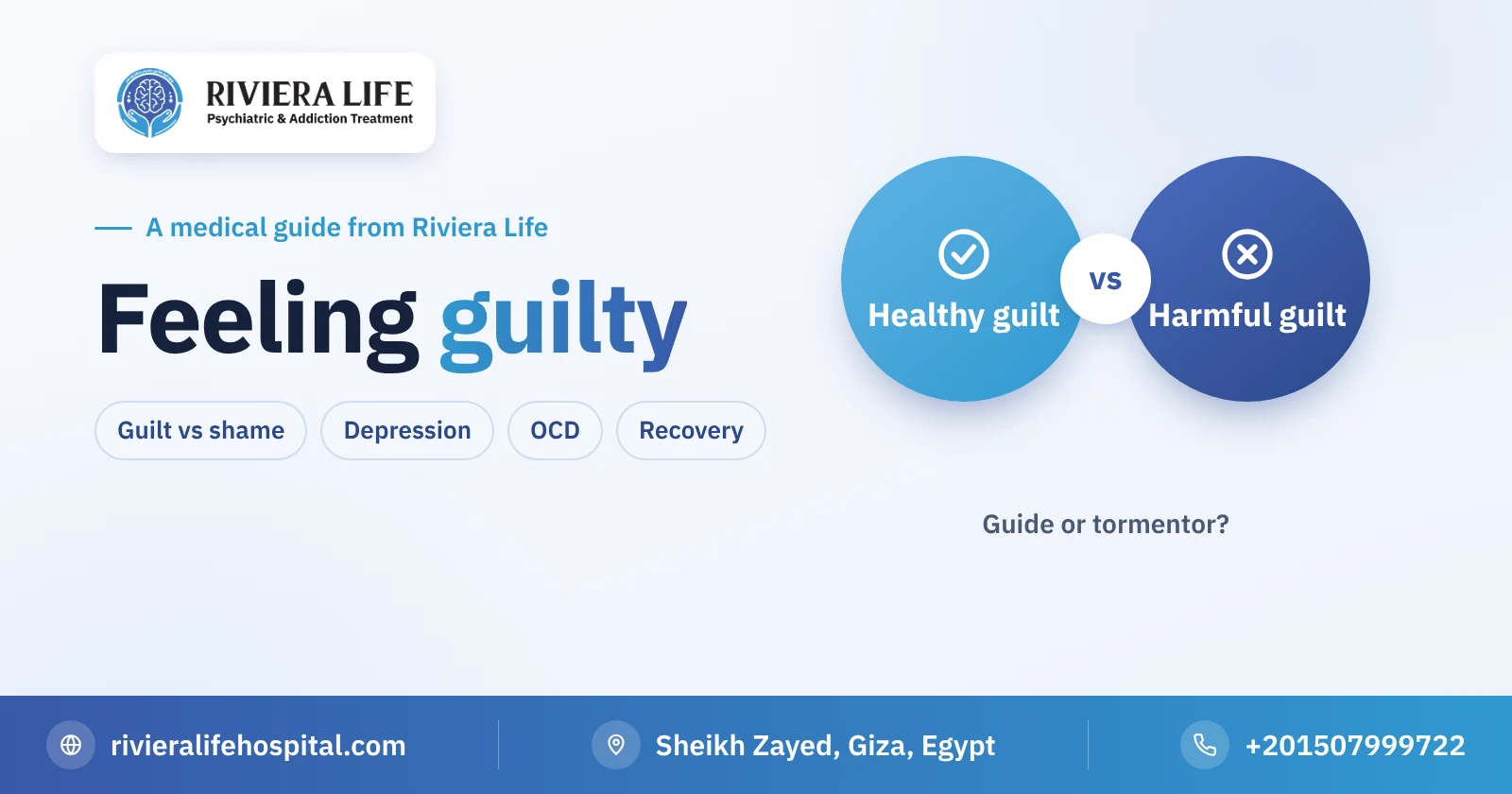
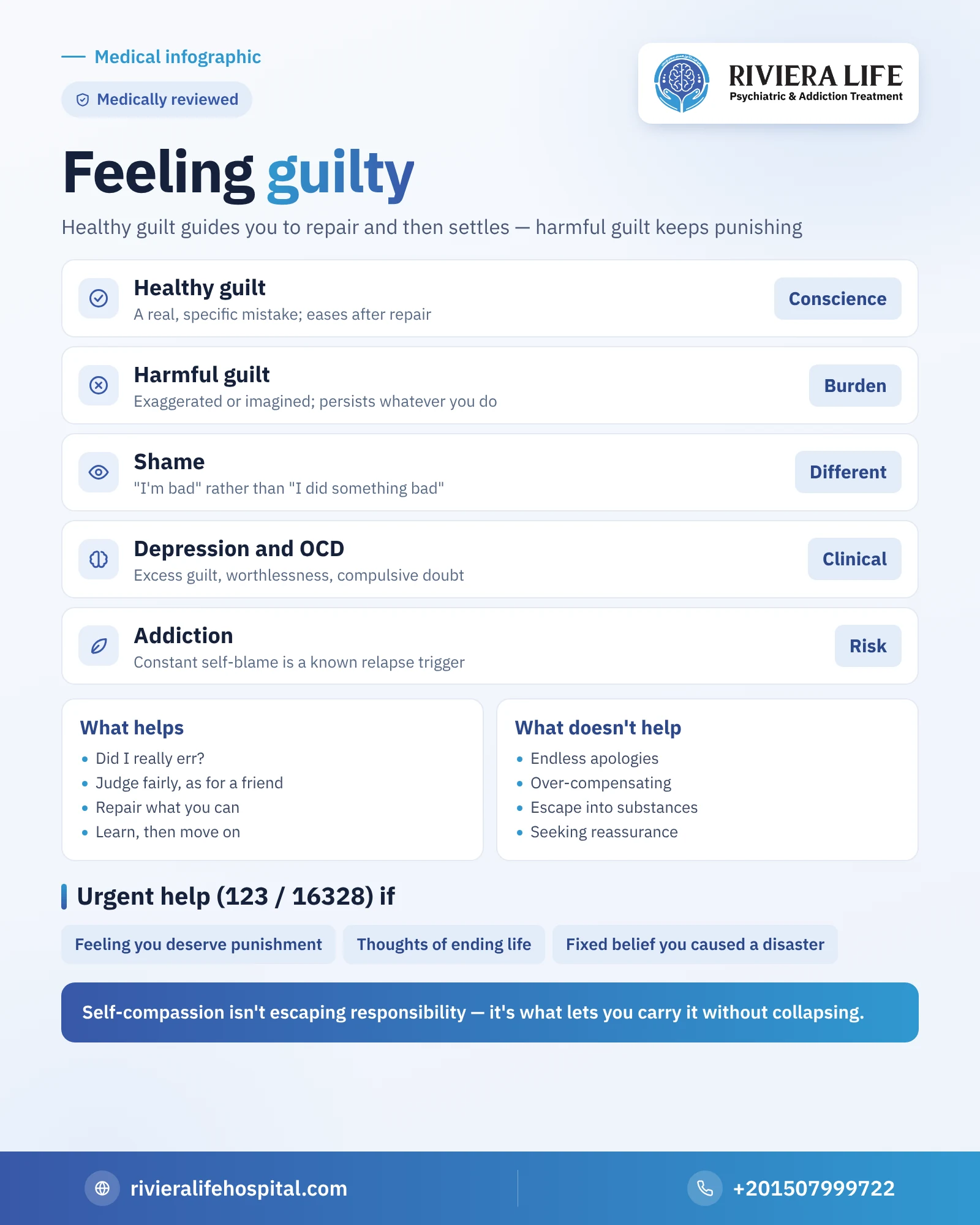
It is a moral emotion that appears when you believe you have gone against your values or hurt someone else. Its function is to correct behavior: you apologize to a friend you hurt, pay a debt you postponed, or draw close to your mother after a period of coldness. If guilt performs its function and then calms down, it is healthy. But when it drags on without repair and without end, it has turned from a guide into a tormentor.
Healthy guilt and toxic guilt
| Point of comparison | Healthy guilt | Harmful guilt |
|---|---|---|
| Cause | A real, specific mistake | An exaggerated or imagined mistake, or one beyond your control |
| Size | Proportionate to the act | Much bigger than the act |
| Result | Apology, repair and learning | Self-punishment, avoidance and silence |
| Duration | Eases after repair | Continues whatever you do |
| Judgment of self | “I did something bad” | “I’m a bad person” |
Test your guilt with three questions: can I describe the mistake in one specific sentence? Is there a practical step I can take? And did my feeling ease after I took it? If the answer to the last is “no” time after time, the problem is usually in rumination, not in the mistake.
Guilt and shame: not the same thing
Guilt concerns your act: “I shouldn’t have said that”. Shame concerns your self: “I’m worthless”. Researchers tend to see guilt as more linked to repair, and shame as more linked to withdrawal and hiding, and to problems such as depression and addiction. If you find your guilt quickly turns into “I’m a failure” or “I don’t deserve”, this is shame that needs treating even if the mistake was small.
Where does it appear in our lives?
- Parental guilt: a working mother who feels she is falling short with her children, and a father who can’t find the time. Usually what lies behind it is real exhaustion, not neglect.
- Survivor’s guilt: surviving an accident, illness or financial crisis while others were hurt, so you feel you don’t deserve to survive.
- Guilt of loss: after a relative’s death, some are haunted by the question “if I had done such-and-such he wouldn’t have died”. Grief has natural paths doctors explain, and this question doesn’t mean you are responsible.
- Religious and moral guilt: regret over a sin may be a motive for repentance and repair, but it becomes pathological if it stands between the person and his life or becomes a compulsive doubt about the validity of every act of worship.
- Guilt in the family and at work: refusing a request, setting a limit or leaving a job so one feels one has let someone down even though one did the right thing.
When is guilt linked to a psychiatric illness?
Depression
Excessive guilt or a feeling of worthlessness is among the signs doctors list among the symptoms of depression. The patient blames himself for everything, and reads neutral events as if they were evidence of his failings. You will find the rest of the picture in depression symptoms.
Obsessive-compulsive disorder
In a type of OCD called moral or religious OCD (scrupulosity), the person is haunted by a constant doubt that he has committed a sin, so he repeats the act of worship or seeks reassurance repeatedly without feeling relief. Here guilt turns into a compulsive ritual. Our article on OCD and depression explains the relationship between the two conditions.
Psychotic guilt
Rarely, the belief in guilt reaches the level of a delusion: the person believes he has committed a terrible crime or caused a public disaster, and arguments don’t work with him. This is an urgent medical condition, explained in our article on psychotic depression.
Addiction and recovery
Many people recovering from addiction carry heavy guilt about what they did during it. Useful guilt pushes towards apology and making amends once recovery is stable. But constant self-punishment is a known trigger for relapse, because the person escapes the pain into the drug itself. The same goes for an addict’s family, who blame themselves with endless “ifs”, and their shortcomings aren’t the cause of the addiction.
How do you deal with feeling guilty?
- Ask: did I really make a mistake? Write down the event as it happened, and identify what was in your hands and what wasn’t.
- Weigh responsibility fairly: imagine a friend living the same story; what would you say to him?
- Repair what can be repaired: a short, sincere apology, or practical compensation, without begging for forgiveness.
- Learn what prevents a repeat: what will you do differently next time?
- Allow yourself to move on: repair doesn’t require lasting suffering; continuing to punish yourself doesn’t help whoever was hurt.
When there is nothing to repair
When guilt is about something irreversible, such as a loss, an accident or a decision that can no longer be changed, it helps to write a letter you don’t send, give charity or do something useful in the person’s name, or talk about the matter with a therapist or someone you trust. Self-compassion here isn’t escaping responsibility, but a condition for bearing it without collapsing. Cognitive behavioral therapy helps examine absolute thoughts such as “I should have” and “I could have” that feed rumination.
What doesn’t help?
- Endless repeated apologies: they turn the hurt person into your reassurer, and keep you trapped in the cycle.
- Over-compensating: pleasing everyone at your own expense to atone for a small mistake.
- Escaping into busyness or drugs: postpones the feeling without resolving it, and may create a new problem that adds new guilt.
- Seeking reassurance from everyone: relieves for minutes then the doubt returns stronger, a known pattern in OCD.
- Denying the mistake entirely: if the mistake is real, acknowledging it is the first step of the solution.
Guilt in children and teenagers
A child tends to blame himself for adults’ problems: his parents’ divorce, one of them being ill, or their arguments, thinking he caused them by his behavior. If you notice this, explain to him in simple words that what happened isn’t because of him, and repeat it calmly. In a teenager guilt may appear as anger or withdrawal. Our page on mental illness in children explains when these signs call for an assessment.
When should you seek a specialist’s help?
Seek an assessment if guilt continues for weeks and spoils your sleep and work, covers matters that have nothing to do with you, is accompanied by sadness and loss of pleasure, or compulsive doubt that consumes hours, or if you have started using alcohol or sedatives to bear it.
Seek urgent help immediately if you see
Call an ambulance on 123 or the mental health hotline on 16328, or go to the nearest emergency department.
- A feeling that you deserve punishment or that your absence would be better for everyone
- Thoughts of ending life or harming yourself
- A firm conviction that you caused a disaster or a crime, with hearing voices or severe suspicion
How can Riviera Life help you?
At Riviera Life you meet a consultant psychiatrist who listens to your story without judgment, distinguishes between normal guilt, depression, OCD and dependence on a substance, then sets with you an appropriate psychotherapy plan. The first consultation is free and confidentiality is complete.
More from our mental health guide
Questions many people ask
Guilt concerns the act: "I made a mistake", and pushes towards repair. Shame concerns the self: "I'm bad", and pushes towards withdrawal and hiding.
When it is bigger than the mistake or without cause, persists despite repair, is accompanied by sadness and loss of pleasure, or by compulsive doubt that consumes hours.
Yes, excessive guilt or a feeling of worthlessness is among the signs doctors list among the symptoms of depression.
Admit what happened, apologize and repair what you can, learn what prevents a repeat, then allow yourself to move on without constant punishment.
Constant self-blame is a known trigger for relapse, which is why shame is treated alongside the addiction itself.